Brand Awareness vs Response Campaigns on Buses
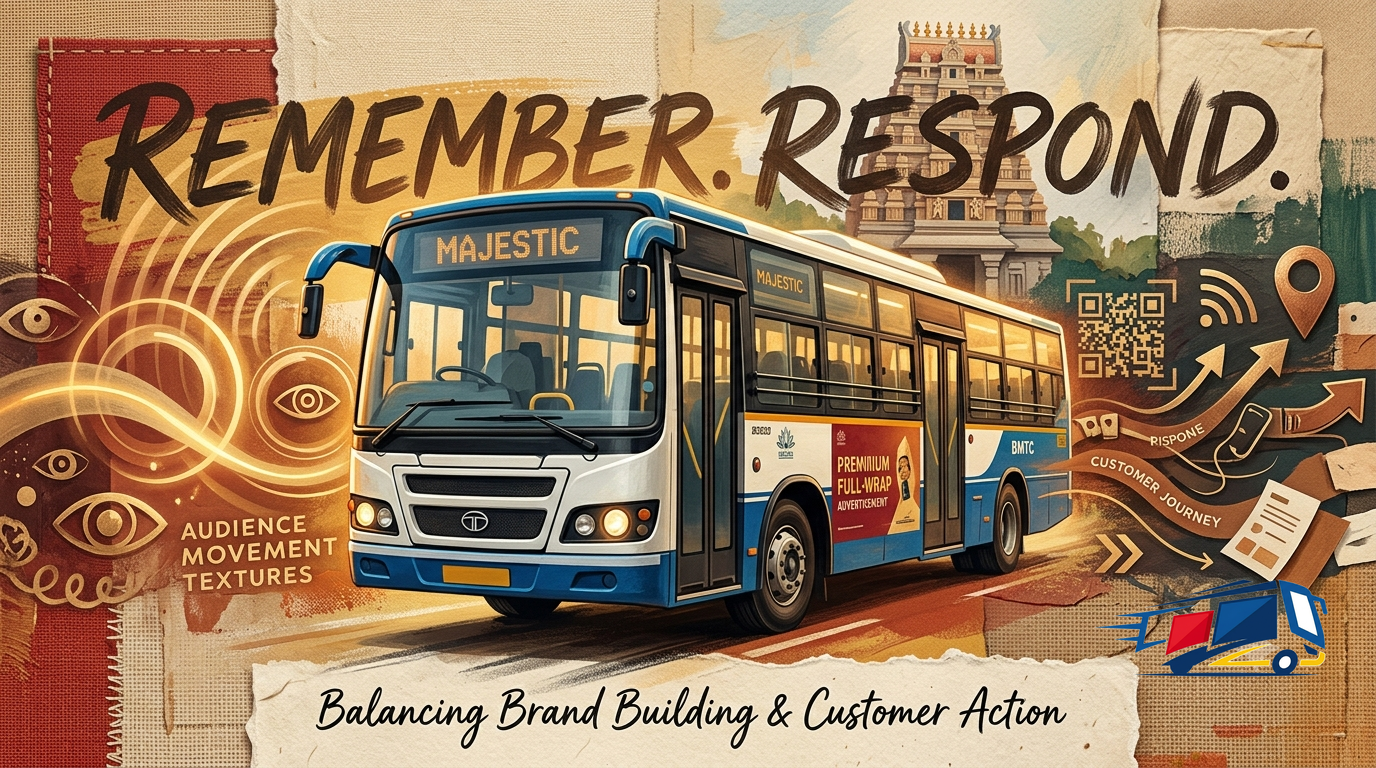
Bus branding can chase two very different things: awareness, making people know and remember you, or response, making them act now. A bus is naturally built for the first and can be coaxed toward the second. Knowing which you are buying, and setting expectations to match, is what separates a campaign that delivers from one that disappoints. Here is the honest split.
Key takeaways
- A bus is a brand medium first: broad, repeated exposure builds memory and recall over time, its natural strength.
- Response is possible but harder: a moving vehicle is a weaker direct-response unit than a phone, so it needs clear hooks.
- The two are measured differently: awareness by recall and search, response by scans, calls, codes and footfall.
- A known split is ~60/40, brand to activation, the balance that tends to maximise combined long and short-term results.
- Blend, do not pick blindly: lead with a brand message and add one clear response cue, judging each by its own measure.
Two different jobs
Awareness and response are not two settings of the same dial, they are two jobs with different timelines. Awareness builds future demand by making you familiar and top of mind. Response captures present demand by prompting an action right now. A campaign should know which it is doing.
Awareness campaign:
- Goal: be known and remembered.
- Works over weeks and months.
- Broad reach, simple bold message.
- Builds future demand.
Response campaign:
- Goal: drive an action now.
- Works in the short term.
- A clear offer and a way to act.
- Captures present demand.
Source: brand building creates future demand and mental availability; activation converts present demand, the two work on different mechanisms and timelines, 2026.
Why a bus favours brand-building
The format itself tilts toward awareness. A bus is large, seen by huge numbers, and passes the same people repeatedly, which is exactly how memory and familiarity are built. It is a brand medium by nature, and that is its strength, not a shortcoming.
Those three traits, broad, repeated, unskippable, are the textbook ingredients of brand-building. They make a bus excellent at lifting recall and keeping a brand top of mind, the slow, compounding work that pays off when a customer is finally ready to buy.
Source: broad, repeated, unskippable exposure builds mental availability and recall, the core mechanism of brand-building media, 2026.
Want your brand on Bengaluru's buses?
Get a route plan, format recommendation and pricing, usually within a minute.
Doing response on a bus, realistically
You can run a response campaign on a bus, but be honest about the physics. A moving vehicle is a weaker direct-response unit than a phone in someone's hand. It works only if you give people a clear, easy way to act and accept that not everyone will, on the spot.
| Hook | Best for | Reality check |
|---|---|---|
| QR code | Instant scan to a page | Hard on a moving bus |
| Promo code | Tracked redemptions | Many act later, never use it |
| Vanity URL | Memorable, type later | Keep it very short |
| "Search [brand]" | Prompts a branded search | Easy, but indirect |
| Phone number | Direct calls, tracked | Best for back panels at signals |
Measuring each correctly
The most common disappointment comes from judging one job by the other's yardstick. An awareness campaign measured on instant sales will look like a failure; a response campaign measured on vague reach will look like a success it did not earn. Match the metric to the job.
| Campaign | Judge it by | Do not judge it by |
|---|---|---|
| Awareness | Recall lift, branded search, reach | Same-week sales |
| Response | Scans, codes, calls, footfall | Long-term brand lift |
A bus is a patient salesman, not a checkout counter. Ask it to build your name and it excels; ask it to ring up a sale on the spot and you will undersell what it is genuinely good at.
Blending the two
The smartest campaigns are not purely one or the other. They lead with a brand message and carry one clear response cue, so the bus does its natural brand work while still giving ready buyers a way to act. A well-studied balance is roughly 60% brand, 40% activation.
Source: analysis of advertising effectiveness cases points to roughly 60% brand-building and 40% activation as a strong balance for combined long and short-term results; it flexes by category and brand stage, 2013 to 2026.
- Lead with the brand. A bold, simple name and message that builds recall as the bus moves.
- Add one response cue. A single clear hook, a short URL, a code, a "search us", not a cluttered list.
- Weight to the goal. Lean more brand for awareness goals, more activation when you need action now.
- Measure both lines. Track recall and search for the brand side, scans and calls for the response side.
We will set the right expectation, then deliver it
Tell us whether you need to be known or to drive action, and we will build for it honestly: a brand-led wrap that compounds recall, a response-ready back panel with a clean hook, or a blend weighted to your goal. We will tell you up front what a bus does brilliantly and where its limits are, and we will measure each side by the right yardstick, so you judge the campaign on what it was actually built to do.
Plan the right mix under bus branding in Bengaluru, or see the full approach in transit advertising.
Frequently Asked Questions
Is bus branding better for awareness or response?+
Awareness. A bus is broad, repeated and unskippable, the ingredients of brand-building. It can carry a response hook, but its natural strength is making you known and remembered over time.
Can a bus drive direct response?+
Yes, with a clear hook, a QR, promo code, short URL or tracked number. Just expect it to capture a slice of action, since a moving bus is a weaker response unit than a phone, and many people act later.
How should I measure each type?+
Awareness by recall lift, branded search and reach; response by scans, codes, calls and footfall. Judging an awareness campaign on same-week sales, or a response one on brand lift, misreads it.
What is the 60/40 idea?+
A well-studied balance: roughly 60% of effort on brand-building, 40% on activation tends to maximise combined long and short-term results. It is a flexible guideline that shifts by category and brand stage, not a fixed law.
Where do response hooks work best on a bus?+
Where the bus pauses, a back panel at a signal or stop gives a few seconds to read a number or scan a code. A wrap seen at speed builds awareness more than instant action.
Should I run pure response on buses?+
Rarely the best use. Buses shine at brand-building, so a blend, brand-led with one clean response cue, usually beats a pure-response campaign that fights the medium's nature.
Bus Branding Glossary
- Full bus branding (wrap)
- A full vehicle wrap covering both sides and the rear of the bus, the highest-impact, most visible format.
- Bus back / rear branding
- Advertising on the rear panel of the bus, in the line of sight of traffic queued behind it at signals and junctions.
- Side panel branding
- Branding on one or both side panels of the bus body, facing pedestrians and parallel traffic along the route.
- Vajra / AC service
- BMTC's premium air-conditioned (Volvo / Vayu Vajra) services, carrying a higher-income commuter set on IT and airport corridors.
- TTMC
- Traffic and Transit Management Centre, a large BMTC bus terminal where many routes start, terminate and interchange.
- Depot
- The BMTC facility where buses are parked, serviced and from which many local routes originate.
- Dwell time
- How long a bus stays in view of a stationary crowd, at a stop, signal or in slow traffic, which lengthens brand exposure.
- Corridor
- A main arterial road (e.g. the Outer Ring Road or Hosur Road) that a bus route runs along, defining who sees the branding.
How to run a BMTC bus branding campaign
Five simple steps from enquiry to a live, tracked campaign on Bengaluru's buses.
- 1
Pick your area & audience
Tell us the Bengaluru area or corridor you want to reach and who you're targeting, IT professionals, shoppers, students or residents.
- 2
Choose a format
Select a format, full bus wrap, rear panel, side panel or premium AC/Vajra service, based on your budget and the impact you want.
- 3
Select routes & bus count
We map the high-frequency routes and stops that cover your audience and recommend how many buses to brand.
- 4
Approve the creative
Share your artwork (or we help design it). We prepare it to BMTC specifications and get the approvals.
- 5
Go live & get proof
We print, wrap and deploy the buses, then share proof of display so you can see your brand on the road.
Bus Branding Formats
Choose how your brand rides, pick the format that fits your goal and budget.
Bus Branding Across Bengaluru
We run BMTC bus branding in every major Bengaluru neighbourhood. Explore more areas:
Outdoor & Transit Advertising Specialists
We plan, design and run BMTC bus branding campaigns across every major Bengaluru corridor, matching brands to the routes, formats and audiences that deliver the most visibility.
Discover More
Geo-Targeting With Bus Routes: Advertising Where Your Customers Are
A bus route is a geo-targeting tool you can drive. How to map your customers to the routes they use, think in catchments instead of points, and stack corridors to cover a neighbourhood or a whole city.
Setting Campaign Objectives Before You Advertise
Why setting one clear objective before you advertise decides everything: awareness vs consideration vs response, how each maps to a different message, format and KPI, and how to write a SMART objective.
How to Build an OOH Media Plan for Bengaluru
A step-by-step framework to build an out-of-home media plan for Bengaluru: set objectives, define the audience, choose corridors and routes, pick formats, split the budget, and build in measurement.