Geo-Targeting With Bus Routes: Advertising Where Your Customers Are
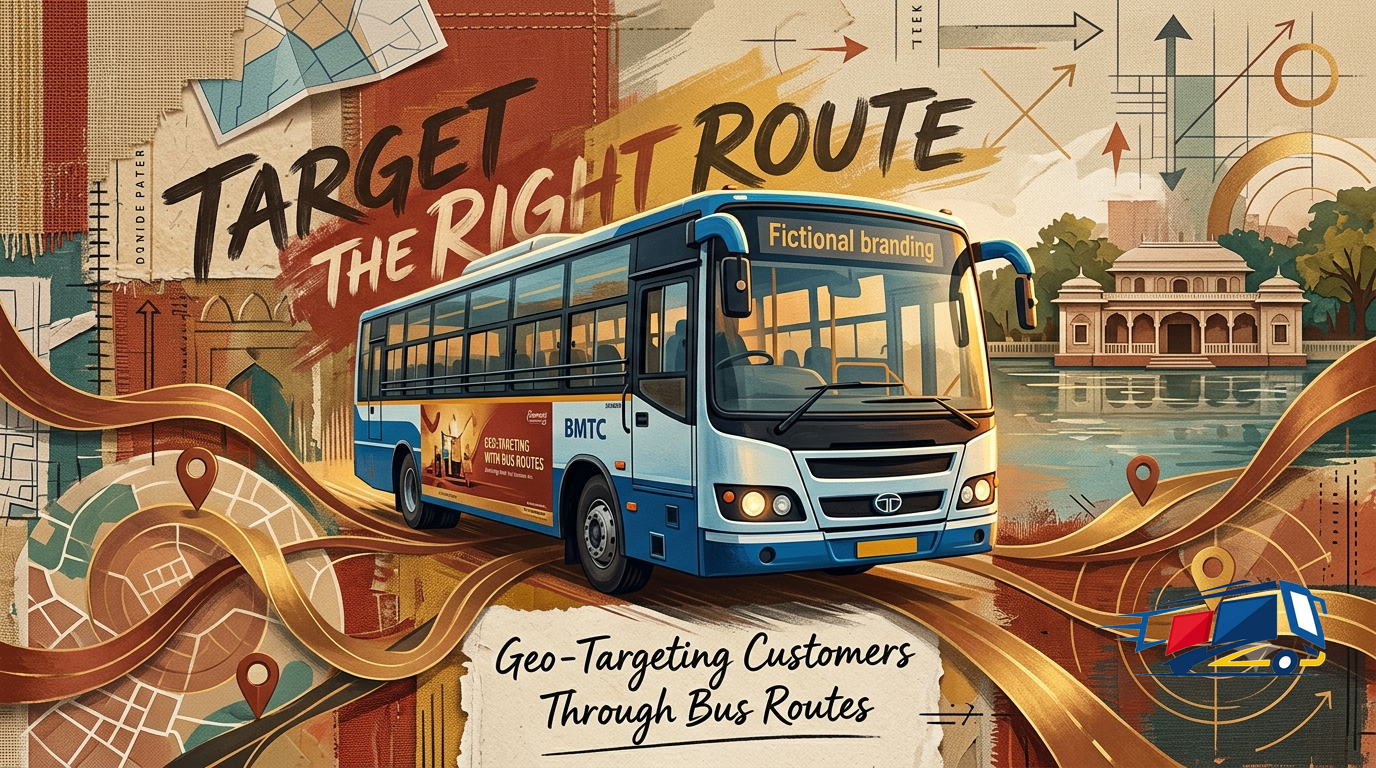
A bus route is a geo-targeting tool you can drive. Because buses run fixed paths through defined parts of the city, choosing routes is choosing an audience, by where they live, work and travel. Instead of broadcasting everywhere, you put your brand on the exact corridors your customers move through. Here is how to target with routes the way digital targets with a map.
Key takeaways
- A route is a targeting tool: picking routes selects the neighbourhoods and commuters your brand reaches.
- Map customers to routes, put the brand on the corridors they actually use, not random across the city.
- Think in catchments: a route covers a whole zone of homes, offices and shops, not a single point.
- Stack routes to cover a neighbourhood, several store locations, or a full city footprint.
- Honest limit: per-route ridership is not public, so targeting is guided by where corridors go and who the area serves.
A route is a targeting tool
Digital lets you draw a circle on a map and show ads inside it. A bus route does something similar in the physical world: it threads a fixed path through chosen neighbourhoods, so selecting it is selecting the area and the people on it. The route is the geo-filter.
The difference from a billboard is that the targeting moves. A fixed site catches one junction; a chosen route carries your brand across a whole defined area and back, all day. You are not buying a spot, you are buying a path through your customers' world.
Source: transit runs fixed routes through defined neighbourhoods, letting advertisers geo-target specific areas and commuter corridors by route selection, 2026.
Map your customers to routes
The method is simple and disciplined: start from where your customers are, then find the routes that serve those places. Advertise on the corridors your audience already travels rather than spraying across a city grid.
| If your customers are | Target routes that serve |
|---|---|
| Near your store | The store's own corridor and feeders |
| Office workers | Tech parks and business districts |
| Students | College and coaching belts |
| Families | Residential and market areas |
| Travellers | Airport and station corridors |
Want your brand on Bengaluru's buses?
Get a route plan, format recommendation and pricing, usually within a minute.
Think in catchments, not points
A route is not a line, it is an area. Everyone who lives, works, shops or waits along its length is in its catchment, plus the traffic it passes. That is why one well-chosen route can blanket a neighbourhood that a fixed site only nicks the edge of.
So when you judge a route, do not picture the bus, picture the strip of city it runs through: the homes, the offices, the markets, the schools, the people at every stop. That strip is your real audience, and it is far larger than the vehicle itself.
Source: route-based campaigns target catchment areas rather than single locations, capturing residents, workers and passers-by along the corridor, 2026.
Stacking routes for bigger footprints
One route owns a corridor. The real power comes from stacking them: combine routes to cover a whole neighbourhood, link several store locations, or stitch together a citywide footprint, all tuned to where your customers actually are.
| Footprint | How to build it |
|---|---|
| One neighbourhood | Several routes through the same area |
| Multiple stores | Routes serving each location's catchment |
| A corridor end to end | Routes along the full stretch |
| Citywide | Key routes across every zone |
Targeting with routes is like drawing your audience's map and then putting your brand on the roads they live on. Pick the right paths and you are everywhere they are, and nowhere they are not.
Bengaluru in practice
Bengaluru sorts neatly into corridor types, which makes route targeting concrete. Match your audience to the corridor and the route list follows. With 5,700+ BMTC routes across the city, there is almost always a path that fits.
| Corridor | Targets |
|---|---|
| ORR, Whitefield, Electronic City | Tech workers, higher income |
| Koramangala, Indiranagar, HSR | Young, urban, high spend |
| Jayanagar, Banashankari, JP Nagar | Families, local shoppers |
| Hosur Rd, Bannerghatta Rd | Mass daily commute |
| Hebbal, airport routes | Travellers, premium |
We will map your customers to the right routes
Tell us where your customers are, a neighbourhood, a set of store locations, an audience type, and we will translate that into the BMTC routes that cover them: the corridors they commute, the markets they shop, the areas they live. We will stack routes to match your footprint, whether that is one locality or the whole city, and be honest about what we can target precisely versus estimate. You point at the customers; we find the paths.
Plan your route targeting under bus branding in Bengaluru, or see the wider approach in transit advertising.
Frequently Asked Questions
Can bus advertising be geo-targeted?+
Yes. Because buses run fixed routes through defined areas, choosing routes targets specific neighbourhoods and commuter corridors, much like drawing a geo-filter, except the filter moves through the area all day.
How do I pick the right routes?+
Start from your customers, not the route list. Map where they live, work and travel, then choose the corridors that serve those places. The customer map should drive the route choice.
What is catchment thinking?+
Seeing a route as an area, not a line. Everyone living, working, shopping or waiting along its length is in its catchment, so one route can cover a whole neighbourhood, not just a single spot.
Can I cover several store locations?+
Yes, by stacking routes. Choose routes that serve each location's catchment, and the campaign covers all of them, scalable from one neighbourhood up to a citywide footprint.
How precise is route targeting?+
Precise about place, directional about volume. You can choose exactly which corridors to be on, but since per-route ridership is not public, audience size by route is an estimate, not an exact count.
Why is this better than a fixed billboard?+
A billboard covers one point; a route covers a whole catchment and moves through it repeatedly. For reaching an audience spread across an area, routes target far more of them for the spend.
Bus Branding Glossary
- Full bus branding (wrap)
- A full vehicle wrap covering both sides and the rear of the bus, the highest-impact, most visible format.
- Bus back / rear branding
- Advertising on the rear panel of the bus, in the line of sight of traffic queued behind it at signals and junctions.
- Side panel branding
- Branding on one or both side panels of the bus body, facing pedestrians and parallel traffic along the route.
- Vajra / AC service
- BMTC's premium air-conditioned (Volvo / Vayu Vajra) services, carrying a higher-income commuter set on IT and airport corridors.
- TTMC
- Traffic and Transit Management Centre, a large BMTC bus terminal where many routes start, terminate and interchange.
- Depot
- The BMTC facility where buses are parked, serviced and from which many local routes originate.
- Dwell time
- How long a bus stays in view of a stationary crowd, at a stop, signal or in slow traffic, which lengthens brand exposure.
- Corridor
- A main arterial road (e.g. the Outer Ring Road or Hosur Road) that a bus route runs along, defining who sees the branding.
How to run a BMTC bus branding campaign
Five simple steps from enquiry to a live, tracked campaign on Bengaluru's buses.
- 1
Pick your area & audience
Tell us the Bengaluru area or corridor you want to reach and who you're targeting, IT professionals, shoppers, students or residents.
- 2
Choose a format
Select a format, full bus wrap, rear panel, side panel or premium AC/Vajra service, based on your budget and the impact you want.
- 3
Select routes & bus count
We map the high-frequency routes and stops that cover your audience and recommend how many buses to brand.
- 4
Approve the creative
Share your artwork (or we help design it). We prepare it to BMTC specifications and get the approvals.
- 5
Go live & get proof
We print, wrap and deploy the buses, then share proof of display so you can see your brand on the road.
Bus Branding Formats
Choose how your brand rides, pick the format that fits your goal and budget.
Bus Branding Across Bengaluru
We run BMTC bus branding in every major Bengaluru neighbourhood. Explore more areas:
Outdoor & Transit Advertising Specialists
We plan, design and run BMTC bus branding campaigns across every major Bengaluru corridor, matching brands to the routes, formats and audiences that deliver the most visibility.
Discover More
Brand Awareness vs Response Campaigns on Buses
What bus branding does best: awareness or direct response? A comparison of the two campaign types on buses, why a moving vehicle favours brand-building, and how to blend both.
Setting Campaign Objectives Before You Advertise
Why setting one clear objective before you advertise decides everything: awareness vs consideration vs response, how each maps to a different message, format and KPI, and how to write a SMART objective.
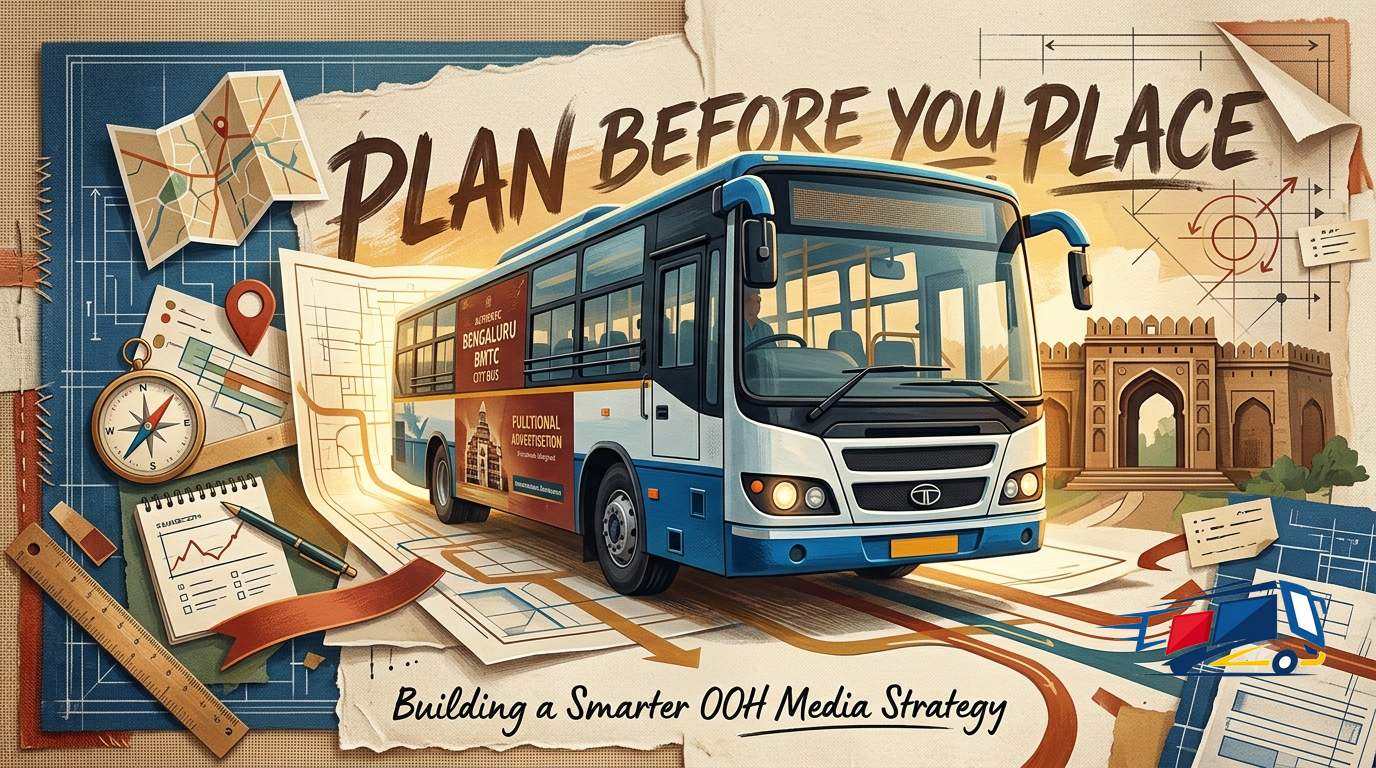
How to Build an OOH Media Plan for Bengaluru
A step-by-step framework to build an out-of-home media plan for Bengaluru: set objectives, define the audience, choose corridors and routes, pick formats, split the budget, and build in measurement.