AC vs Non-AC Bus Advertising: Cost & Audience Differences
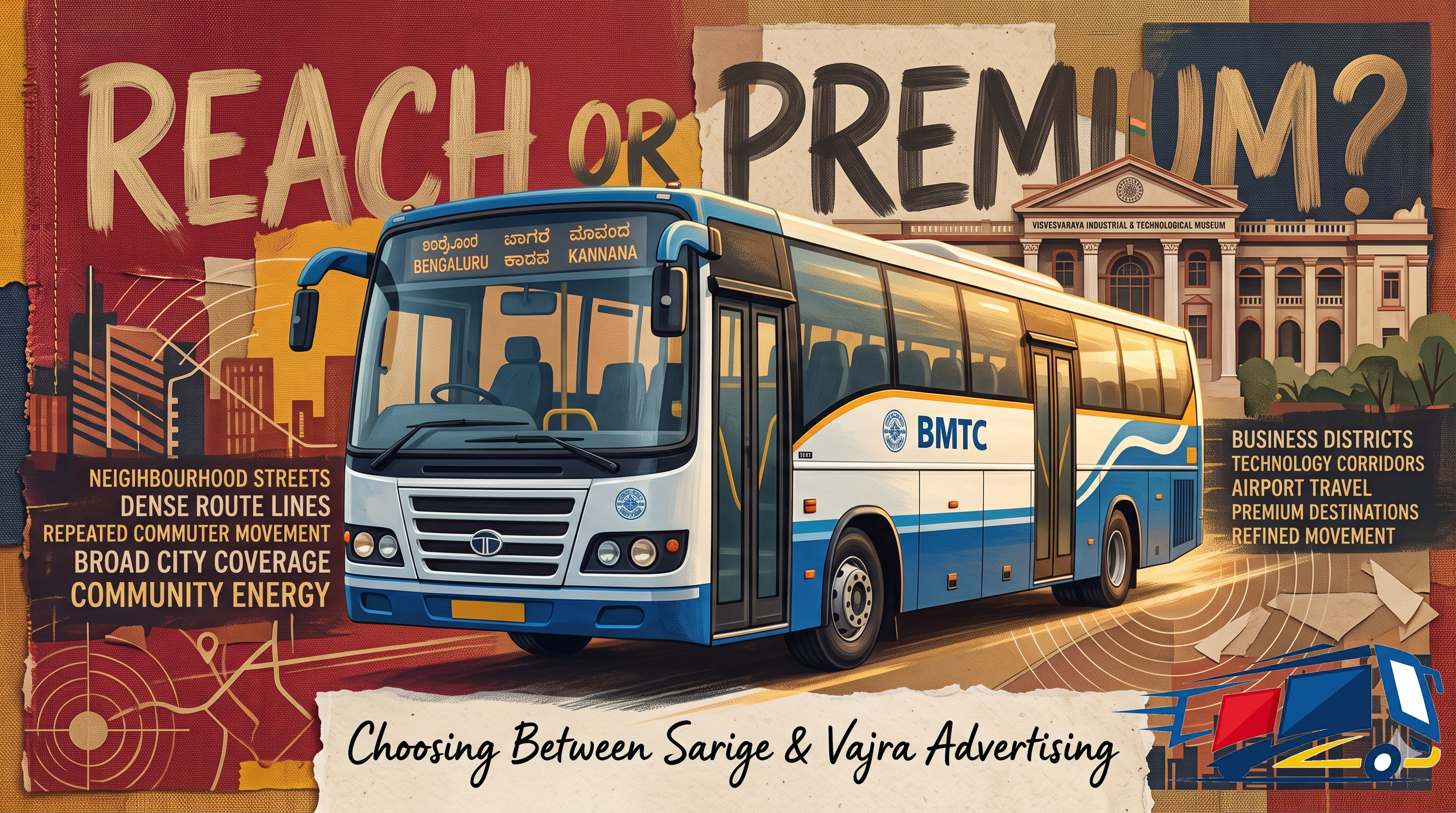
In Bengaluru, non-AC buses are Bengaluru Sarige and AC buses are Vajra, and the choice between them is really a choice of audience. Non-AC blankets every locality and the mass commuter, AC concentrates on tech corridors and the airport and a higher-income rider. One reaches more people, the other reaches a narrower, premium few. Here is how to pick.
Key takeaways
- Non-AC (Bengaluru Sarige) is the mass fleet, most of the 7,038 buses, every locality, the widest reach.
- AC (Vajra) is a smaller premium fleet (~825 Volvo) on tech corridors; Vayu Vajra serves the airport.
- Audience differs: AC fares run 1.5 to 3x ordinary, so AC riders skew higher-income and self-selecting.
- Shakti free travel applies to non-AC only, lifting everyday ridership there, especially women.
- AC costs more per bus to brand, so the question is reach for the rupee versus a premium audience.
The two classes, and a third
BMTC splits its fleet by comfort and price. Non-AC buses carry the Bengaluru Sarige branding and make up the bulk of the fleet; AC buses are Vajra; and the airport gets its own AC shuttle, Vayu Vajra, with fewer stops.
| Class | Name | Where it runs |
|---|---|---|
| Non-AC | Bengaluru Sarige | Citywide, every locality |
| AC | Vajra | Tech corridors, premium routes |
| AC airport | Vayu Vajra | City to airport, fewer stops |
The split matters for advertising because each class travels a different kind of route and carries a different kind of rider. You are not just buying a cooler bus, you are buying a different audience and map.
Who each one actually reaches
Non-AC is mass reach: the largest fleet, running through residential, commercial and market areas across the city, carrying the everyday commuter. AC is narrower and higher up the income ladder, concentrated on tech corridors and the airport, where riders pay a premium for comfort.
Non-AC (Bengaluru Sarige) reaches:
- The mass daily commuter, citywide.
- Every neighbourhood and market area.
- Value-conscious, high-frequency riders.
- Strong women ridership via Shakti free travel.
AC (Vajra) reaches:
- Tech-corridor and IT-park commuters.
- Higher-income, comfort-paying riders.
- Air travellers and airport staff (Vayu Vajra).
- A narrower, more affluent slice.
Source: Vajra historically served the IT corridor and runs premium routes; Vayu Vajra serves airport routes; Shakti free travel applies to non-AC (ordinary) buses only, 2025.
Want your brand on Bengaluru's buses?
Get a route plan, format recommendation and pricing, usually within a minute.
How the cost compares
Branding an AC bus costs more than a non-AC bus, reflecting the premium vehicle and route. So the spend question is simple: non-AC buys more reach per rupee, AC buys a narrower but more affluent audience at a higher price per bus.
| Class | Relative cost per bus | What you are paying for |
|---|---|---|
| Non-AC full | Lower entry point | Mass reach, widest footprint |
| AC full | A clear premium | Affluent, targeted audience |
Because AC costs more per bus, the same budget brands fewer AC buses than non-AC. That sharpens the decision: if you need broad citywide presence, non-AC stretches further; if you want to reach a specific affluent audience, AC concentrates spend where they ride.
Side by side
The full comparison in one view. Read it as a trade-off, not a winner: each class wins for a different objective.
| Factor | Non-AC (Sarige) | AC (Vajra) |
|---|---|---|
| Fleet size | The bulk of the fleet | Smaller, premium |
| Coverage | Every locality | Tech corridors, airport |
| Audience | Mass, mixed, value | Higher-income, niche |
| Ridership lift | Shakti boosts it | Not in Shakti |
| Cost per bus | Lower | Premium |
| Reach per rupee | Higher | Lower, but targeted |
Which fits your brand
Match the class to who you sell to. Mass-market and local brands belong on non-AC; premium, tech and travel-facing brands often justify AC, sometimes a mix of both.
| Brand / goal | Lean towards |
|---|---|
| FMCG, retail, local services | Non-AC, mass reach |
| Wide citywide awareness | Non-AC, footprint |
| Premium, finance, real estate | AC, affluent audience |
| Tech, SaaS, employer brand | AC on tech corridors |
| Travel, hospitality, duty-free | Vayu Vajra, airport |
| Broad reach + premium pockets | Mix of both |
It is not AC versus non-AC, it is reach versus a particular audience. Non-AC puts you in front of the whole city; AC puts you in front of the people who can afford the premium.
How to decide
Work from your customer, then your budget. The class follows from who you need to reach and how far the spend has to stretch.
- Define your customer. Mass and value points to non-AC; affluent or niche points to AC.
- Match the map. Citywide and local needs non-AC; tech corridors or the airport needs AC.
- Weigh reach vs targeting. Non-AC for more eyes, AC for the right eyes.
- Check the budget stretch. AC costs more per bus, so it brands fewer for the same spend.
- Consider a mix. Non-AC for breadth, a few AC on premium routes for the affluent slice.
We will match the bus class to your audience
Tell us who you are trying to reach and your budget, and we will recommend the right split. Non-AC Bengaluru Sarige for broad, citywide, value-led reach; Vajra AC on tech corridors for an affluent, professional audience; Vayu Vajra for travellers at the airport. Often the smartest plan blends them. You get a class-by-class recommendation with the audience logic, and an exact per-bus rate on a quick quote.
Plan the mix under bus branding in Bengaluru, or see how class ties to price in transit advertising.
Frequently Asked Questions
What is the difference between AC and non-AC bus advertising?+
Audience and reach. Non-AC (Bengaluru Sarige) is the mass fleet across every locality; AC (Vajra) is a smaller premium fleet on tech corridors and the airport, reaching a higher-income rider.
Which costs more to brand, AC or non-AC?+
AC carries a clear premium per bus over non-AC, reflecting the premium vehicle and route. The exact per-bus rate depends on format, quantity and duration and is confirmed on a quote.
Who rides AC buses in Bengaluru?+
A more affluent, self-selecting rider. AC fares run 1.5 to 3x ordinary, and Vajra serves tech corridors while Vayu Vajra carries air travellers and airport staff.
Why does non-AC reach more people?+
It is the bulk of the 7,038-bus fleet, runs through every locality, and its everyday ridership is lifted by Shakti free travel for women and transgender riders, which applies to non-AC only.
Which should my brand choose?+
Non-AC for mass-market, retail and citywide awareness; AC for premium, tech, finance or travel-facing brands. Many brands run a mix, breadth on non-AC plus premium pockets on AC.
Can I advertise on airport buses?+
Yes, on Vayu Vajra, the AC airport shuttle. It reaches travellers and airport workers on routes with fewer stops, useful for travel, hospitality and premium brands.
Bus Branding Glossary
- Full bus branding (wrap)
- A full vehicle wrap covering both sides and the rear of the bus, the highest-impact, most visible format.
- Bus back / rear branding
- Advertising on the rear panel of the bus, in the line of sight of traffic queued behind it at signals and junctions.
- Side panel branding
- Branding on one or both side panels of the bus body, facing pedestrians and parallel traffic along the route.
- Vajra / AC service
- BMTC's premium air-conditioned (Volvo / Vayu Vajra) services, carrying a higher-income commuter set on IT and airport corridors.
- TTMC
- Traffic and Transit Management Centre, a large BMTC bus terminal where many routes start, terminate and interchange.
- Depot
- The BMTC facility where buses are parked, serviced and from which many local routes originate.
- Dwell time
- How long a bus stays in view of a stationary crowd, at a stop, signal or in slow traffic, which lengthens brand exposure.
- Corridor
- A main arterial road (e.g. the Outer Ring Road or Hosur Road) that a bus route runs along, defining who sees the branding.
How to run a BMTC bus branding campaign
Five simple steps from enquiry to a live, tracked campaign on Bengaluru's buses.
- 1
Pick your area & audience
Tell us the Bengaluru area or corridor you want to reach and who you're targeting, IT professionals, shoppers, students or residents.
- 2
Choose a format
Select a format, full bus wrap, rear panel, side panel or premium AC/Vajra service, based on your budget and the impact you want.
- 3
Select routes & bus count
We map the high-frequency routes and stops that cover your audience and recommend how many buses to brand.
- 4
Approve the creative
Share your artwork (or we help design it). We prepare it to BMTC specifications and get the approvals.
- 5
Go live & get proof
We print, wrap and deploy the buses, then share proof of display so you can see your brand on the road.
Bus Branding Formats
Choose how your brand rides, pick the format that fits your goal and budget.
Bus Branding Across Bengaluru
We run BMTC bus branding in every major Bengaluru neighbourhood. Explore more areas:
Outdoor & Transit Advertising Specialists
We plan, design and run BMTC bus branding campaigns across every major Bengaluru corridor, matching brands to the routes, formats and audiences that deliver the most visibility.
Discover More
Brand Awareness vs Response Campaigns on Buses
What bus branding does best: awareness or direct response? A comparison of the two campaign types on buses, why a moving vehicle favours brand-building, and how to blend both.
Geo-Targeting With Bus Routes: Advertising Where Your Customers Are
A bus route is a geo-targeting tool you can drive. How to map your customers to the routes they use, think in catchments instead of points, and stack corridors to cover a neighbourhood or a whole city.
Setting Campaign Objectives Before You Advertise
Why setting one clear objective before you advertise decides everything: awareness vs consideration vs response, how each maps to a different message, format and KPI, and how to write a SMART objective.