What Is Barter Bus Branding & When Does It Make Sense?
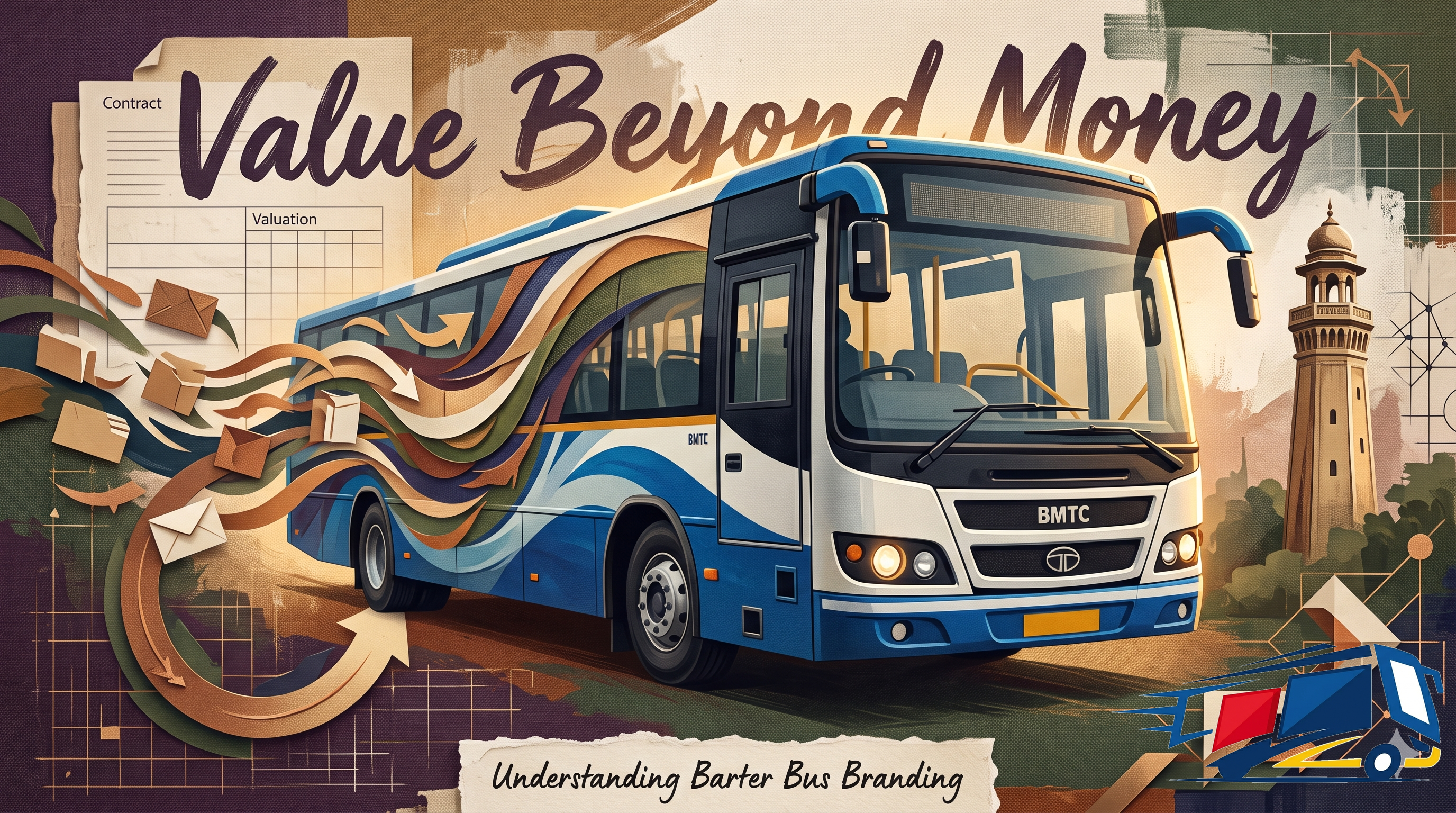
Not every campaign has to be paid in cash. Barter bus branding lets a brand pay for bus advertising wholly or partly in its own goods or services, trading what it already has for visibility on the road. It is a niche route, powerful for the right business and wrong for others. Here is how it works and when it fits.
Key takeaways
- Barter means paying for bus branding in goods or services instead of cash, in full or part.
- Deals are valued at an agreed worth, often a part-cash, part-goods mix to ease cash flow.
- It suits brands with sellable surplus, spare capacity, or a product the partner can use.
- The main win is preserving cash while still getting a campaign on the road.
- The main risk is valuation clarity, so the trade value and the media must both be fair.
What barter bus branding means
Barter is paying for media with value other than cash. In bus branding, a brand exchanges its own goods or services, valued at an agreed amount, for advertising space on the buses, instead of writing a full cheque.
| Aspect | Cash deal | Barter deal |
|---|---|---|
| You pay with | Money | Goods, services, or a mix |
| Cash outlay | Full | Reduced or none |
| Best when | Cash is available | Cash is tight, stock is not |
| Valuation | Simple | Needs agreed worth |
The idea is old and simple: trade what you have for what you need. A business sitting on stock or spare capacity turns it into road visibility, without draining the bank.
How barter deals are structured
Barter is rarely all or nothing. Most deals land somewhere on a spectrum from full barter to a part-cash, part-goods mix, with the trade value agreed up front.
| Structure | How it works |
|---|---|
| Full barter | Entire cost paid in goods or services |
| Part cash, part goods | A share in cash, the rest in trade |
| Trade credit | Goods valued as credit toward media |
| Service swap | Your service exchanged for the campaign |
Want your brand on Bengaluru's buses?
Get a route plan, format recommendation and pricing, usually within a minute.
The honest pros and cons
Barter is a genuine option, not a free lunch. It trades cash savings against valuation complexity, so it is worth weighing both sides plainly.
- Preserves cash for other priorities.
- Monetises surplus stock or idle capacity.
- Gets a campaign live without a big outlay.
- Turns dead inventory into visibility.
- Valuation can be murky if not agreed clearly.
- Media must fit your audience, not just be available.
- Your goods must be genuinely useful to the partner.
- More negotiation than a simple cash buy.
The deciding factor is fairness on both counts: the value placed on your goods, and the value of the media you get. Get those right and barter works; leave them vague and it sours.
Who barter suits
Barter fits brands that have something sellable to trade and a reason to protect cash. The closer your product is to what the partner can actually use or resell, the better the deal.
Think of a hotel with empty rooms, a brand with last-season stock, or a service business with spare capacity. Each has value sitting idle that barter can convert into a campaign on the road.
When barter is the wrong call
Barter is not for everyone. If you have cash and want speed and simplicity, or your goods are not useful to the partner, a straight cash buy is cleaner and faster.
| Situation | Better route |
|---|---|
| Cash is available and you want speed | Cash buy |
| Your goods are hard to value or resell | Cash buy |
| You need exact routes, no compromise | Cash buy |
| Surplus stock, tight cash flow | Consider barter |
Honesty here protects you. If barter is not a fit, forcing it leads to a deal where the values do not add up. The point is to use it only where it genuinely serves you.
How a barter deal is set up
A clean barter deal follows a clear path: agree what you are trading, value it fairly, match it to media that fits, and put the terms in writing before anything goes live.
- Identify what you can trade. Surplus stock, spare capacity, or a service the agency can use.
- Agree the value. Set a fair, written worth for the goods and for the media.
- Match the media. Ensure the buses and routes actually fit your audience.
- Decide the mix. Full barter, or part cash and part goods to balance both sides.
- Put it in writing. A clear agreement covering value, media, duration and terms.
- Run and prove it. The campaign goes live with the same proof of posting as any deal.
Source: typical barter deal setup, 2026. Terms confirmed in a written agreement before the campaign starts.
Have value to trade? Let us structure it fairly
If cash is tight but you have surplus stock, spare capacity or a useful service, barter can put your brand on the road without the full outlay. We will value the trade openly, match it to buses and routes that actually fit your audience, and structure a full or part-cash deal that is fair on both sides, with the same proof of posting as a cash campaign. If barter is not right for you, we will say so.
Talk through the options under bus branding in Bengaluru, or see how pricing works in transit advertising.
Frequently Asked Questions
What is barter bus branding?+
Paying for bus advertising in goods or services instead of cash, in full or part. The brand trades value it already has for visibility on the buses.
Can I pay partly in cash and partly in goods?+
Yes, and many deals are exactly that. A part-cash, part-goods mix eases your cash flow while giving the agency a value it can use, balancing both sides.
Who is barter best for?+
Brands with surplus stock, spare capacity or a useful service and a reason to preserve cash, especially when the goods are easy to value and resell.
What is the main risk of barter?+
Valuation clarity. The worth of your goods and the value of the media must both be agreed fairly and in writing, or the deal can become lopsided.
When should I just pay cash instead?+
When cash is available and you want speed, when your goods are hard to value, or when you need exact routes with no compromise. A cash buy is then cleaner.
Do I still get proof the campaign ran?+
Yes. A barter campaign should come with the same proof of posting, dated and geotagged photos, as any cash deal. Barter changes the payment, not the standards.
Bus Branding Glossary
- Full bus branding (wrap)
- A full vehicle wrap covering both sides and the rear of the bus, the highest-impact, most visible format.
- Bus back / rear branding
- Advertising on the rear panel of the bus, in the line of sight of traffic queued behind it at signals and junctions.
- Side panel branding
- Branding on one or both side panels of the bus body, facing pedestrians and parallel traffic along the route.
- Vajra / AC service
- BMTC's premium air-conditioned (Volvo / Vayu Vajra) services, carrying a higher-income commuter set on IT and airport corridors.
- TTMC
- Traffic and Transit Management Centre, a large BMTC bus terminal where many routes start, terminate and interchange.
- Depot
- The BMTC facility where buses are parked, serviced and from which many local routes originate.
- Dwell time
- How long a bus stays in view of a stationary crowd, at a stop, signal or in slow traffic, which lengthens brand exposure.
- Corridor
- A main arterial road (e.g. the Outer Ring Road or Hosur Road) that a bus route runs along, defining who sees the branding.
How to run a BMTC bus branding campaign
Five simple steps from enquiry to a live, tracked campaign on Bengaluru's buses.
- 1
Pick your area & audience
Tell us the Bengaluru area or corridor you want to reach and who you're targeting, IT professionals, shoppers, students or residents.
- 2
Choose a format
Select a format, full bus wrap, rear panel, side panel or premium AC/Vajra service, based on your budget and the impact you want.
- 3
Select routes & bus count
We map the high-frequency routes and stops that cover your audience and recommend how many buses to brand.
- 4
Approve the creative
Share your artwork (or we help design it). We prepare it to BMTC specifications and get the approvals.
- 5
Go live & get proof
We print, wrap and deploy the buses, then share proof of display so you can see your brand on the road.
Bus Branding Formats
Choose how your brand rides, pick the format that fits your goal and budget.
Bus Branding Across Bengaluru
We run BMTC bus branding in every major Bengaluru neighbourhood. Explore more areas:
Outdoor & Transit Advertising Specialists
We plan, design and run BMTC bus branding campaigns across every major Bengaluru corridor, matching brands to the routes, formats and audiences that deliver the most visibility.
Discover More
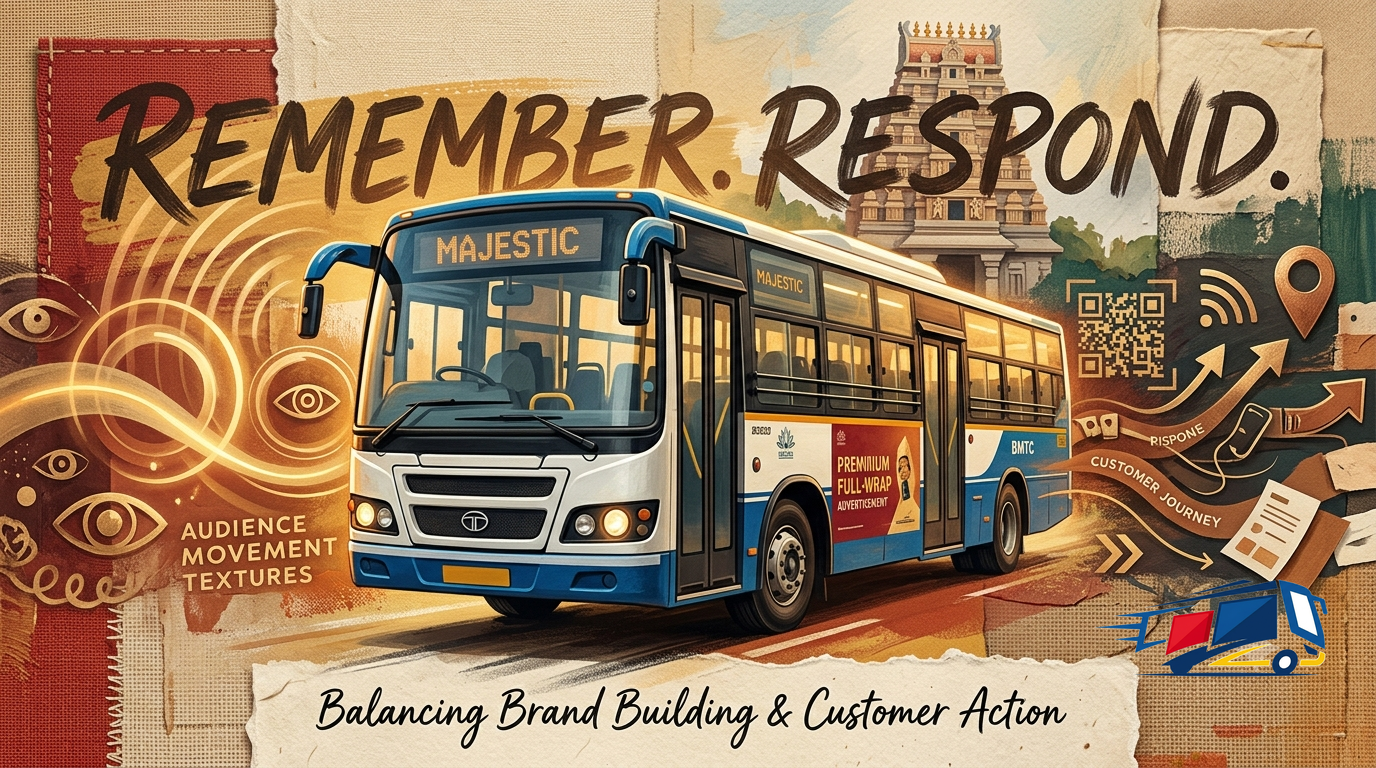
Brand Awareness vs Response Campaigns on Buses
What bus branding does best: awareness or direct response? A comparison of the two campaign types on buses, why a moving vehicle favours brand-building, and how to blend both.
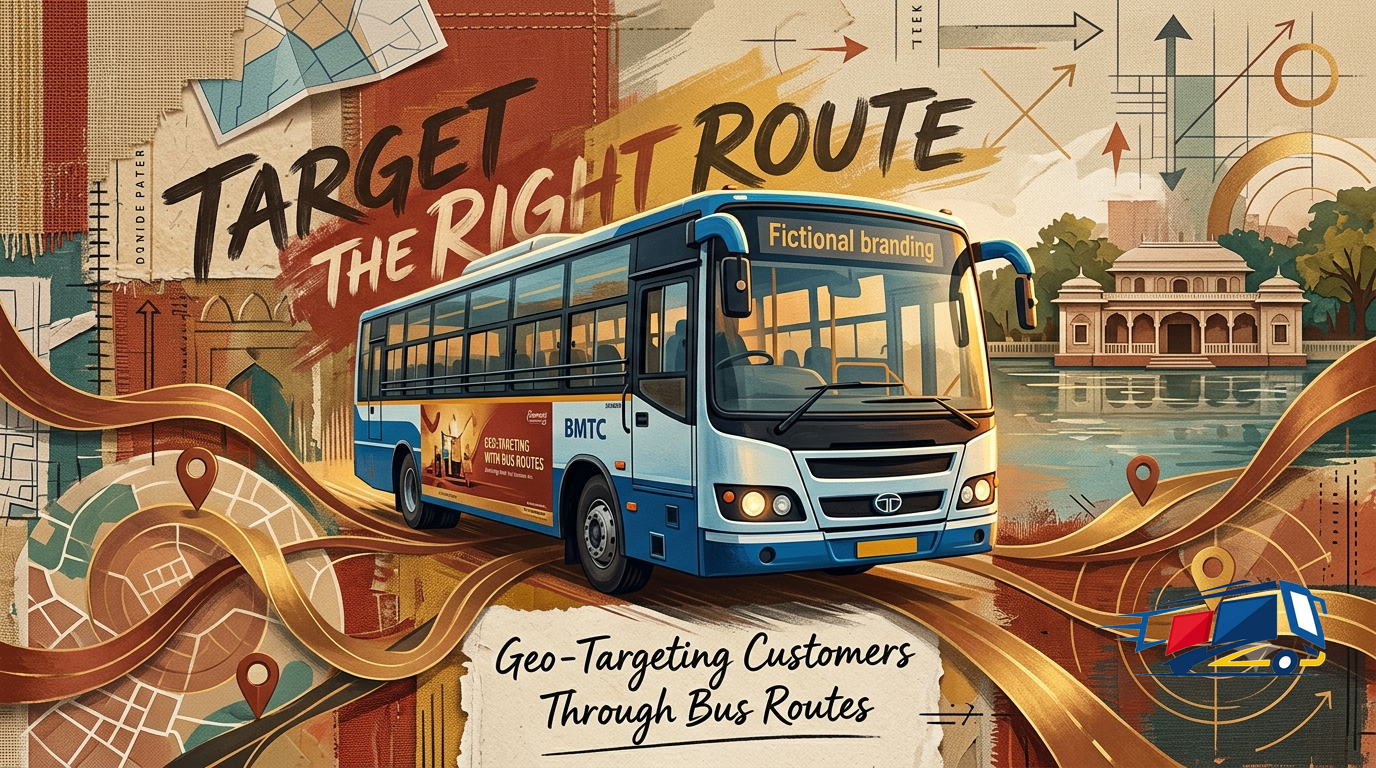
Geo-Targeting With Bus Routes: Advertising Where Your Customers Are
A bus route is a geo-targeting tool you can drive. How to map your customers to the routes they use, think in catchments instead of points, and stack corridors to cover a neighbourhood or a whole city.
Setting Campaign Objectives Before You Advertise
Why setting one clear objective before you advertise decides everything: awareness vs consideration vs response, how each maps to a different message, format and KPI, and how to write a SMART objective.