BMTC Bus Numbering System Explained
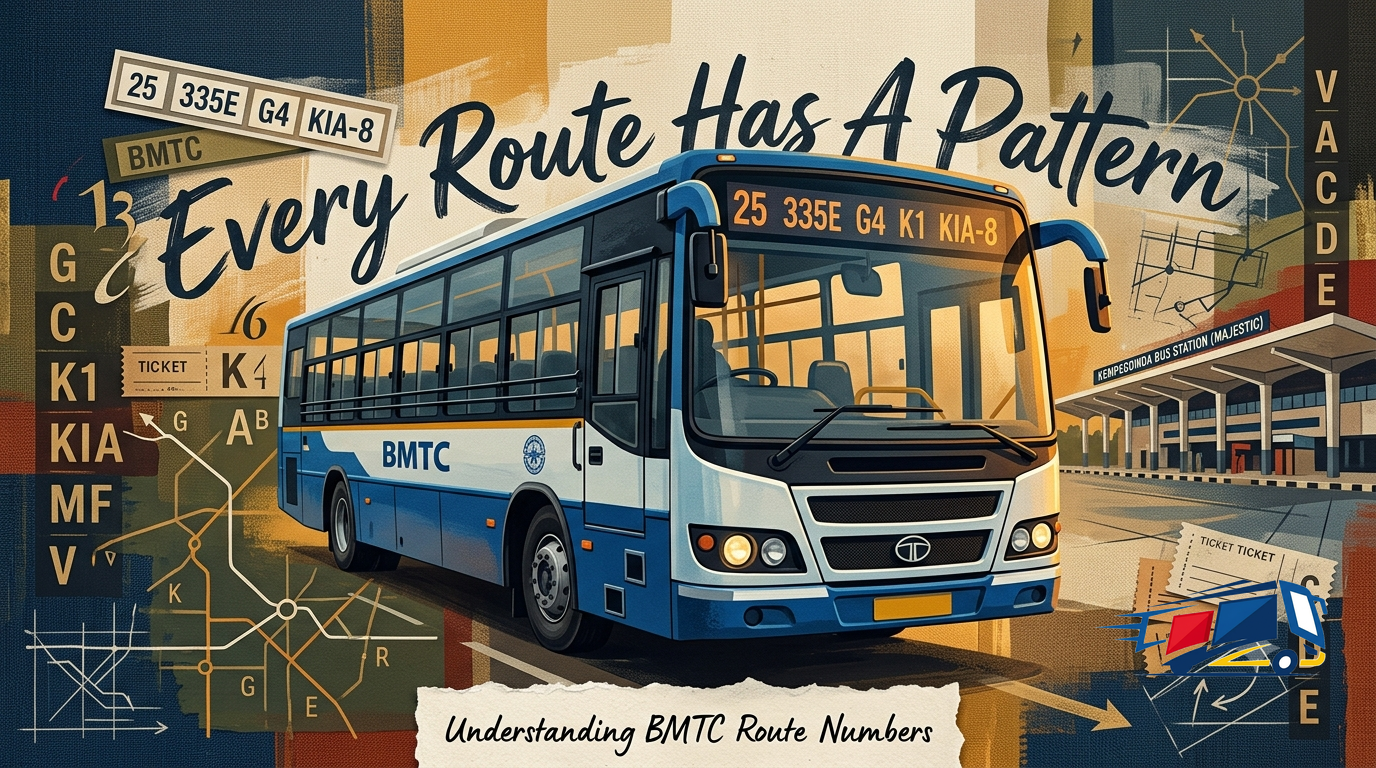
A BMTC bus number is not random. The digits hint at the zone, a letter in front marks a special series like Big10 or airport, and a letter at the end marks a variant of a parent route. Once you know the pattern, any board makes sense.
Stand at any BMTC stop and the boards can look like a jumble of numbers and letters: 25, 335E, G4, KIA-8, K1. There is a logic underneath, built on a hub-and-spoke network centred on three big terminals. Learn three rules, what the number says, what a prefix says, and what a suffix says, and you can read almost any route at a glance.
| Key fact | Detail |
|---|---|
| 2 digits | Core city routes |
| 3 digits to 499 | Suburban routes |
| 500 and up | Ring road routes |
| Prefix letter | Special series (G, C, K, KIA, MF, V) |
| Suffix letter | Variant of a parent route |
How the numbers work
The base number is set between two key points, and its size hints at the zone.
Every major route between two important places gets a number, like 25 for Majestic to BTM, or 335 for Majestic to Kadugodi. As a rough guide, the length of the number signals how far out the route runs. The whole system fans out from three hubs: Majestic, KR Market and Shivajinagar.
| Number | Usually means |
|---|---|
| 2 digits | Core city routes, the old city limits |
| 3 digits up to 499 | Suburban routes |
| 500 and above | Ring road routes |
What the prefix letters mean
A letter in front of the number marks a special series of buses.
Some routes belong to named families with their own look and job. These carry a prefix instead of, or alongside, a plain number. The common ones are below.
| Prefix | Series | What it is |
|---|---|---|
| G | Big10 | Green buses on about 12 major corridors into the city core |
| C | Big Circle | Outer ring road routes |
| K | Chikka (inner) Circle | Inner ring loops, K1 to K3, near the centre |
| KIA | Airport | Vayu Vajra AC buses to the airport |
| MF | Metro Feeder | Routes feeding Namma Metro stations |
| V | Vajra | AC Volvo city service |
Want your brand on Bengaluru's buses?
Get a route plan, format recommendation and pricing, usually within a minute.
What the suffix letters mean
A letter after the number marks a variant of a parent route.
When a route mostly follows an existing one but starts somewhere else or diverts partway, it keeps the parent number and adds a letter. The rule of thumb is that a variant shares at least 60% of the parent route. AC Volvo versions and short-turn services get their own letters too.
| Example | What it means |
|---|---|
| 25 | Parent route, Majestic to BTM |
| 25E | Variant of 25 that diverts partway |
| 201G | Variant sharing 60%+ of route 201 |
| 335E | AC Volvo version of route 335 |
| 335T | Short-turn, ends before the full route |
How to read a route board
The board shows the code and destination, usually in Kannada and English, plus any series logo.
Putting it together, a route board is easy to decode once you split it into parts. Take a board reading G4 to Kempegowda: the G says Big10, the 4 is the corridor, and the destination tells you where it ends.
Example route board: Kempegowda Bus Station to Kadugodi. 335 is the parent route, E marks the AC Volvo variant.
| On the board | Tells you |
|---|---|
| Route number | The route and roughly its zone |
| Prefix letter | The special series, if any |
| Suffix letter | The variant of the parent route |
| Destination | Where it ends, in Kannada and English |
| Logo or indicator | Big10, Big Circle or BIAS for airport |
The codes are basically a map written in shorthand. Once you can read them, you stop guessing which bus to take, and if you plan advertising, you stop guessing where a bus actually goes.
Why advertisers care about route codes
A code tells you a bus's path and roughly its riders, which makes targeting precise.
For a campaign, route codes are a gift. Because the code reveals the corridor and the service type, you can choose routes that match the audience you want, rather than scattering a wrap across random buses. The table maps common codes to who they reach.
| Code | Reaches |
|---|---|
| G series (Big10) | City-core commuters on major corridors |
| KIA | Airport and business travellers |
| V / Vajra | Tech park and premium commuters |
| 200s and 300s | Specific suburban zones |
| C / 500s | Cross-city ring road audiences |
To target by route, our bus branding solutions plan campaigns by code and corridor. You can also read the bus types guide for the audience behind each service, or pick an area such as Koramangala.
Frequently Asked Questions
How does BMTC number its buses?+
A route gets a base number between two key points. As a general guide, two-digit numbers are core city routes, three-digit numbers up to 499 are suburban, and 500 and above are ring road routes, with letters marking series or variants.
What does the letter after a BMTC bus number mean?+
A suffix letter marks a variant of a parent route. It usually shares at least 60% of the parent route but starts elsewhere or takes a slightly different path, like 25E being a variant of route 25.
What does G mean on a BMTC bus?+
A G prefix marks the Big10 series, green buses on about 12 major corridors into the Central Business District, introduced in 2009 around the idea of frequent buses on main roads.
What does KIA mean on a BMTC route?+
KIA marks airport routes, the Vayu Vajra AC buses between the city and Kempegowda International Airport. These routes also carry a BIAS indicator on the board.
What are K and C route buses?+
C marks Big Circle buses on the outer ring road, and K marks the inner Chikka Circle routes, K1 to K3, that loop within a few kilometres of the city centre from three main terminals.
Why do route codes matter for advertising?+
A code tells you where a bus goes and roughly who rides it, so advertisers can pick routes by corridor and audience, such as G-series for the city core or KIA for airport travellers.
Bus Branding Glossary
- Full bus branding (wrap)
- A full vehicle wrap covering both sides and the rear of the bus, the highest-impact, most visible format.
- Bus back / rear branding
- Advertising on the rear panel of the bus, in the line of sight of traffic queued behind it at signals and junctions.
- Side panel branding
- Branding on one or both side panels of the bus body, facing pedestrians and parallel traffic along the route.
- Vajra / AC service
- BMTC's premium air-conditioned (Volvo / Vayu Vajra) services, carrying a higher-income commuter set on IT and airport corridors.
- TTMC
- Traffic and Transit Management Centre, a large BMTC bus terminal where many routes start, terminate and interchange.
- Depot
- The BMTC facility where buses are parked, serviced and from which many local routes originate.
- Dwell time
- How long a bus stays in view of a stationary crowd, at a stop, signal or in slow traffic, which lengthens brand exposure.
- Corridor
- A main arterial road (e.g. the Outer Ring Road or Hosur Road) that a bus route runs along, defining who sees the branding.
How to run a BMTC bus branding campaign
Five simple steps from enquiry to a live, tracked campaign on Bengaluru's buses.
- 1
Pick your area & audience
Tell us the Bengaluru area or corridor you want to reach and who you're targeting, IT professionals, shoppers, students or residents.
- 2
Choose a format
Select a format, full bus wrap, rear panel, side panel or premium AC/Vajra service, based on your budget and the impact you want.
- 3
Select routes & bus count
We map the high-frequency routes and stops that cover your audience and recommend how many buses to brand.
- 4
Approve the creative
Share your artwork (or we help design it). We prepare it to BMTC specifications and get the approvals.
- 5
Go live & get proof
We print, wrap and deploy the buses, then share proof of display so you can see your brand on the road.
Bus Branding Formats
Choose how your brand rides, pick the format that fits your goal and budget.
Bus Branding Across Bengaluru
We run BMTC bus branding in every major Bengaluru neighbourhood. Explore more areas:
Outdoor & Transit Advertising Specialists
We plan, design and run BMTC bus branding campaigns across every major Bengaluru corridor, matching brands to the routes, formats and audiences that deliver the most visibility.
Discover More
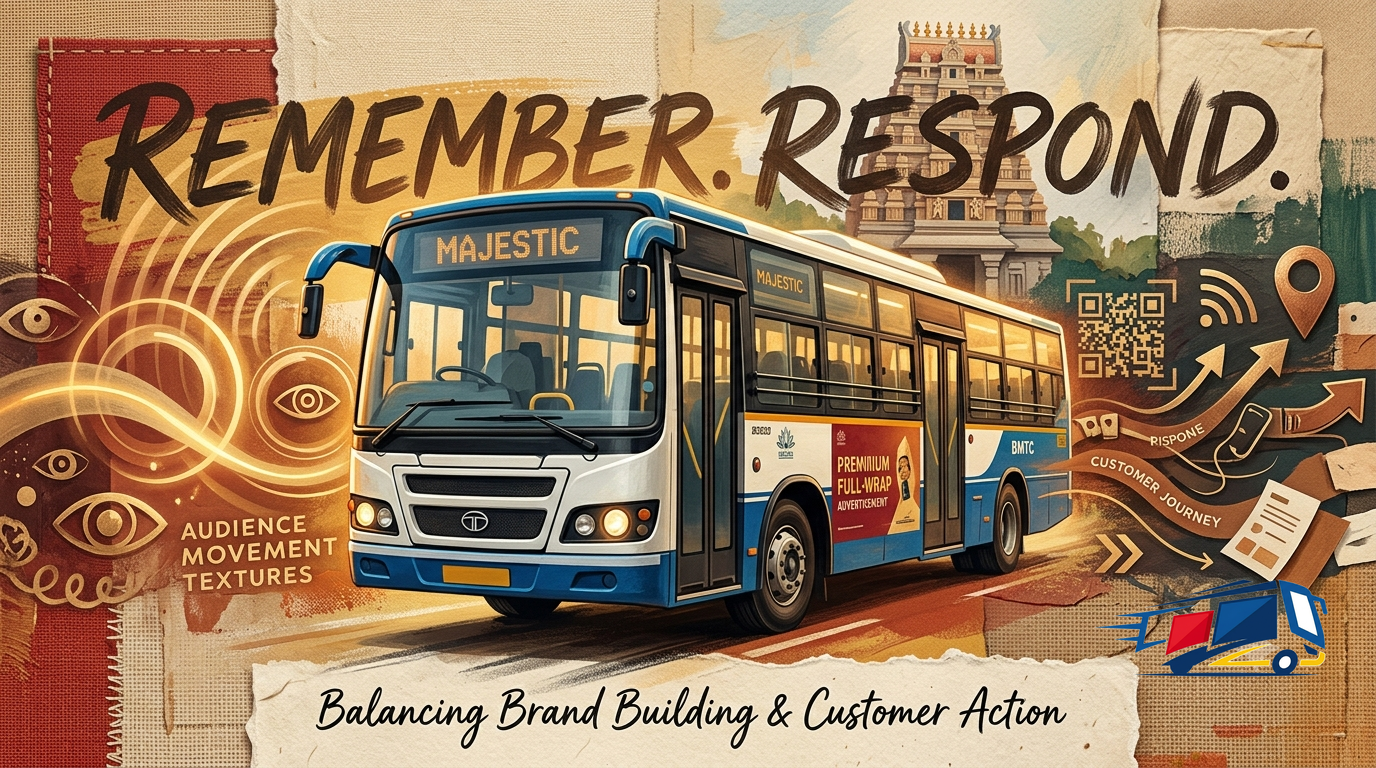
Brand Awareness vs Response Campaigns on Buses
What bus branding does best: awareness or direct response? A comparison of the two campaign types on buses, why a moving vehicle favours brand-building, and how to blend both.
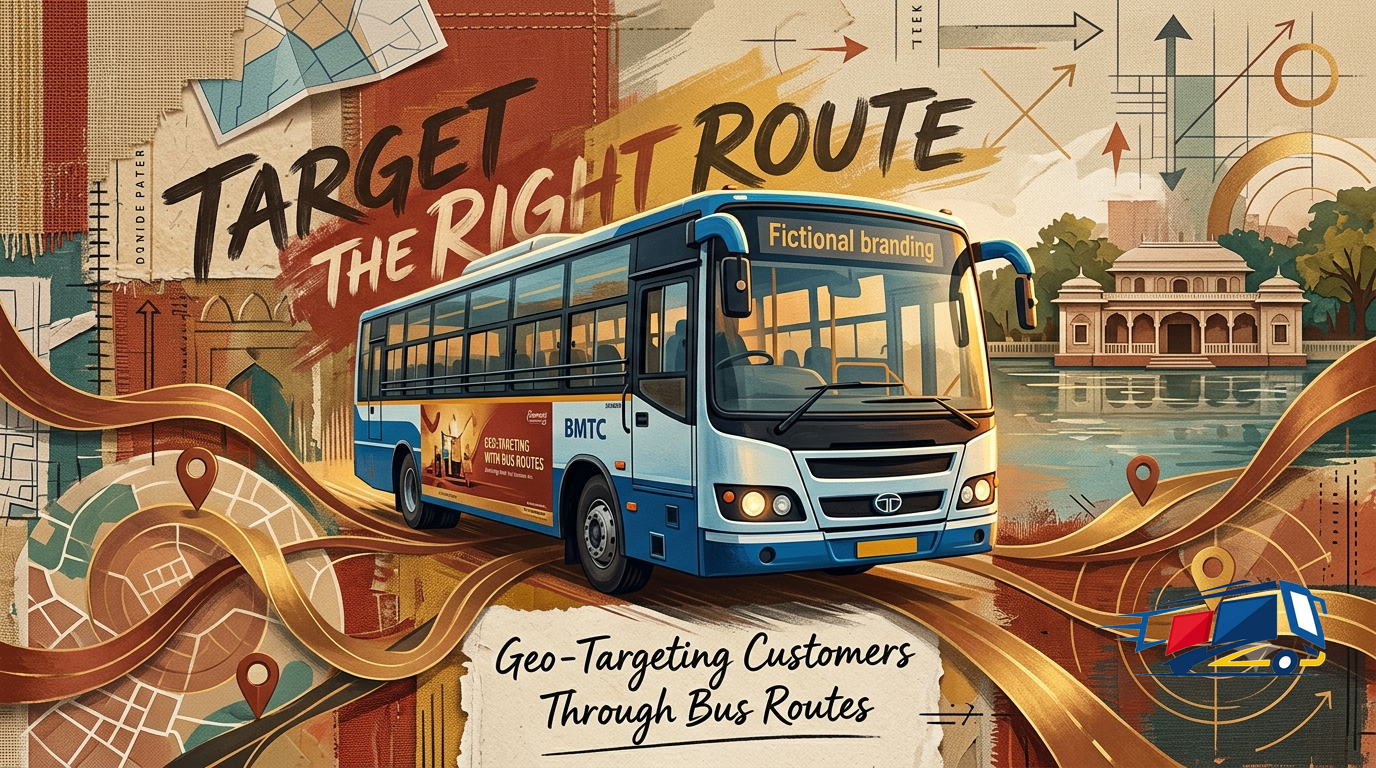
Geo-Targeting With Bus Routes: Advertising Where Your Customers Are
A bus route is a geo-targeting tool you can drive. How to map your customers to the routes they use, think in catchments instead of points, and stack corridors to cover a neighbourhood or a whole city.
Setting Campaign Objectives Before You Advertise
Why setting one clear objective before you advertise decides everything: awareness vs consideration vs response, how each maps to a different message, format and KPI, and how to write a SMART objective.