BMTC Fares & Ticketing Explained (2026)
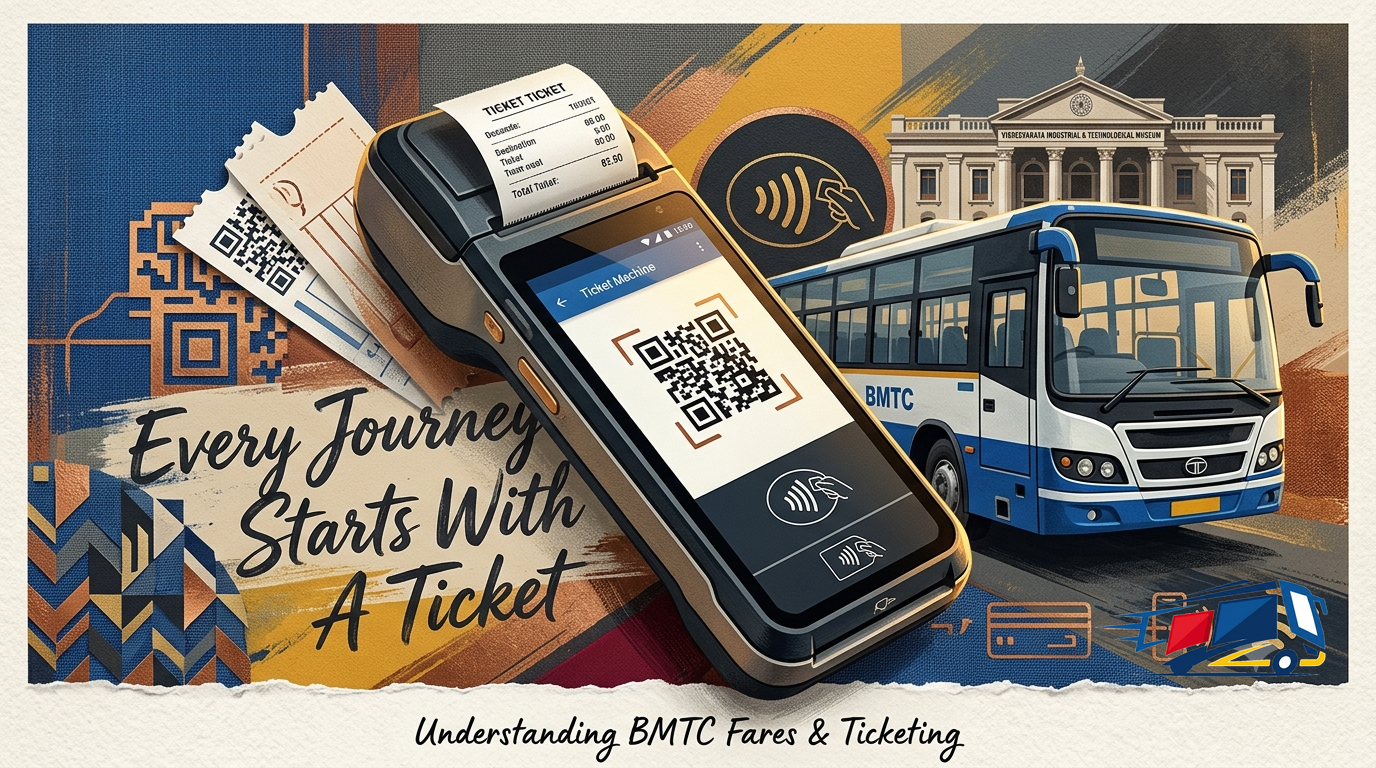
A BMTC fare is built on a simple idea: the city is split into stages of roughly two kilometres each, and you pay for the number of stages you cross. Ordinary buses start at ₹6 and AC Vajra buses at ₹10, and in 2026 you can settle that fare with cash, UPI, a card, or the same NCMC card you tap on the Metro.
Key takeaways
- Ordinary fares begin at ₹6 and rise stage by stage; one stage is about 2 km.
- AC Vajra fares start at ₹10, and the airport Vayu Vajra runs up to roughly ₹300.
- You can pay by cash, dynamic QR (UPI), debit or credit card, or NCMC card.
- BMTC is fitting around 11,000 new Android ETMs with dynamic QR to end fake-QR fraud.
- From June 2026, one NCMC card works across BMTC buses and Namma Metro.
How are BMTC fares calculated?
BMTC uses a stage system. The route is divided into stages of about two kilometres, and your fare depends on how many stages lie between where you board and where you get off.
| Element | Detail |
|---|---|
| One stage | Roughly 2 km of route |
| Ordinary minimum | ₹6 |
| AC Vajra minimum | ₹10 |
| How fare grows | Steps up with each extra stage crossed |
| Airport (Vayu Vajra) | Up to ~₹300 |
| Women, non-AC | Free (Shakti) |
Because fares are rounded to convenient figures, the jump between the first few stages can feel sharp. The conductor's machine, or the fare calculator inside the Namma BMTC app, shows the exact amount for any stop pair before you pay.
What does a BMTC ticket actually cost?
A short hop costs ₹6 on an ordinary bus, a typical cross-town trip lands in the ₹20 to ₹30 range, and AC fares run noticeably higher for the same distance.
| Trip | Approx. distance | Ordinary | AC Vajra |
|---|---|---|---|
| Short hop | 1 to 2 stages (~4 km) | ₹6 to ₹12 | ₹10 to ₹20 |
| Mid trip | 5 to 6 stages (~12 km) | ~₹20 to ₹25 | ~₹35 to ₹45 |
| Cross-city | 10+ stages (~20 km) | ~₹30+ | ~₹50+ |
| City to airport | Vayu Vajra | n/a | up to ~₹300 |
Want your brand on Bengaluru's buses?
Get a route plan, format recommendation and pricing, usually within a minute.
How can you pay for a BMTC ticket?
Every BMTC bus still takes cash, and most now accept UPI through a dynamic QR shown on the ETM, with cards and NCMC arriving as the new machines roll out.
| Method | How it works | Status |
|---|---|---|
| Cash | Pay the conductor, get a printed ticket | Everywhere |
| Dynamic QR (UPI) | Scan the QR on the ETM, pay, ticket prints | Rolling out, 6,000+ buses |
| Debit / credit card | Tap on the new ETM | New machines |
| NCMC card | Tap the same card used on Metro | From June 2026 |
| Digital pass | Show day or monthly pass in the app | Live (Namma BMTC, Tummoc) |
The digital ticketing upgrade
BMTC is replacing its old ticket machines with around 11,000 Android-based ETMs that take UPI, cards and NCMC, in a project run with transit firm Chalo.
Source: BMTC ETM and NCMC rollout reporting, 2026.
Paying by UPI, step by step:
- Tell the conductor where you are getting off.
- The ETM shows the fare and a dynamic QR on its screen.
- Scan that QR with any UPI app and pay the exact amount.
- Once payment confirms, the machine prints your ticket.
- Keep the ticket until you get off, in case of a check.
Single tickets or a day pass?
If you make more than four ordinary rides in a single day, the ₹80 day pass usually works out cheaper than buying tickets one by one.
| Rides in a day | Pay per ticket | Day pass | Cheaper option |
|---|---|---|---|
| 2 (one round trip) | ₹40 | ₹80 | Single tickets |
| 3 | ₹60 | ₹80 | Single tickets |
| 4 | ₹80 | ₹80 | About even |
| 5 or more | ₹100+ | ₹80 | Day pass |
Run errands across the city, change buses twice, or sightsee for a day, and the day pass stops being a saving and starts being a convenience.
The scale behind the fare box
BMTC moves roughly 45 lakh riders a day, far more than Namma Metro, making its buses the single largest moving audience on Bengaluru's roads.
Those riders board at the same stops, wait at the same junctions and travel the same corridors every working day. The fare box is one side of that scale; the other side is attention.
A city bus is the only piece of street advertising that drives itself through every kind of neighbourhood, past lakhs of the same commuters, day after day.
45 lakh daily riders move past your message, not the other way round
A hoarding waits for traffic to arrive. A branded bus travels into it, looping through residential streets, tech corridors and market roads on a fixed route, in front of the same dense commuter crowd the fare system already counts every day.
See how we turn that movement into reach in our guide to bus branding in Bengaluru, or compare formats in transit advertising options.
Frequently Asked Questions
What is the minimum BMTC bus fare in 2026?+
The ordinary (non-AC) minimum fare is ₹6 for the first stage of about 2 km. AC Vajra buses start at around ₹10.
Can I pay BMTC bus fare by UPI?+
Yes. Most buses now show a dynamic QR on the conductor's machine. Scan it with any UPI app, pay the exact fare, and the conductor prints your ticket.
How is the fare decided on a BMTC bus?+
By the number of stages between your boarding and exit points. One stage is roughly 2 km, and the fare steps up with each extra stage.
Is one card valid for both BMTC buses and Namma Metro?+
From June 2026, the same NCMC card works on both, as BMTC fits new machines that read it. Until then the card is mainly used on the Metro.
Do women pay BMTC fare?+
No. Women and transgender residents of Karnataka travel free on non-AC BMTC buses under the Shakti scheme by showing a government photo ID. AC buses are not covered.
Why did a conductor show a QR sticker instead of the machine?+
Static stickers were misused in some fraud cases. Always pay using the dynamic QR on the ETM screen, not a printed sticker, so your money reaches BMTC.
Bus Branding Glossary
- Full bus branding (wrap)
- A full vehicle wrap covering both sides and the rear of the bus, the highest-impact, most visible format.
- Bus back / rear branding
- Advertising on the rear panel of the bus, in the line of sight of traffic queued behind it at signals and junctions.
- Side panel branding
- Branding on one or both side panels of the bus body, facing pedestrians and parallel traffic along the route.
- Vajra / AC service
- BMTC's premium air-conditioned (Volvo / Vayu Vajra) services, carrying a higher-income commuter set on IT and airport corridors.
- TTMC
- Traffic and Transit Management Centre, a large BMTC bus terminal where many routes start, terminate and interchange.
- Depot
- The BMTC facility where buses are parked, serviced and from which many local routes originate.
- Dwell time
- How long a bus stays in view of a stationary crowd, at a stop, signal or in slow traffic, which lengthens brand exposure.
- Corridor
- A main arterial road (e.g. the Outer Ring Road or Hosur Road) that a bus route runs along, defining who sees the branding.
How to run a BMTC bus branding campaign
Five simple steps from enquiry to a live, tracked campaign on Bengaluru's buses.
- 1
Pick your area & audience
Tell us the Bengaluru area or corridor you want to reach and who you're targeting, IT professionals, shoppers, students or residents.
- 2
Choose a format
Select a format, full bus wrap, rear panel, side panel or premium AC/Vajra service, based on your budget and the impact you want.
- 3
Select routes & bus count
We map the high-frequency routes and stops that cover your audience and recommend how many buses to brand.
- 4
Approve the creative
Share your artwork (or we help design it). We prepare it to BMTC specifications and get the approvals.
- 5
Go live & get proof
We print, wrap and deploy the buses, then share proof of display so you can see your brand on the road.
Bus Branding Formats
Choose how your brand rides, pick the format that fits your goal and budget.
Bus Branding Across Bengaluru
We run BMTC bus branding in every major Bengaluru neighbourhood. Explore more areas:
Outdoor & Transit Advertising Specialists
We plan, design and run BMTC bus branding campaigns across every major Bengaluru corridor, matching brands to the routes, formats and audiences that deliver the most visibility.
Discover More
Brand Awareness vs Response Campaigns on Buses
What bus branding does best: awareness or direct response? A comparison of the two campaign types on buses, why a moving vehicle favours brand-building, and how to blend both.
Geo-Targeting With Bus Routes: Advertising Where Your Customers Are
A bus route is a geo-targeting tool you can drive. How to map your customers to the routes they use, think in catchments instead of points, and stack corridors to cover a neighbourhood or a whole city.
Setting Campaign Objectives Before You Advertise
Why setting one clear objective before you advertise decides everything: awareness vs consideration vs response, how each maps to a different message, format and KPI, and how to write a SMART objective.