BMTC Routes That Serve Bengaluru's Tech Corridors
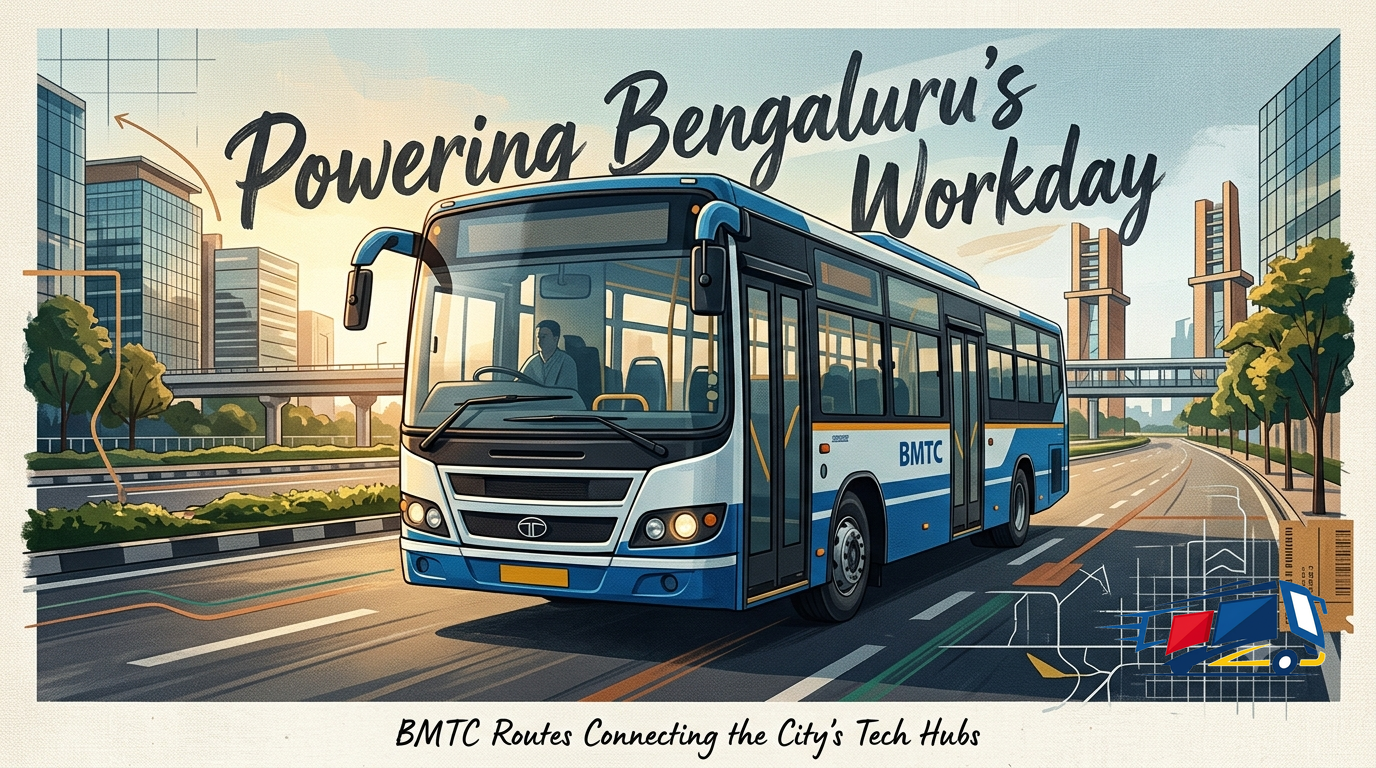
Bengaluru's tech belts run on a few BMTC corridors. The 500 series sweeps the Outer Ring Road, 335E reaches Whitefield, the 356 family drops into Electronic City, and the 290 and 500 routes feed Manyata. Ride any of them at peak hour and the bus fills with the city's IT workforce.
Key takeaways
- The four tech belts are the ORR, Whitefield, Electronic City and Manyata / Hebbal.
- Anchor routes: 500 series (ORR), 335E (Whitefield), 356 family (Electronic City), 290 / 500 (Manyata).
- The rider profile skews toward salaried IT professionals with high spending power.
- BMTC and ORRCA built a dedicated IT bus tie-up on the ORR, proof of demand on these routes.
- For brands chasing that audience, the route is the targeting.
Bengaluru's four big tech belts
Four clusters hold most of the city's offices: the Outer Ring Road, Whitefield in the east, Electronic City in the south, and the Manyata and Hebbal belt in the north.
| Corridor | Where | Anchors |
|---|---|---|
| Outer Ring Road | East / southeast | Bellandur, Marathahalli, Ecospace |
| Whitefield | East | ITPL, EPIP, Kadugodi |
| Electronic City | South | Infosys, Wipro, Phase 1 and 2 |
| Manyata / Hebbal | North | Manyata Embassy Business Park |
These belts share one trait that matters to advertisers: they pull in lakhs of salaried professionals every working day, on a tight cluster of roads BMTC already serves heavily.
The routes that serve each corridor
Each belt has a recognisable set of BMTC routes. Learn the families and you can target a corridor by route alone.
| Corridor | Anchor routes | Connects from |
|---|---|---|
| Outer Ring Road | 500 series (500C, 500D, 500CA) | KR Puram, Silk Board |
| Whitefield | 335E, 335A, V-500CA | Majestic, KR Puram |
| Electronic City | 356, 356C, V-356Q | Majestic, Silk Board |
| Manyata / Hebbal | 290 series, 500-D variants, KIA-8 | Nagawara, Hebbal |
Want your brand on Bengaluru's buses?
Get a route plan, format recommendation and pricing, usually within a minute.
Who rides these routes?
The peak-hour crowd on tech-corridor buses is overwhelmingly working professionals: salaried, app-savvy, and with higher discretionary spend than the city average.
| Trait | What it means for a brand |
|---|---|
| Salaried IT staff | Steady, high discretionary income |
| Young, urban | Open to new brands and apps |
| Fixed daily route | Repeat exposure on the commute |
| Digital-first | Responsive to QR and app-led calls |
| Peak-hour density | Concentrated reach 8 to 10 and 5 to 8 |
That this audience will ride a bus at all is not assumed. BMTC and ORRCA, an association of 24 ORR firms including major tech names, set up a dedicated Common Bus System precisely to move these professionals.
Brands that benefit most
Any brand selling to young, salaried, urban professionals finds its audience packed onto these corridors at predictable hours.
Indicative categories whose audience concentrates on Bengaluru's tech corridors.
Planning a campaign by corridor
Targeting IT professionals is mostly about route selection. Pick the belt your customer works in, then the routes that run it.
- Identify the belt: ORR for breadth, Whitefield or EC for a specific cluster.
- Choose the anchor routes for that corridor, like the 500 series for the ORR.
- Weight toward peak-hour, high-frequency runs when the buses are fullest.
- Use full wraps for a flagship corridor, panels to extend the budget.
- Pair the on-bus design with a QR or app call, since this audience acts on the phone.
You cannot buy a billboard inside a tech park, but a bus on the 500 series spends its whole day in front of the people who work there.
Why tech-corridor routes convert
These routes line up a high-income, high-intent audience against a daily, repeated message, which is exactly the setup performance-minded brands want.
The route is your audience filter
Most outdoor media reaches everyone and no one. A bus on the ORR, Whitefield or Electronic City corridors does the targeting for you: it runs in front of salaried IT professionals, twice a day, on the same stretch they sit in traffic. For a fintech, D2C or food brand chasing that exact buyer, route choice is the cleanest filter on the road.
See how we map brands to corridors in bus branding in Bengaluru, or plan an audience-led buy with transit advertising.
Frequently Asked Questions
Which BMTC routes serve the Outer Ring Road tech belt?+
The 500 series, including 500C, 500D and 500CA, is the ORR spine, running KR Puram to Silk Board past Marathahalli and Bellandur, where most ORR tech parks sit.
How do IT employees reach Whitefield and Electronic City by bus?+
Whitefield is served by the Volvo 335E and 335A; Electronic City by the 356 family (356C, V-356Q) along Hosur Road. Many 500-series variants also feed both.
Which buses go to Manyata Tech Park?+
Routes in the 290 series and several 500-D variants, plus airport route KIA-8, stop near Manyata at Nagawara on the ORR.
Why do advertisers target tech-corridor routes?+
They concentrate a high-income, salaried, digital-first audience on a few roads at predictable peak hours, which makes route choice an effective audience filter.
What is ORRCA?+
The Outer Ring Road Companies Association, a group of 24 ORR firms that partnered with BMTC on a dedicated bus system for IT staff, a clear signal of commuter demand on the corridor.
Which brands suit these corridors?+
Fintech, D2C, food and QSR, edtech, real estate and mobility brands, all of which target the young, salaried professionals these routes carry.
Bus Branding Glossary
- Full bus branding (wrap)
- A full vehicle wrap covering both sides and the rear of the bus, the highest-impact, most visible format.
- Bus back / rear branding
- Advertising on the rear panel of the bus, in the line of sight of traffic queued behind it at signals and junctions.
- Side panel branding
- Branding on one or both side panels of the bus body, facing pedestrians and parallel traffic along the route.
- Vajra / AC service
- BMTC's premium air-conditioned (Volvo / Vayu Vajra) services, carrying a higher-income commuter set on IT and airport corridors.
- TTMC
- Traffic and Transit Management Centre, a large BMTC bus terminal where many routes start, terminate and interchange.
- Depot
- The BMTC facility where buses are parked, serviced and from which many local routes originate.
- Dwell time
- How long a bus stays in view of a stationary crowd, at a stop, signal or in slow traffic, which lengthens brand exposure.
- Corridor
- A main arterial road (e.g. the Outer Ring Road or Hosur Road) that a bus route runs along, defining who sees the branding.
How to run a BMTC bus branding campaign
Five simple steps from enquiry to a live, tracked campaign on Bengaluru's buses.
- 1
Pick your area & audience
Tell us the Bengaluru area or corridor you want to reach and who you're targeting, IT professionals, shoppers, students or residents.
- 2
Choose a format
Select a format, full bus wrap, rear panel, side panel or premium AC/Vajra service, based on your budget and the impact you want.
- 3
Select routes & bus count
We map the high-frequency routes and stops that cover your audience and recommend how many buses to brand.
- 4
Approve the creative
Share your artwork (or we help design it). We prepare it to BMTC specifications and get the approvals.
- 5
Go live & get proof
We print, wrap and deploy the buses, then share proof of display so you can see your brand on the road.
Bus Branding Formats
Choose how your brand rides, pick the format that fits your goal and budget.
Bus Branding Across Bengaluru
We run BMTC bus branding in every major Bengaluru neighbourhood. Explore more areas:
Outdoor & Transit Advertising Specialists
We plan, design and run BMTC bus branding campaigns across every major Bengaluru corridor, matching brands to the routes, formats and audiences that deliver the most visibility.
Discover More
Brand Awareness vs Response Campaigns on Buses
What bus branding does best: awareness or direct response? A comparison of the two campaign types on buses, why a moving vehicle favours brand-building, and how to blend both.
Geo-Targeting With Bus Routes: Advertising Where Your Customers Are
A bus route is a geo-targeting tool you can drive. How to map your customers to the routes they use, think in catchments instead of points, and stack corridors to cover a neighbourhood or a whole city.
Setting Campaign Objectives Before You Advertise
Why setting one clear objective before you advertise decides everything: awareness vs consideration vs response, how each maps to a different message, format and KPI, and how to write a SMART objective.