How Long Does a Bus Branding Campaign Take to Launch?
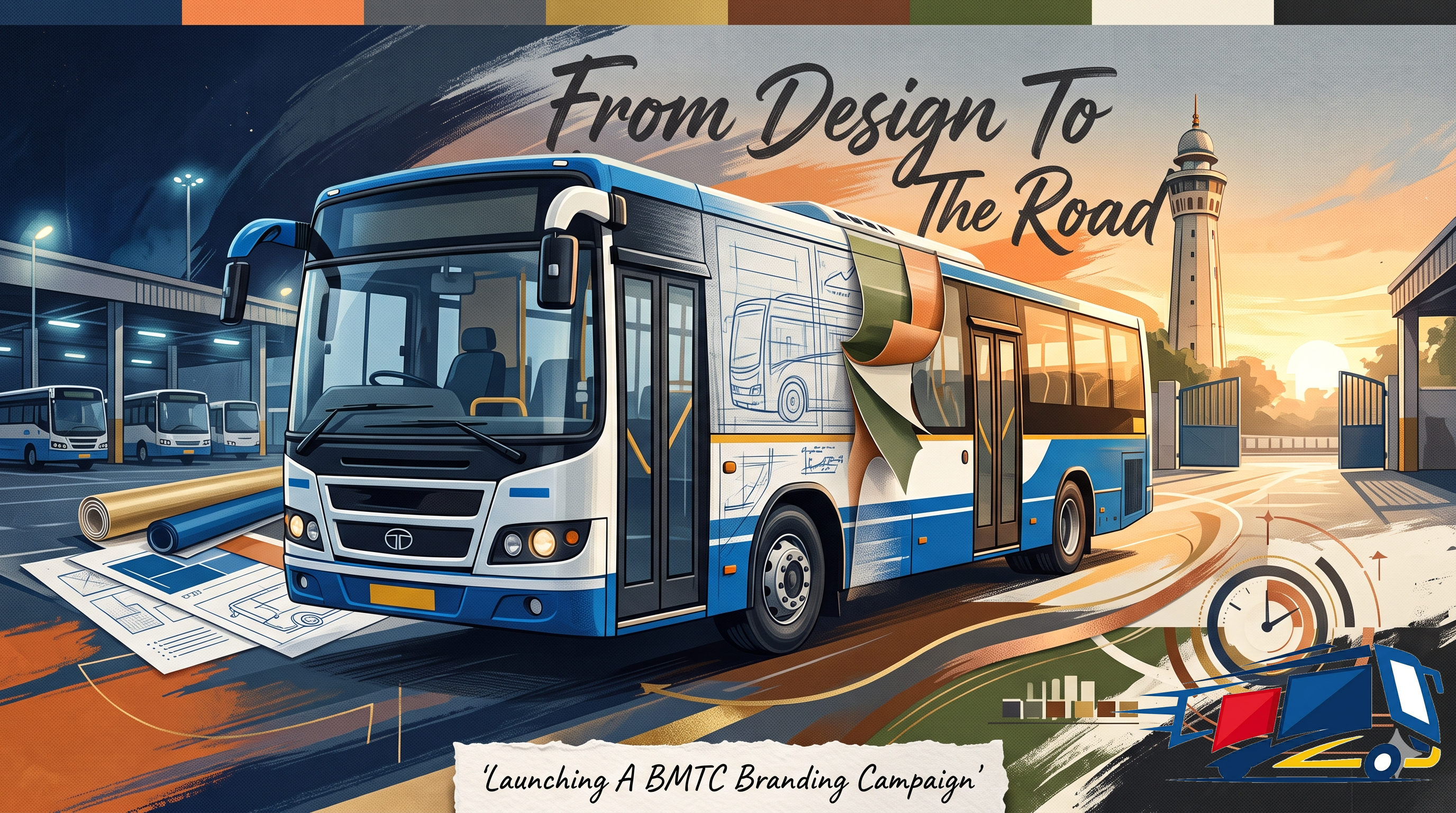
A bus branding campaign does not flip on like a switch. It moves through four phases: design, approval, wrap and live. The single biggest variable is how fast you approve the artwork, since the clock barely starts until then. Here is a realistic timeline, and why starting early pays off.
Key takeaways
- The campaign runs in four phases: design, approval, wrap and live.
- The clock effectively starts at artwork approval, so fast sign-off speeds everything.
- Installers brand around 5 to 6 buses a day, each taking 5 to 6 hours.
- Wrapping happens at night, when buses return and halt at the stands.
- Rain delays installation, since wet surfaces make vinyl lift, so weather is a real factor.
The four phases of a launch
Every campaign passes through the same sequence. Design and approval are paced by you; printing and installation are paced by production and the buses returning to the depot.
| Phase | What happens | Paced by |
|---|---|---|
| Design | Artwork built or adapted to format | You and the team |
| Approval | You sign off the final proof | You |
| Wrap | Printing then night installation | Production |
| Live | Branded buses run the routes | On the road |
The useful thing to notice is which phases you control. Two of the four sit with you, design and approval, so the parts most able to slow a launch are also the ones you can move fastest on.
The approval clock is the one that counts
Printing and installation only begin once you approve the final artwork. That single sign-off is the gate, so the days spent reviewing proofs are usually what decide whether a launch is quick or slow.
Want your brand on Bengaluru's buses?
Get a route plan, format recommendation and pricing, usually within a minute.
How the wrapping actually happens
Installation is not a daytime job in a workshop. Buses run their routes through the day, so branding is done at night, when they return and halt at the stands, and each bus takes several hours.
| Factor | Reality |
|---|---|
| When | At night, buses halted at stands |
| Per bus | Around 5 to 6 hours |
| Per day | About 5 to 6 buses branded |
| Why night | Buses are on routes all day |
This is why fleet size drives the schedule. If a campaign covers many buses, installation rolls over several nights at roughly five to six buses each, so a larger booking naturally needs a longer install window.
Why weather is part of the timeline
Vinyl needs a clean, dry surface to bond. In the rain, installation stops, because moisture makes the vinyl lift and the finish fails. So the monsoon and wet nights can stretch a schedule.
How fleet size shapes the schedule
A handful of buses can be done in a night or two; a large fleet rolls across more nights. Since the install runs at roughly five to six buses a night, the count sets the calendar.
| Buses | Indicative install nights |
|---|---|
| 5 to 6 | About 1 night |
| 10 to 12 | About 2 nights |
| 25 to 30 | About 5 nights |
| 50+ | Plan a rolling schedule |
For big fleets, a rolling launch is normal and often better, the first buses go live while later ones are still being wrapped, so your campaign starts earning impressions sooner.
What speeds a launch up
You cannot control the rain, but you can control most of the timeline. Quick approvals, ready artwork and an early start are what get a campaign on the road fastest.
- Approve artwork quickly. The clock starts at sign-off, so fast, careful approval is the biggest lever.
- Have brand assets ready. Logos and creative on hand mean design moves straight to proof.
- Lock the brief early. Format, routes and fleet size settled up front avoid mid-stream changes.
- Start before your deadline. Begin well ahead of a launch date so weather has room to behave.
- Use a rolling install. For big fleets, go live in batches rather than waiting for all buses.
Tell us your launch date, we will work back from it
The smartest move is to start early. Give us your go-live date and we will plan backwards through wrapping, printing and approval, so you know exactly when artwork must be signed off. We brand around five to six buses a night once you approve, work around the weather, and keep you updated so the campaign hits the road on time. Leave buffer for rain and your launch stays safe.
See how campaigns run under bus branding in Bengaluru, or plan the full picture in transit advertising.
Frequently Asked Questions
What are the phases of a bus branding launch?+
Four: design, approval, wrap and live. You pace the first two; printing and night installation pace the wrap before the buses go live on their routes.
What slows a launch the most?+
Usually slow artwork approval. Printing and installation only begin once you sign off the final proof, so the review stage is where most delay happens.
How many buses can be branded in a day?+
Around 5 to 6 buses per day, with each bus taking roughly 5 to 6 hours. Larger fleets roll across several nights.
Why is the wrapping done at night?+
Because the buses run their routes all day. Branding happens at night when they return and halt at the stands, so service is not disrupted.
Does rain affect the timeline?+
Yes. Rain stops installation, since vinyl will not bond to a wet surface and tends to lift. Wet nights can push a schedule, so build in a buffer.
How do I get my campaign live faster?+
Approve artwork quickly and carefully, have your assets ready, lock the brief early, and start ahead of your deadline. For big fleets, a rolling install gets you live sooner.
Bus Branding Glossary
- Full bus branding (wrap)
- A full vehicle wrap covering both sides and the rear of the bus, the highest-impact, most visible format.
- Bus back / rear branding
- Advertising on the rear panel of the bus, in the line of sight of traffic queued behind it at signals and junctions.
- Side panel branding
- Branding on one or both side panels of the bus body, facing pedestrians and parallel traffic along the route.
- Vajra / AC service
- BMTC's premium air-conditioned (Volvo / Vayu Vajra) services, carrying a higher-income commuter set on IT and airport corridors.
- TTMC
- Traffic and Transit Management Centre, a large BMTC bus terminal where many routes start, terminate and interchange.
- Depot
- The BMTC facility where buses are parked, serviced and from which many local routes originate.
- Dwell time
- How long a bus stays in view of a stationary crowd, at a stop, signal or in slow traffic, which lengthens brand exposure.
- Corridor
- A main arterial road (e.g. the Outer Ring Road or Hosur Road) that a bus route runs along, defining who sees the branding.
How to run a BMTC bus branding campaign
Five simple steps from enquiry to a live, tracked campaign on Bengaluru's buses.
- 1
Pick your area & audience
Tell us the Bengaluru area or corridor you want to reach and who you're targeting, IT professionals, shoppers, students or residents.
- 2
Choose a format
Select a format, full bus wrap, rear panel, side panel or premium AC/Vajra service, based on your budget and the impact you want.
- 3
Select routes & bus count
We map the high-frequency routes and stops that cover your audience and recommend how many buses to brand.
- 4
Approve the creative
Share your artwork (or we help design it). We prepare it to BMTC specifications and get the approvals.
- 5
Go live & get proof
We print, wrap and deploy the buses, then share proof of display so you can see your brand on the road.
Bus Branding Formats
Choose how your brand rides, pick the format that fits your goal and budget.
Bus Branding Across Bengaluru
We run BMTC bus branding in every major Bengaluru neighbourhood. Explore more areas:
Outdoor & Transit Advertising Specialists
We plan, design and run BMTC bus branding campaigns across every major Bengaluru corridor, matching brands to the routes, formats and audiences that deliver the most visibility.
Discover More
Brand Awareness vs Response Campaigns on Buses
What bus branding does best: awareness or direct response? A comparison of the two campaign types on buses, why a moving vehicle favours brand-building, and how to blend both.
Geo-Targeting With Bus Routes: Advertising Where Your Customers Are
A bus route is a geo-targeting tool you can drive. How to map your customers to the routes they use, think in catchments instead of points, and stack corridors to cover a neighbourhood or a whole city.
Setting Campaign Objectives Before You Advertise
Why setting one clear objective before you advertise decides everything: awareness vs consideration vs response, how each maps to a different message, format and KPI, and how to write a SMART objective.