
Bus Branding Contract Terms Every Advertiser Should Know
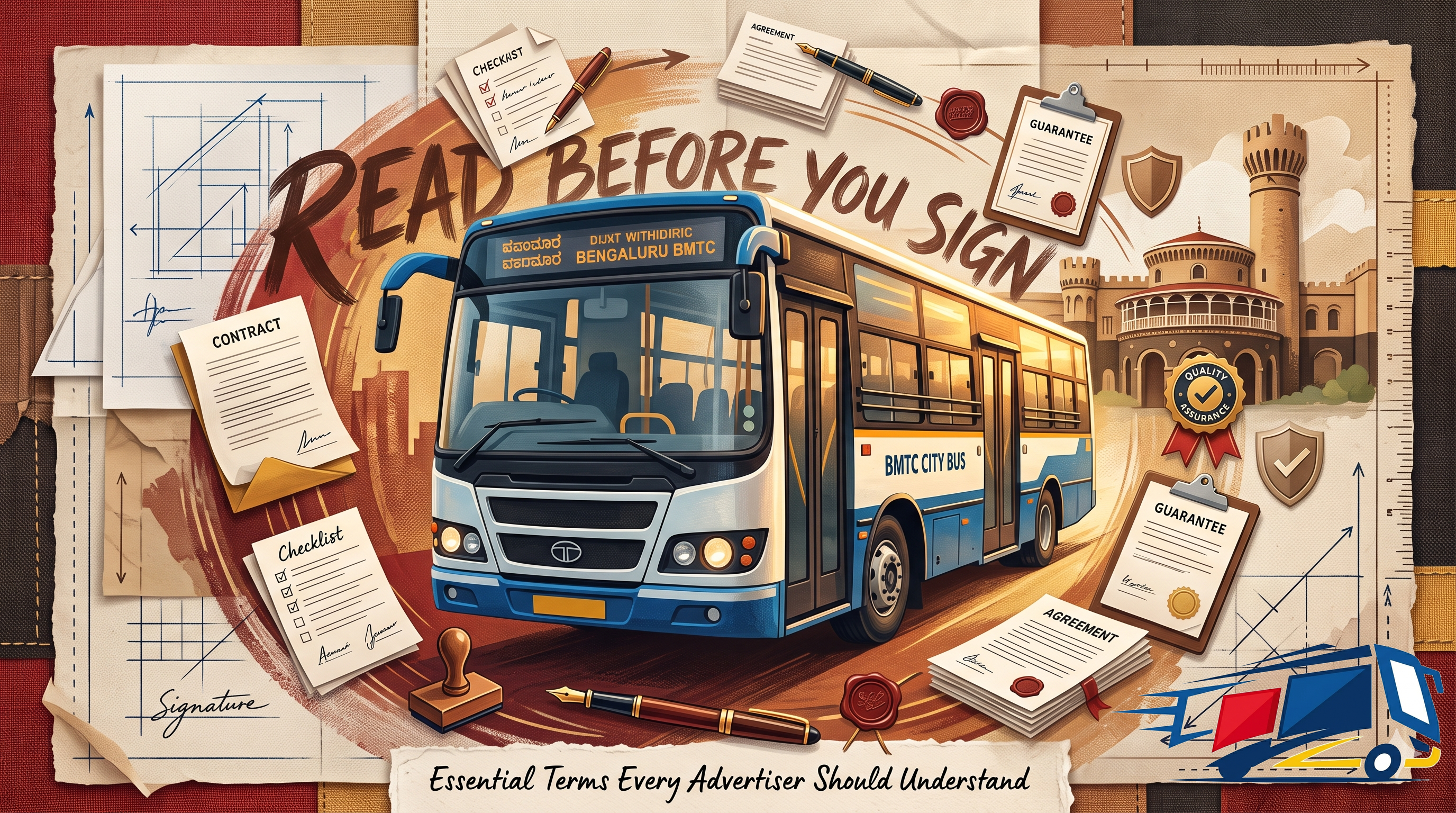
A bus branding agreement is short, but a few clauses decide whether the campaign goes smoothly. The ones that matter most: the term and bus-count guarantee, who handles maintenance and damage, removal, payment, and any exclusivity. Here is each in plain language, with what to check before you sign.
Key takeaways
- Term and guarantee: wrap campaigns often carry a minimum commitment because install costs are high.
- Bus-count guarantee: a good contract says how a sidelined bus is handled, usually moved to another or replaced.
- Maintenance and damage responsibility should be named, the agency typically bears upkeep and removal.
- Payment, exclusivity and content rules are the clauses most often left vague; pin them down.
- This is general information, not legal advice; have a professional review anything you sign.
Term, duration and the minimum guarantee
The term sets how long your branding stays live. Because printing and installation are a big upfront cost, whole-bus campaigns usually carry a minimum commitment, so the contract states a guaranteed period rather than letting you stop after a few days.
| Item | What to check |
|---|---|
| Start date | When the live period begins, at install or at go-live |
| Duration | The exact live months you are paying for |
| Minimum | Any minimum commitment before you can stop |
| End date | When branding comes down and the term closes |
Bus-count guarantee and downtime
You book a number of buses, so the contract should guarantee that number stays live. Buses go for service or break down, and a fair agreement says exactly how that is handled, normally by moving your branding to another bus or replacing the unit, so your count holds.
The industry term for the cushion is an overage, extra capacity that absorbs the odd bus being sidelined. Confirm the contract names a remedy for downtime rather than leaving your live count to chance.
Want your brand on Bengaluru's buses?
Get a route plan, format recommendation and pricing, usually within a minute.
Maintenance, damage and removal
Three linked questions decide who pays if something goes wrong: who maintains the wrap, who is liable for damage, and who removes it at the end. In most transit-ad contracts the advertising contractor carries these costs, but the clause should say so plainly.
| Responsibility | Usually sits with | Check the wording |
|---|---|---|
| Upkeep of wrap | Agency | Touch-ups if it lifts or fades |
| Damage / vandalism | Defined in contract | Who repairs, who pays |
| Removal at end | Agency | Clean removal, no extra bill to you |
| Vehicle damage on removal | Defined in contract | Who is liable if paint lifts |
Payment and cancellation
The money clauses should leave nothing to interpretation: the fee, the billing schedule, what triggers each payment, and what happens if either side cancels. Vague payment terms are the most common source of later disputes.
| Term | What to confirm |
|---|---|
| Fee basis | Per bus per month, and what is included |
| Schedule | Advance, milestone or staged payments |
| Extras | Whether design or rush work is separate |
| Cancellation | Notice period and any charge if you stop early |
| Late payment | Any interest or penalty terms |
Tie payments to clear milestones where you can, for example a stage on artwork approval and the rest on go-live, so money tracks delivery. And read the cancellation clause before you sign, not after you need it.
Exclusivity and content rules
Two scope clauses catch advertisers out. Exclusivity, whether the agency or routes can also carry a competitor, and content rules, the design and category restrictions that apply to bus advertising. Both are better understood up front.
If you need a competitor kept off your routes, exclusivity must be written in and its scope defined: which rivals, which routes, how long. Separately, bus advertising carries content and category rules, and your design is checked for compliance before it goes to print, so confirm whose job that approval is.
Liability and renewal
Two closing clauses round out the agreement. Liability, who is responsible if something goes wrong and any cap on it, and renewal, how the agreement extends or ends when the term is up.
| Clause | What it covers |
|---|---|
| Liability | Who is responsible, and any limit |
| Indemnity | Cover for third-party claims |
| Renewal | How to extend, and on what rate |
| Dispute | How disagreements are resolved |
On renewal, check whether it auto-renews or needs a fresh sign-off, and on what rate, since a continued, longer commitment usually earns a lower per-month rate. On disputes, a clause favouring mediation first tends to be faster and cheaper than going straight to court.
A clear contract is part of the service
You should know what you are signing. A straightforward bus branding agreement names the term and bus-count guarantee, puts maintenance and removal on us, sets clear payment milestones, and spells out exclusivity and renewal up front. We are happy to walk you through every clause before you commit, so the only surprises are how well the campaign performs.
See how a campaign is run end to end under bus branding in Bengaluru, or read what shapes the deal in transit advertising.
Your pre-sign checklist
Before you put your name to a bus branding agreement, run these checks. Each one closes a gap that otherwise turns into a dispute later.
- When does the term start and end? Confirm the live window and any minimum commitment.
- Is my bus count guaranteed? Check how a sidelined bus is moved or replaced.
- Who maintains and removes the wrap? Confirm upkeep and clean removal are included.
- Who is liable for damage? To the wrap, and to the bus on removal.
- What exactly do I pay, and when? Fee basis, schedule, extras, cancellation.
- Is there exclusivity? And does it cover the competitors and routes you care about.
- How does it renew or end? Auto-renew or fresh sign-off, and on what rate.
A good contract is not there to trap you, it is there so neither side has to guess. The clauses that protect you most are the ones that say plainly what happens when something goes wrong.
Frequently Asked Questions
Is there a minimum duration in a bus branding contract?+
Often yes. Because installation is a large upfront cost, whole-bus wrap campaigns commonly carry a minimum commitment, frequently around 3 to 6 months, set out in the term clause.
What happens if a branded bus breaks down?+
A fair contract guarantees your count. The branding is usually moved to another bus or replaced, often using an overage of spare capacity, so the number you booked stays live.
Who pays for maintenance and removal?+
In most transit-ad contracts the agency carries upkeep and removal. Confirm removal is included and that liability for any vehicle marking on removal is named in writing.
Should I ask for exclusivity?+
Only if you need a competitor kept off your routes, and then define its scope, which rivals and which routes. Blanket exclusivity can be hard to honour and may raise the price.
What are the most common gaps in these contracts?+
Removal, cancellation and payment timing. Agreements that cover print and install sometimes leave these vague, which is where most later disputes start.
Is this legal advice?+
No. This is general information to help you read a contract and ask better questions. Have a qualified professional review anything before you sign.
Bus Branding Glossary
- Full bus branding (wrap)
- A full vehicle wrap covering both sides and the rear of the bus, the highest-impact, most visible format.
- Bus back / rear branding
- Advertising on the rear panel of the bus, in the line of sight of traffic queued behind it at signals and junctions.
- Side panel branding
- Branding on one or both side panels of the bus body, facing pedestrians and parallel traffic along the route.
- Vajra / AC service
- BMTC's premium air-conditioned (Volvo / Vayu Vajra) services, carrying a higher-income commuter set on IT and airport corridors.
- TTMC
- Traffic and Transit Management Centre, a large BMTC bus terminal where many routes start, terminate and interchange.
- Depot
- The BMTC facility where buses are parked, serviced and from which many local routes originate.
- Dwell time
- How long a bus stays in view of a stationary crowd, at a stop, signal or in slow traffic, which lengthens brand exposure.
- Corridor
- A main arterial road (e.g. the Outer Ring Road or Hosur Road) that a bus route runs along, defining who sees the branding.
How to run a BMTC bus branding campaign
Five simple steps from enquiry to a live, tracked campaign on Bengaluru's buses.
- 1
Pick your area & audience
Tell us the Bengaluru area or corridor you want to reach and who you're targeting, IT professionals, shoppers, students or residents.
- 2
Choose a format
Select a format, full bus wrap, rear panel, side panel or premium AC/Vajra service, based on your budget and the impact you want.
- 3
Select routes & bus count
We map the high-frequency routes and stops that cover your audience and recommend how many buses to brand.
- 4
Approve the creative
Share your artwork (or we help design it). We prepare it to BMTC specifications and get the approvals.
- 5
Go live & get proof
We print, wrap and deploy the buses, then share proof of display so you can see your brand on the road.
Bus Branding Formats
Choose how your brand rides, pick the format that fits your goal and budget.
Bus Branding Across Bengaluru
We run BMTC bus branding in every major Bengaluru neighbourhood. Explore more areas:
Outdoor & Transit Advertising Specialists
We plan, design and run BMTC bus branding campaigns across every major Bengaluru corridor, matching brands to the routes, formats and audiences that deliver the most visibility.
Discover More
Brand Awareness vs Response Campaigns on Buses
What bus branding does best: awareness or direct response? A comparison of the two campaign types on buses, why a moving vehicle favours brand-building, and how to blend both.
Geo-Targeting With Bus Routes: Advertising Where Your Customers Are
A bus route is a geo-targeting tool you can drive. How to map your customers to the routes they use, think in catchments instead of points, and stack corridors to cover a neighbourhood or a whole city.
Setting Campaign Objectives Before You Advertise
Why setting one clear objective before you advertise decides everything: awareness vs consideration vs response, how each maps to a different message, format and KPI, and how to write a SMART objective.