Full vs Back vs Side Bus Branding: Formats Compared
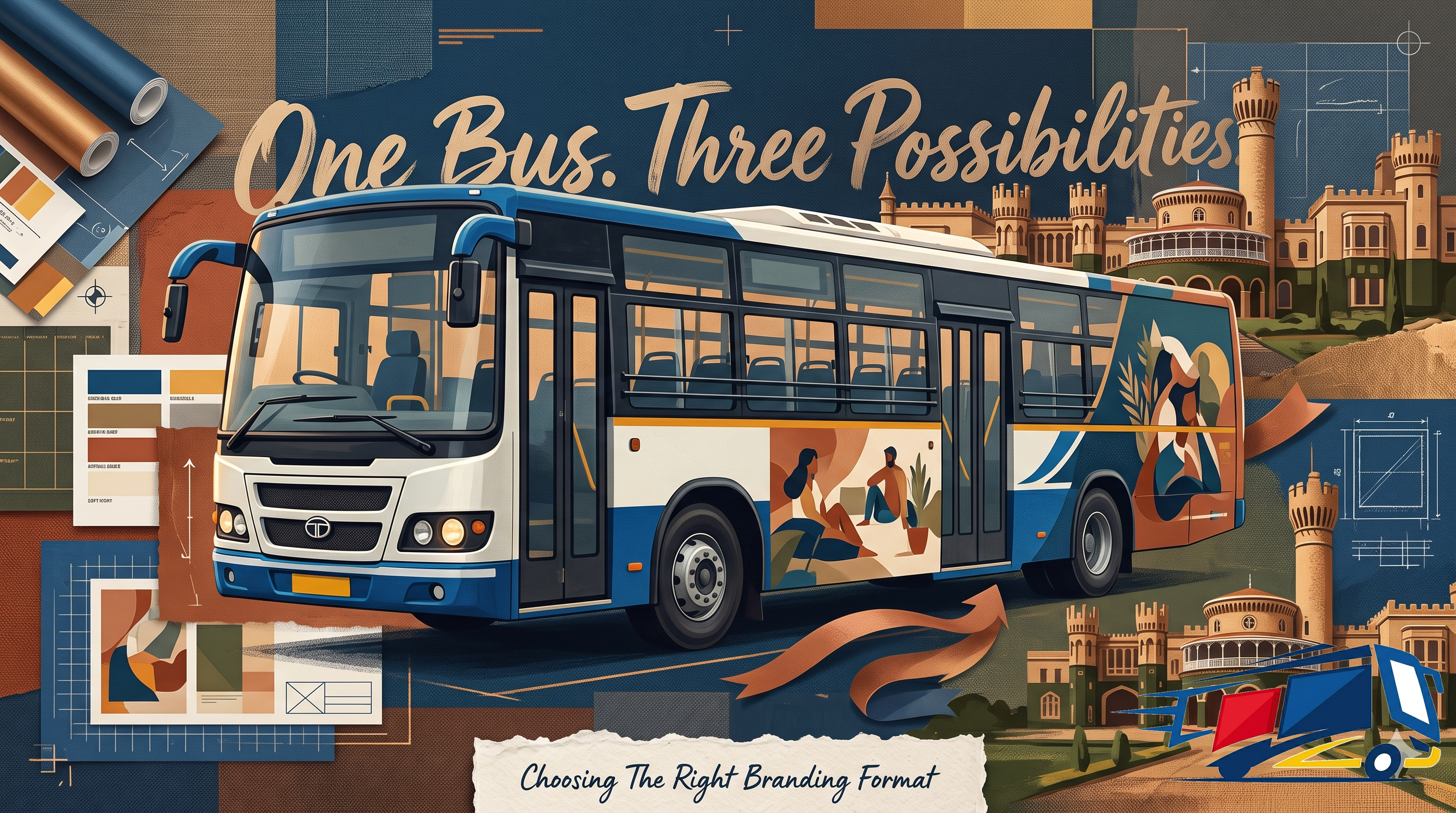
Picking a bus branding format is really picking a canvas. A full wrap turns the whole bus into a billboard, a bus back owns the view of everyone stuck behind it, and a side panel runs a long banner past the street. Each sees a different crowd and sits in a different price tier. Here is how to choose.
Key takeaways
- Full wrap covers the whole bus for maximum impact, and sits in the top price tier.
- Bus back sits at eye level and is read by drivers and pedestrians stuck behind in traffic.
- Side panel is a long banner along the body, seen by the street the bus passes.
- Format is the biggest cost lever: more coverage means more vinyl, print and labour.
- The right pick depends on goal and budget, not on which looks biggest.
The three formats at a glance
Each format trades coverage against cost and reaches a different viewer. Full wrap is the biggest and dearest, bus back the value pick for traffic, side panel the long-banner middle ground.
| Format | Covers | Mainly seen by | Cost tier |
|---|---|---|---|
| Full wrap | Whole exterior | Everyone, all angles | Highest |
| Bus back | Rear panel | Traffic behind, pedestrians | Value |
| Side panel | One body side | Roadside traffic and walkers | Mid |
| Half wrap | Lower body, side(s) | Roadside, strong presence | Mid-high |
| Interior | Inside panels | Seated passengers | Low, niche |
Read the table by viewer, not just by size. The best format is the one that reaches the crowd you care about, at a cost that lets you run enough buses for long enough to matter.
Full wrap: the whole bus as a billboard
A full wrap covers the entire exterior, sides, rear and often the windows with perforated film, turning the bus into a 360 degree moving billboard. It is the highest impact format and the highest cost.
| Aspect | Detail |
|---|---|
| Coverage | Entire exterior, all sides |
| Impact | Highest, impossible to miss |
| Cost tier | Top |
| Best for | Launches, city-wide awareness |
| Watch for | Cluttered design dilutes it |
A full wrap is the choice when the goal is dominance: a product launch, a brand push, or a campaign that needs to feel everywhere. The caution is creative, a busy wrap can overwhelm, so the strongest ones keep the message simple.
Want your brand on Bengaluru's buses?
Get a route plan, format recommendation and pricing, usually within a minute.
Bus back: the format traffic cannot avoid
The bus back is the rear panel, read at eye level by every driver and pedestrian stuck behind the bus. It is the value format, modest in size but unusually high in dwell time.
| Aspect | Detail |
|---|---|
| Coverage | Rear of the bus |
| Typical panel | About 4ft x 2.5ft |
| Impact | High dwell, captive viewers |
| Cost tier | Value, lowest of the three |
| Best for | Bold one-line messages, calls to action |
Side panel: the long roadside banner
A side panel runs a long horizontal banner along the body of the bus, seen by the traffic and pedestrians the bus passes. It is the middle ground: more presence than a back, less cost than a wrap.
| Aspect | Detail |
|---|---|
| Coverage | One long body side |
| Typical strip | About 18ft x 1.5ft |
| Impact | Wide, billboard-like along the street |
| Cost tier | Mid |
| Best for | Longer messages, route-side visibility |
The side panel suits a message that needs a little room, a tagline, a product shot, a logo lockup, shown to the street as the bus rolls by. It reaches the widest roadside audience short of a full wrap.
The in-between options
Beyond the big three sit useful variants. A half wrap bridges side and full, and interior panels reach a captive seated audience for a small spend.
These let a budget stretch. A half wrap gets close to wrap-level presence for less, and interior panels add a captive in-bus audience that the exterior formats never reach.
How to choose your format
Match the format to the job. Want dominance, go full. Want a punchy message to captive traffic at low cost, go back. Want roadside presence in the middle, go side.
The biggest format is not always the right one. A bus back on fifty buses can beat one full wrap, if your goal is reach rather than show.
Match the format to the goal
Start from what you want the campaign to do, then let the format follow. Each goal has a natural canvas.
Not sure which canvas fits? We will map it
The format you pick shapes both who sees your brand and what you pay. A full wrap dominates, a bus back converts captive traffic cheaply, a side panel spreads presence along the route. Tell us the goal and budget, and we will recommend the format mix that gets the most from it, then quote a clear per bus per month rate for each option.
See formats in action under bus branding in Bengaluru, or read what drives the price in transit advertising.
Frequently Asked Questions
What is bus back advertising?+
It is branding on the rear panel of the bus, read at eye level by drivers and pedestrians behind it. Its high dwell time in traffic makes it a strong value format.
Which format is cheapest?+
Among the exterior options, the bus back is usually the lowest cost, followed by side panels. Full wraps cost the most because they cover the whole bus.
Which format has the most impact?+
The full wrap, since it covers the entire exterior and is visible from every angle. It suits launches and city-wide awareness where dominance is the goal.
Is a full wrap always the best choice?+
No. For reach on a budget, many buses with backs or side panels can outperform a single wrap. The best format depends on whether you want impact or spread.
What sizes are the panels?+
Indicatively, a BMTC back panel is around 4ft x 2.5ft and a side panel around 18ft x 1.5ft. Exact sizes vary by bus model and should be confirmed per booking.
Can I mix formats in one campaign?+
Yes. Many campaigns combine a few full wraps for impact with backs or sides across more buses for reach, balancing show and spread within the budget.
Bus Branding Glossary
- Full bus branding (wrap)
- A full vehicle wrap covering both sides and the rear of the bus, the highest-impact, most visible format.
- Bus back / rear branding
- Advertising on the rear panel of the bus, in the line of sight of traffic queued behind it at signals and junctions.
- Side panel branding
- Branding on one or both side panels of the bus body, facing pedestrians and parallel traffic along the route.
- Vajra / AC service
- BMTC's premium air-conditioned (Volvo / Vayu Vajra) services, carrying a higher-income commuter set on IT and airport corridors.
- TTMC
- Traffic and Transit Management Centre, a large BMTC bus terminal where many routes start, terminate and interchange.
- Depot
- The BMTC facility where buses are parked, serviced and from which many local routes originate.
- Dwell time
- How long a bus stays in view of a stationary crowd, at a stop, signal or in slow traffic, which lengthens brand exposure.
- Corridor
- A main arterial road (e.g. the Outer Ring Road or Hosur Road) that a bus route runs along, defining who sees the branding.
How to run a BMTC bus branding campaign
Five simple steps from enquiry to a live, tracked campaign on Bengaluru's buses.
- 1
Pick your area & audience
Tell us the Bengaluru area or corridor you want to reach and who you're targeting, IT professionals, shoppers, students or residents.
- 2
Choose a format
Select a format, full bus wrap, rear panel, side panel or premium AC/Vajra service, based on your budget and the impact you want.
- 3
Select routes & bus count
We map the high-frequency routes and stops that cover your audience and recommend how many buses to brand.
- 4
Approve the creative
Share your artwork (or we help design it). We prepare it to BMTC specifications and get the approvals.
- 5
Go live & get proof
We print, wrap and deploy the buses, then share proof of display so you can see your brand on the road.
Bus Branding Formats
Choose how your brand rides, pick the format that fits your goal and budget.
Bus Branding Across Bengaluru
We run BMTC bus branding in every major Bengaluru neighbourhood. Explore more areas:
Outdoor & Transit Advertising Specialists
We plan, design and run BMTC bus branding campaigns across every major Bengaluru corridor, matching brands to the routes, formats and audiences that deliver the most visibility.
Discover More
Brand Awareness vs Response Campaigns on Buses
What bus branding does best: awareness or direct response? A comparison of the two campaign types on buses, why a moving vehicle favours brand-building, and how to blend both.
Geo-Targeting With Bus Routes: Advertising Where Your Customers Are
A bus route is a geo-targeting tool you can drive. How to map your customers to the routes they use, think in catchments instead of points, and stack corridors to cover a neighbourhood or a whole city.
Setting Campaign Objectives Before You Advertise
Why setting one clear objective before you advertise decides everything: awareness vs consideration vs response, how each maps to a different message, format and KPI, and how to write a SMART objective.