Bus Branding Maintenance: Keeping Your Campaign Looking Sharp
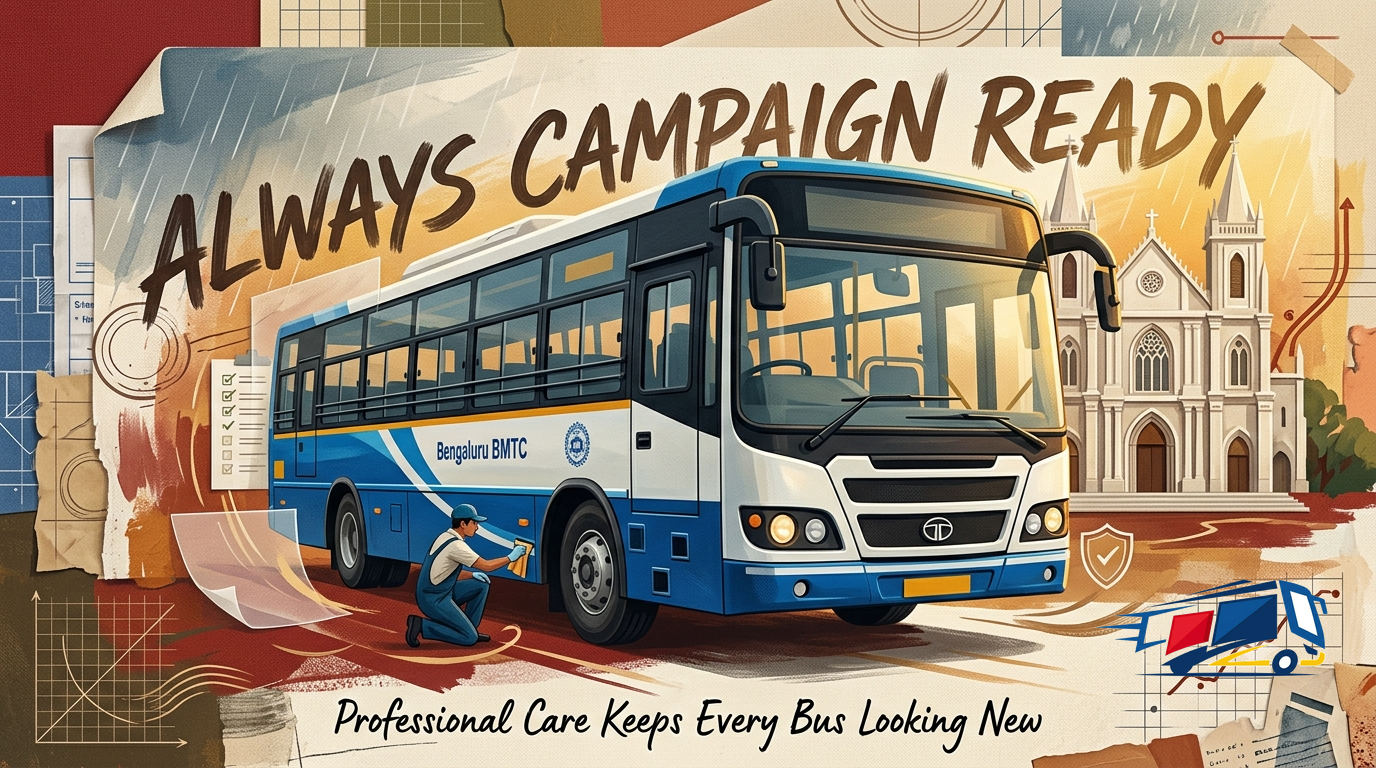
A wrapped bus lives outdoors, in sun, rain and traffic, every single day. The good news for advertisers: keeping it sharp is the agency's job, not yours. This page covers what actually wears a wrap, how it is monitored and touched up, and exactly who is responsible, so a dull or peeling bus never quietly undoes your campaign.
Key takeaways
- UV and heat are the main fade drivers; rain, grime and pollutants dull and stain a neglected wrap.
- Wear starts at the edges, the seams and corners, where a small lift can spread if left alone.
- A lifted edge is fixed by gentle reheating and re-pressing; damaged panels are patched or reprinted.
- Upkeep is the agency's responsibility, not the advertiser's; you do no washing or care.
- Monitoring catches issues early, while they are cheap to fix, so the bus stays on-brand all run.
What actually wears a wrap
A bus wrap faces the same enemies as any outdoor vinyl, just more of them and for longer. Sun and heat fade colour, rain and road grime dull the surface, and acidic contaminants stain it if left to sit. Knowing the causes is how you stay ahead of them.
| Factor | What it does | Guarded by |
|---|---|---|
| UV / sun | Fades colour, dulls finish over time | UV-stable film, upkeep |
| Heat | Softens vinyl, stresses adhesive | Quality install, cure |
| Rain / monsoon | Drives grime into edges if neglected | Cleaning, edge checks |
| Road grime / pollutants | Dulls and can stain the surface | Regular washing |
| Bird droppings, sap | Acidic, can etch the vinyl | Prompt removal |
Why wear starts at the edges
A wrap rarely fails in the middle. It starts at the edges, the seams, corners and curves, where the film is under the most stress and most exposed. A small lift there can catch wind, dirt and moisture and spread if it is not caught early.
This is why a good install matters and why monitoring focuses on edges. A lifted corner spotted early is a five-minute fix; the same lift ignored for weeks can peel a whole panel. Catching it early is the whole game.
Want your brand on Bengaluru's buses?
Get a route plan, format recommendation and pricing, usually within a minute.
How a wrap is touched up
Most upkeep is small and quick. A lifted edge is cleaned and gently reheated so the adhesive grabs again, then pressed back flat. Bubbles are worked out; a torn or faded section is patched or reprinted to match. Nothing dramatic, just done promptly.
- Lifted edge. Clean the spot, warm the vinyl gently, press it back from the bonded side outward.
- Bubble. Release the trapped air and smooth the film flat again.
- Tear or scuff. Cut a matching patch and blend it in, or replace the affected panel.
- Faded section. Reprint the graphic to match and replace just that panel.
Source: standard wrap repair practice, 2026. Edge lifts are reheated and re-pressed; tears and fade are patched or panel-replaced to keep the design consistent.
The principle across all of it: fix small, fix early. A panel swap on one bus is routine; letting damage spread across the fleet is what turns upkeep into a problem, which is exactly what monitoring prevents.
How the campaign is monitored
A wrap is not installed and forgotten. Through the run, the buses are checked so issues are spotted while they are small, and the brand stays looking sharp from the first day to the last.
| Check | Why |
|---|---|
| Edge lift | Catch a small lift before it spreads |
| Fade / dulling | Keep colour true to the brand |
| Grime / stains | Clean before it sets or etches |
| Damage | Patch tears and scuffs early |
A wrap that looks tired stops selling and starts raising doubts. Monitoring exists so your buses never reach that point, the brand stays as sharp on day ninety as on day one.
Who is responsible: not you
Here is the part that should put you at ease. A private wrap owner has to hand-wash, avoid brush car washes and watch the edges themselves. As an advertiser, you do none of that. The bus is operated by BMTC and the branding is maintained by the agency.
Your job:
- Approve the artwork.
- Tell us if you ever spot something.
- That is it.
The agency's job:
- Monitor the buses through the run.
- Touch up edges, bubbles and damage.
- Keep the wrap clean and on-brand.
- Handle removal cleanly at the end.
Source: in most transit-ad arrangements the advertising contractor carries upkeep, cleaning and removal; the advertiser does not maintain the vehicle, 2026.
You brief it, we keep it sharp
Your only job is the artwork. From there, the buses run on BMTC routes and we keep the branding looking the way it did on day one: monitored through the campaign, edges and damage touched up promptly, grime cleaned before it sets, and a clean removal at the end. A wrap that fades or peels works against you, so keeping it sharp is part of the service, not an extra you chase.
See how a campaign is run end to end under bus branding in Bengaluru, or how the wrap is built to last in transit advertising.
Frequently Asked Questions
Do I have to clean or maintain the branded bus?+
No. The bus is operated by BMTC and the branding is maintained by the agency. Your only job is approving the artwork; upkeep, cleaning and touch-ups are handled for you.
What makes a bus wrap fade or wear?+
Mainly UV and heat, which fade colour, plus rain, road grime and pollutants that dull or stain a neglected wrap. Acidic contaminants like bird droppings can etch the vinyl if left.
Where does a wrap usually start to fail?+
At the edges, the seams, corners and curves, where film is most stressed. A small lift there can spread, so monitoring focuses on edges to catch it early.
How are problems fixed during the campaign?+
Small ones quickly: a lifted edge is cleaned, gently reheated and pressed back; bubbles are smoothed; tears or faded sections are patched or reprinted to match.
How do you know if a bus needs attention?+
The buses are monitored through the run for edge lift, fade, grime and damage, so issues are spotted while they are small and the brand stays sharp.
What if I spot a problem myself?+
Just tell us. We will check and fix it. You are never expected to maintain the wrap yourself, only to flag anything you happen to notice.
Bus Branding Glossary
- Full bus branding (wrap)
- A full vehicle wrap covering both sides and the rear of the bus, the highest-impact, most visible format.
- Bus back / rear branding
- Advertising on the rear panel of the bus, in the line of sight of traffic queued behind it at signals and junctions.
- Side panel branding
- Branding on one or both side panels of the bus body, facing pedestrians and parallel traffic along the route.
- Vajra / AC service
- BMTC's premium air-conditioned (Volvo / Vayu Vajra) services, carrying a higher-income commuter set on IT and airport corridors.
- TTMC
- Traffic and Transit Management Centre, a large BMTC bus terminal where many routes start, terminate and interchange.
- Depot
- The BMTC facility where buses are parked, serviced and from which many local routes originate.
- Dwell time
- How long a bus stays in view of a stationary crowd, at a stop, signal or in slow traffic, which lengthens brand exposure.
- Corridor
- A main arterial road (e.g. the Outer Ring Road or Hosur Road) that a bus route runs along, defining who sees the branding.
How to run a BMTC bus branding campaign
Five simple steps from enquiry to a live, tracked campaign on Bengaluru's buses.
- 1
Pick your area & audience
Tell us the Bengaluru area or corridor you want to reach and who you're targeting, IT professionals, shoppers, students or residents.
- 2
Choose a format
Select a format, full bus wrap, rear panel, side panel or premium AC/Vajra service, based on your budget and the impact you want.
- 3
Select routes & bus count
We map the high-frequency routes and stops that cover your audience and recommend how many buses to brand.
- 4
Approve the creative
Share your artwork (or we help design it). We prepare it to BMTC specifications and get the approvals.
- 5
Go live & get proof
We print, wrap and deploy the buses, then share proof of display so you can see your brand on the road.
Bus Branding Formats
Choose how your brand rides, pick the format that fits your goal and budget.
Bus Branding Across Bengaluru
We run BMTC bus branding in every major Bengaluru neighbourhood. Explore more areas:
Outdoor & Transit Advertising Specialists
We plan, design and run BMTC bus branding campaigns across every major Bengaluru corridor, matching brands to the routes, formats and audiences that deliver the most visibility.
Discover More
Brand Awareness vs Response Campaigns on Buses
What bus branding does best: awareness or direct response? A comparison of the two campaign types on buses, why a moving vehicle favours brand-building, and how to blend both.
Geo-Targeting With Bus Routes: Advertising Where Your Customers Are
A bus route is a geo-targeting tool you can drive. How to map your customers to the routes they use, think in catchments instead of points, and stack corridors to cover a neighbourhood or a whole city.
Setting Campaign Objectives Before You Advertise
Why setting one clear objective before you advertise decides everything: awareness vs consideration vs response, how each maps to a different message, format and KPI, and how to write a SMART objective.