Bus Branding vs Digital Ads: How They Work Together
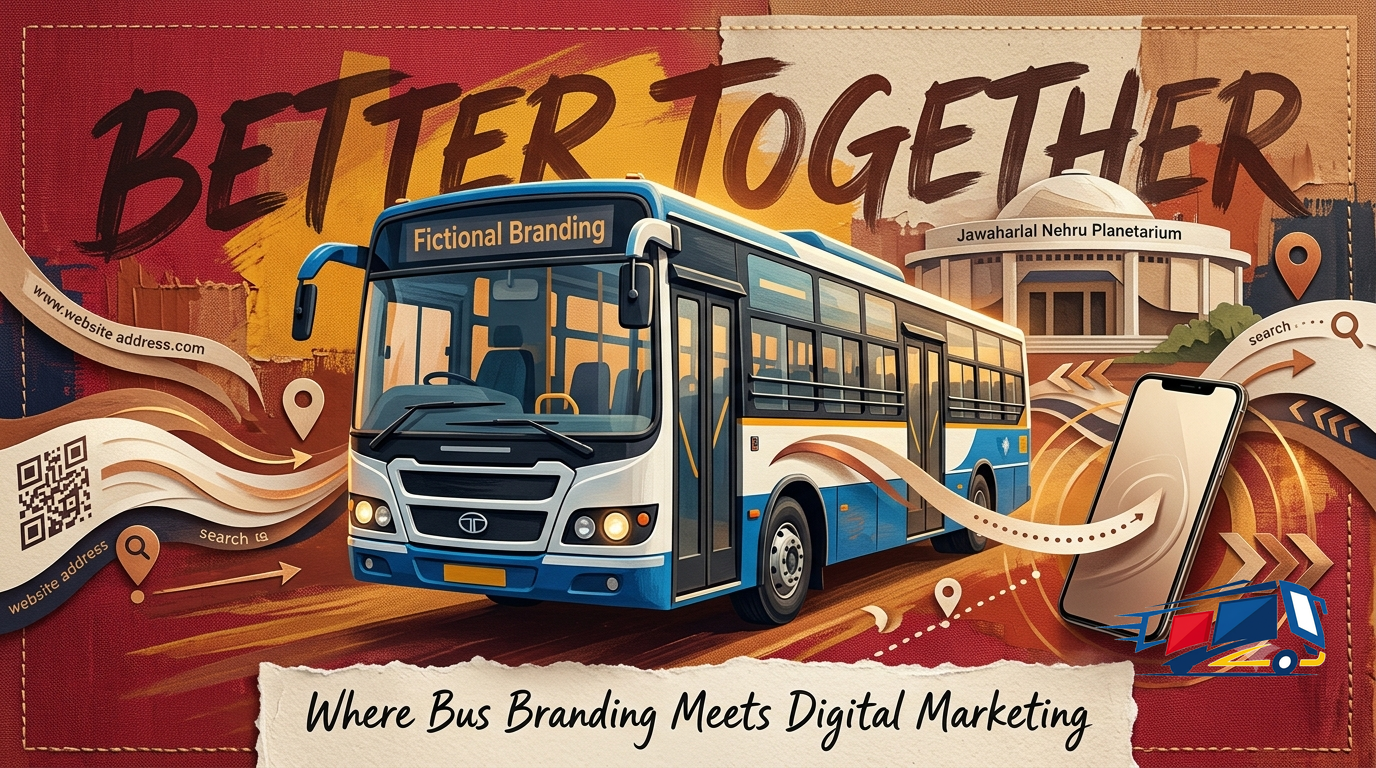
The "vs" is misleading. Bus branding and digital ads are not fighting for the same job; they run a relay. The bus does what digital struggles to: broad, unskippable, trust-building presence. Digital does what a bus cannot: target, retarget and close. The bus prompts the search; the phone finishes the sale. For a digital-first marketer, the bus is the part of the funnel your ads cannot reach.
Key takeaways
- Different jobs: bus branding builds broad, trusted awareness; digital targets and converts. They cover different funnel stages.
- OOH drives online action: roughly 46% search and about 48% visit a brand site after seeing an outdoor ad.
- OOH lifts digital: search campaigns see a 20 to 40% lift, and retargeting and paid social perform better through familiarity.
- QR and vanity URLs bridge the two: codes on OOH get 2 to 4 times the response of print codes.
- Run them as one campaign: same message, same geography, the bus for reach, digital to capture the response.
They do different jobs
Comparing them head to head misses the point, because they are good at opposite things. A bus reaches everyone in a city broadly and earns trust through sheer presence; digital reaches a defined audience precisely and drives the click. One opens the door, the other walks people through it.
Bus branding is strong at:
- Broad, citywide reach.
- Unskippable, ad-blocker proof presence.
- Trust and legitimacy from scale.
- Top of the funnel: awareness and recall.
Digital ads are strong at:
- Precise audience targeting.
- Retargeting people who showed interest.
- Click-level measurement.
- Bottom of the funnel: conversion.
Source: OOH is valued for broad reach, unskippable presence and trust; digital for targeting and measurable conversion, 2026. The two map to different funnel stages.
The offline-to-online journey
Here is the link a digital marketer cares about. People who see a bus do not act on the bus, they act on their phone. The outdoor impression is the trigger; the online behaviour is the proof. That is why OOH shows up as a lift in search and site visits, not as a click.
Source: roughly 46% of adults search online after an outdoor or transit ad (Nielsen/OAAA); about 48% visit a brand's website after OOH (Google), 2024 to 2026.
So when a digital marketer says "I only trust trackable media", the honest answer is that a bus is trackable, just one step removed. It shows up as more people searching your name and landing on your site, exactly the signals your dashboards already watch.
Want your brand on Bengaluru's buses?
Get a route plan, format recommendation and pricing, usually within a minute.
The bridges between bus and phone
You do not have to leave the handoff to chance. A few simple devices on the bus turn the offline glance into a trackable online action, and tie the two media into one measurable loop.
| Bridge | What it does | Why it helps |
|---|---|---|
| QR code | Scan to your page | 2 to 4x print response on OOH |
| Vanity URL | A short, memorable link | Counts campaign visits |
| "Search [brand]" | Prompts a branded search | Feeds your search lift |
| Social handle / hashtag | Sends to your social | Drives mentions and follows |
| Geo-retargeting | Ads to those near the routes | Re-touches exposed people |
How a bus makes your digital work harder
The most useful finding for a performance marketer: OOH does not just run alongside digital, it lifts it. People who have seen your brand on the street respond better to your ads online, because the name is already familiar and trusted.
The mechanism is simple: familiarity. A retargeting ad to someone who already saw your bus is not a cold approach, it is a reminder. That is why combined campaigns tend to beat the sum of their parts, the bus warms the audience and the digital ad converts the warmed audience.
Source: search campaigns see a 20 to 40% lift when supported by OOH; OOH improves paid social and retargeting performance through a familiarity effect, 2026. Figures are industry benchmarks, results vary.
Digital is brilliant at catching demand. Bus branding is brilliant at creating it. Run them apart and you are either capturing demand you did not build, or building demand you do not capture.
Running them together
The combined play is straightforward. Use the bus for broad reach in your target area, mirror it with digital in the same geography and message, and connect them with a bridge so the whole loop is measurable.
- One message, both media. Same line and look on the bus and in the feed, so each reinforces the other.
- Match the geography. Run digital where the buses run, so exposure and retargeting overlap.
- Add a bridge. A QR, a vanity URL or a "search us" prompt on the bus to pull people online.
- Retarget the exposed. Serve digital ads to people near the routes to re-touch a warmed audience.
- Measure the loop. Watch branded search, site visits and bridge clicks rise together during the run.
We will make the bus feed your digital funnel
If digital is your engine, think of bus branding as the fuel that warms the audience before they hit your ads. We will run the buses in your target area, build in the bridges (QR, a vanity URL, a search prompt) and align the creative with your digital so the two pull together. You keep measuring the way you already do, branded search, site visits, retargeting performance, and you will see the bus show up in those numbers.
Plan the integrated play under bus branding in Bengaluru, or see the wider approach in transit advertising.
Frequently Asked Questions
Is bus branding better than digital ads?+
Neither is better; they do different jobs. The bus builds broad, trusted awareness at the top of the funnel; digital targets and converts at the bottom. They work best together, not as alternatives.
How does a bus help my digital campaign?+
By warming the audience. People who saw your brand on a bus respond better to your ads, search campaigns see a 20 to 40% lift with OOH support, and retargeting and paid social gain from the familiarity.
Can I track what the bus does?+
Indirectly, yes. Roughly 46% search and 48% visit a brand site after an outdoor ad, so the bus shows up as a rise in branded search and site traffic, plus any QR scans and vanity-URL visits.
What is the best way to connect them?+
A bridge on the bus: a QR code (2 to 4x print response), a short vanity URL, a "search us" prompt, or a social handle, then geo-retarget people near the routes.
Should the creative be the same?+
Yes. Use one message and look across the bus and your digital so each reinforces the other. Consistency is what makes the audience connect the feed ad to the bus they saw.
I am a digital-first marketer. Why add a bus?+
Because digital captures demand but rarely creates it at scale. A bus builds the awareness and trust that make your targeting and retargeting work harder, and it cannot be skipped or blocked.
Bus Branding Glossary
- Full bus branding (wrap)
- A full vehicle wrap covering both sides and the rear of the bus, the highest-impact, most visible format.
- Bus back / rear branding
- Advertising on the rear panel of the bus, in the line of sight of traffic queued behind it at signals and junctions.
- Side panel branding
- Branding on one or both side panels of the bus body, facing pedestrians and parallel traffic along the route.
- Vajra / AC service
- BMTC's premium air-conditioned (Volvo / Vayu Vajra) services, carrying a higher-income commuter set on IT and airport corridors.
- TTMC
- Traffic and Transit Management Centre, a large BMTC bus terminal where many routes start, terminate and interchange.
- Depot
- The BMTC facility where buses are parked, serviced and from which many local routes originate.
- Dwell time
- How long a bus stays in view of a stationary crowd, at a stop, signal or in slow traffic, which lengthens brand exposure.
- Corridor
- A main arterial road (e.g. the Outer Ring Road or Hosur Road) that a bus route runs along, defining who sees the branding.
How to run a BMTC bus branding campaign
Five simple steps from enquiry to a live, tracked campaign on Bengaluru's buses.
- 1
Pick your area & audience
Tell us the Bengaluru area or corridor you want to reach and who you're targeting, IT professionals, shoppers, students or residents.
- 2
Choose a format
Select a format, full bus wrap, rear panel, side panel or premium AC/Vajra service, based on your budget and the impact you want.
- 3
Select routes & bus count
We map the high-frequency routes and stops that cover your audience and recommend how many buses to brand.
- 4
Approve the creative
Share your artwork (or we help design it). We prepare it to BMTC specifications and get the approvals.
- 5
Go live & get proof
We print, wrap and deploy the buses, then share proof of display so you can see your brand on the road.
Bus Branding Formats
Choose how your brand rides, pick the format that fits your goal and budget.
Bus Branding Across Bengaluru
We run BMTC bus branding in every major Bengaluru neighbourhood. Explore more areas:
Outdoor & Transit Advertising Specialists
We plan, design and run BMTC bus branding campaigns across every major Bengaluru corridor, matching brands to the routes, formats and audiences that deliver the most visibility.
Discover More
Brand Awareness vs Response Campaigns on Buses
What bus branding does best: awareness or direct response? A comparison of the two campaign types on buses, why a moving vehicle favours brand-building, and how to blend both.
Geo-Targeting With Bus Routes: Advertising Where Your Customers Are
A bus route is a geo-targeting tool you can drive. How to map your customers to the routes they use, think in catchments instead of points, and stack corridors to cover a neighbourhood or a whole city.
Setting Campaign Objectives Before You Advertise
Why setting one clear objective before you advertise decides everything: awareness vs consideration vs response, how each maps to a different message, format and KPI, and how to write a SMART objective.