Bus Branding vs Hoardings: A Budget Comparison
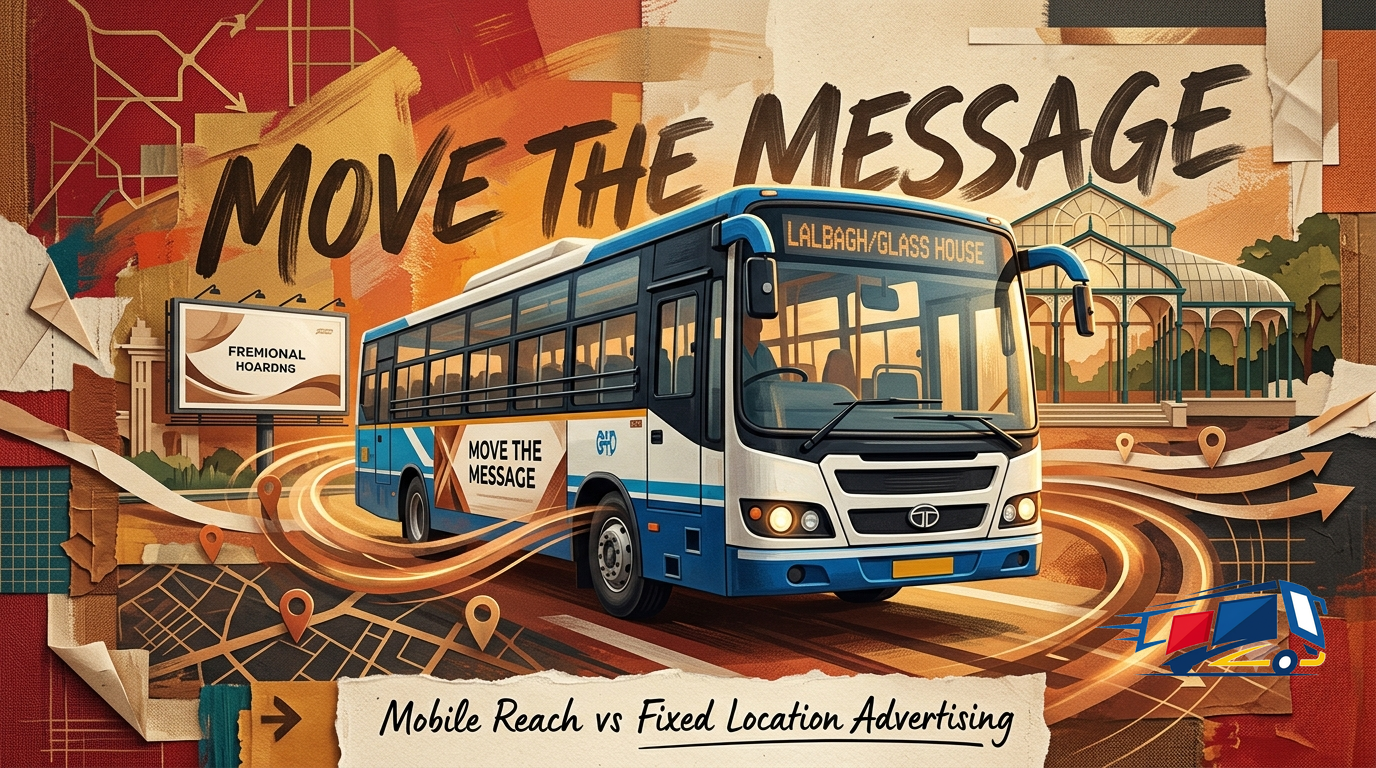
A hoarding waits in one place for the audience to pass it. A branded bus goes to the audience, through dozens of areas, all day. That difference shapes the budget: bus branding tends to spread a rupee across more places and more eyes, while a hoarding concentrates it on one spot. In Bengaluru, there is a regulatory twist too. Here is the head-to-head.
Key takeaways
- Mobility is the core difference: a bus passes many areas a day; a hoarding reaches only those who pass its one location.
- Cost per exposure favours buses: transit advertising typically carries a lower CPM than a fixed billboard.
- Bengaluru regulates hoardings tightly: banned 2018 to 2025, now legal only via auction with strict size and spacing limits.
- Buses scale with budget: start with a few and add more; a hoarding is one fixed site on a fixed lease.
- It is not either/or: hoardings own a landmark spot, buses own movement; the budget question is which your goal needs.
Cost per exposure, not just cost
A headline price means little without the eyes it buys. The fair comparison is cost per thousand views, the CPM. Transit advertising generally lands at a lower CPM than a fixed billboard, because a moving bus keeps gathering new views across the day rather than waiting at one junction.
| What you pay for | Bus branding | Hoarding |
|---|---|---|
| Pricing basis | Per bus, per duration | Per site, per month |
| Cost per thousand views | Typically lower | Typically higher |
| Views source | Moves to new audiences | Waits for passers-by |
Coverage and mobility
This is where the two media split most clearly. A hoarding is one location, period. A bus threads many corridors and neighbourhoods on every shift, so a single bus delivers a kind of coverage a single hoarding structurally cannot.
If your customers all funnel through one famous junction, a hoarding there is hard to beat for that spot. But if they are spread across a part of the city, a hoarding only catches the few who pass it, while buses carry your brand into all the areas they actually live, work and shop in. For most brands, that spread is where the budget works harder.
Want your brand on Bengaluru's buses?
Get a route plan, format recommendation and pricing, usually within a minute.
The Bengaluru regulation factor
Bengaluru is a special case, and it matters to the budget. The city effectively banned commercial hoardings from 2018 after thousands of illegal ones and safety concerns. That ban was lifted only in 2025, and hoardings are now allowed but tightly regulated.
| Rule | What it means for you |
|---|---|
| Auction only | Rights granted via BBMP auction / tender |
| Licensed agency | Must work through a registered agency |
| Location limits | Only on wider roads / designated zones |
| Spacing limit | No two hoardings within 175m |
| Size caps | Size limited by road width |
| Land consent | Written consent of the land owner |
Flexibility and commitment
Budgets like options. Bus branding scales: start with a few buses on one corridor and add more, change routes, mix formats. A hoarding is a single fixed site, usually on a longer lease, with little to adjust once it is up.
Bus branding:
- Scale from a few buses to many.
- Choose and change routes.
- Mix formats and bus types.
- Move to another bus if one is off-road.
Hoarding:
- One fixed location.
- Audience must pass that spot.
- Longer fixed commitment.
- Strong for owning a landmark junction.
Neither is simply better. A hoarding is a fixed asset that owns a place; bus branding is a flexible buy that owns movement. The budget question is which behaviour your campaign needs.
Head to head
The full comparison in one view. Read it by your goal, not as a scoreboard, each medium wins a different column.
| Factor | Bus branding | Hoarding |
|---|---|---|
| Reach pattern | Mobile, many areas | Fixed, one spot |
| Cost per view | Typically lower | Typically higher |
| Best at | Spread and frequency | Owning a landmark |
| Scalability | High | Low, site by site |
| Bengaluru availability | Stable channel | Regulated, auction-gated |
| Commitment | Flexible | Fixed lease |
A hoarding asks the city to come to your message. A bus takes your message to the city. On a fixed budget, the one that moves usually shows up in more places, in front of more people.
Which should win your budget
Decide by goal and geography. If your audience is spread across the city or a few corridors, buses spread the spend efficiently. If everything funnels through one iconic spot, a hoarding there can earn its keep, where the rules allow it.
- Map your audience. Spread across areas points to buses; one funnel point points to a hoarding.
- Compare on CPM. Cost per thousand views, not the sticker price, is the fair test.
- Check Bengaluru availability. A compliant hoarding site may not be available where you want it.
- Weigh flexibility. If you want to adjust routes or scale, buses give you room.
- Consider both. A landmark hoarding plus buses for spread can be the strongest mix.
Make your outdoor budget go further
If you are weighing a hoarding against bus branding, we will give you the honest comparison for your goal: where buses spread your spend more efficiently, where a fixed site still makes sense, and what Bengaluru's current rules allow. Often the right answer is buses for reach and frequency, with a landmark site only where it truly owns your audience. Tell us your area, goal and budget, and we will show you where the rupee works hardest.
Plan the efficient option under bus branding in Bengaluru, or see the full approach in transit advertising.
Frequently Asked Questions
Is bus branding cheaper than a hoarding?+
On cost per thousand views, transit advertising usually comes in lower than a fixed billboard, because a bus keeps reaching new audiences as it moves. The sticker prices differ in basis, so compare on CPM, not headline cost.
What is the main difference for my budget?+
Mobility. A hoarding reaches only people who pass its one spot; a bus carries your brand through many areas a day, so the same spend touches far more ground.
Can I even put up a hoarding in Bengaluru?+
Only under the current rules. Commercial hoardings were banned from 2018 and allowed again from 2025, now via BBMP auction with strict size, spacing (175m apart) and location limits. Availability is limited and the rules are still contested.
Which reaches more people for the money?+
For an audience spread across the city, buses, because they move through many corridors. For an audience that all passes one famous junction, a hoarding there can be very efficient for that spot.
Is bus branding more flexible?+
Yes. You can scale buses, change routes and mix formats, and a downed bus is swapped for another. A hoarding is one fixed site on a longer lease with little to adjust.
Should I use both?+
Often the strongest plan is buses for spread and frequency plus a single landmark hoarding where it genuinely owns your audience, budget and Bengaluru rules permitting.
Bus Branding Glossary
- Full bus branding (wrap)
- A full vehicle wrap covering both sides and the rear of the bus, the highest-impact, most visible format.
- Bus back / rear branding
- Advertising on the rear panel of the bus, in the line of sight of traffic queued behind it at signals and junctions.
- Side panel branding
- Branding on one or both side panels of the bus body, facing pedestrians and parallel traffic along the route.
- Vajra / AC service
- BMTC's premium air-conditioned (Volvo / Vayu Vajra) services, carrying a higher-income commuter set on IT and airport corridors.
- TTMC
- Traffic and Transit Management Centre, a large BMTC bus terminal where many routes start, terminate and interchange.
- Depot
- The BMTC facility where buses are parked, serviced and from which many local routes originate.
- Dwell time
- How long a bus stays in view of a stationary crowd, at a stop, signal or in slow traffic, which lengthens brand exposure.
- Corridor
- A main arterial road (e.g. the Outer Ring Road or Hosur Road) that a bus route runs along, defining who sees the branding.
How to run a BMTC bus branding campaign
Five simple steps from enquiry to a live, tracked campaign on Bengaluru's buses.
- 1
Pick your area & audience
Tell us the Bengaluru area or corridor you want to reach and who you're targeting, IT professionals, shoppers, students or residents.
- 2
Choose a format
Select a format, full bus wrap, rear panel, side panel or premium AC/Vajra service, based on your budget and the impact you want.
- 3
Select routes & bus count
We map the high-frequency routes and stops that cover your audience and recommend how many buses to brand.
- 4
Approve the creative
Share your artwork (or we help design it). We prepare it to BMTC specifications and get the approvals.
- 5
Go live & get proof
We print, wrap and deploy the buses, then share proof of display so you can see your brand on the road.
Bus Branding Formats
Choose how your brand rides, pick the format that fits your goal and budget.
Bus Branding Across Bengaluru
We run BMTC bus branding in every major Bengaluru neighbourhood. Explore more areas:
Outdoor & Transit Advertising Specialists
We plan, design and run BMTC bus branding campaigns across every major Bengaluru corridor, matching brands to the routes, formats and audiences that deliver the most visibility.
Discover More
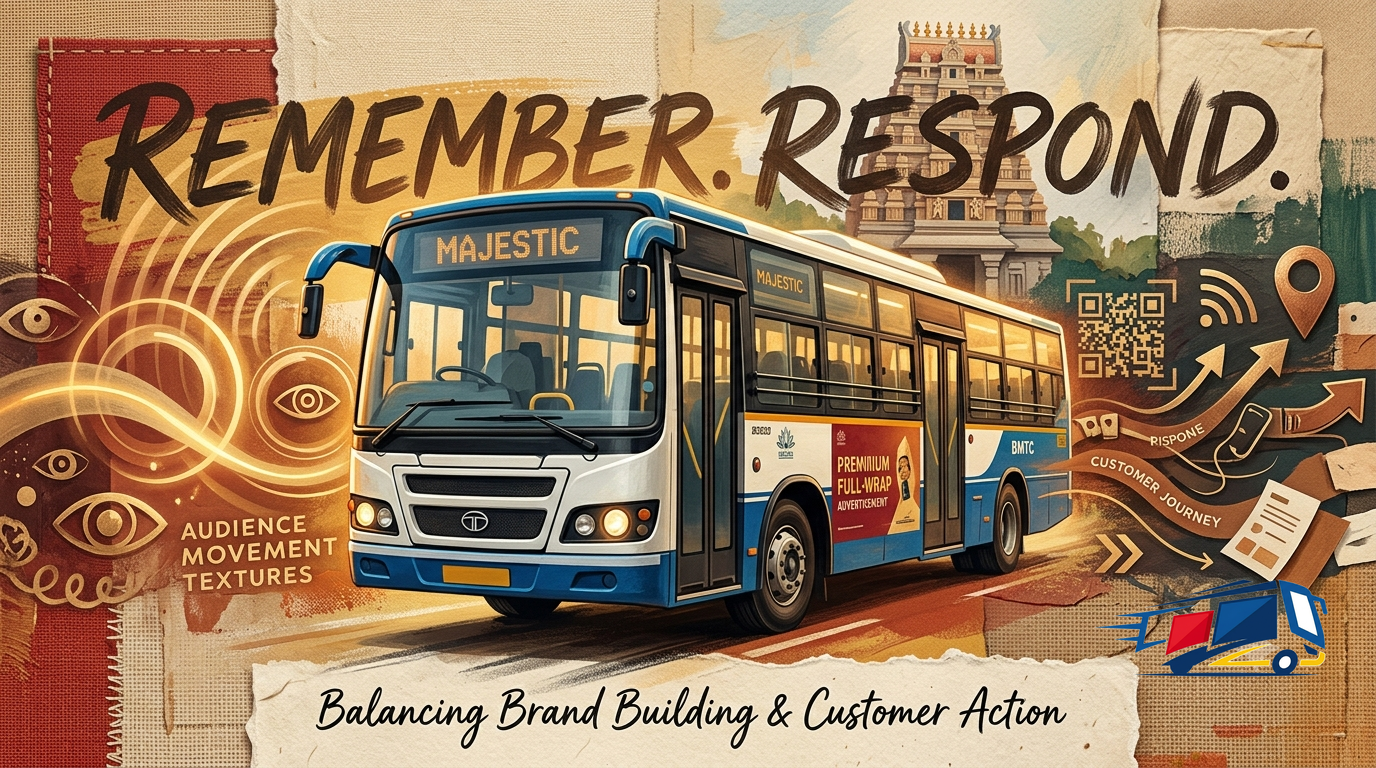
Brand Awareness vs Response Campaigns on Buses
What bus branding does best: awareness or direct response? A comparison of the two campaign types on buses, why a moving vehicle favours brand-building, and how to blend both.
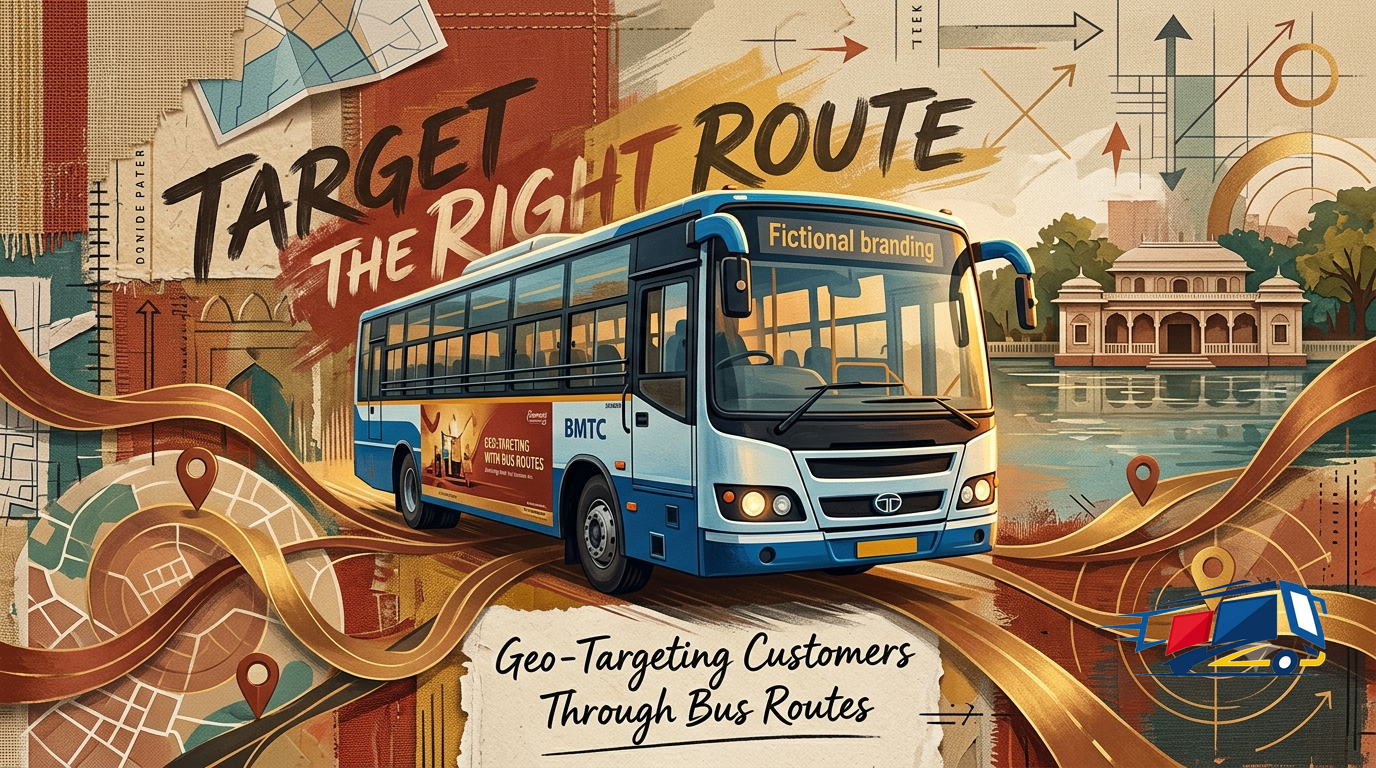
Geo-Targeting With Bus Routes: Advertising Where Your Customers Are
A bus route is a geo-targeting tool you can drive. How to map your customers to the routes they use, think in catchments instead of points, and stack corridors to cover a neighbourhood or a whole city.
Setting Campaign Objectives Before You Advertise
Why setting one clear objective before you advertise decides everything: awareness vs consideration vs response, how each maps to a different message, format and KPI, and how to write a SMART objective.