The Busiest BMTC Routes in Bengaluru & Why Advertisers Want Them
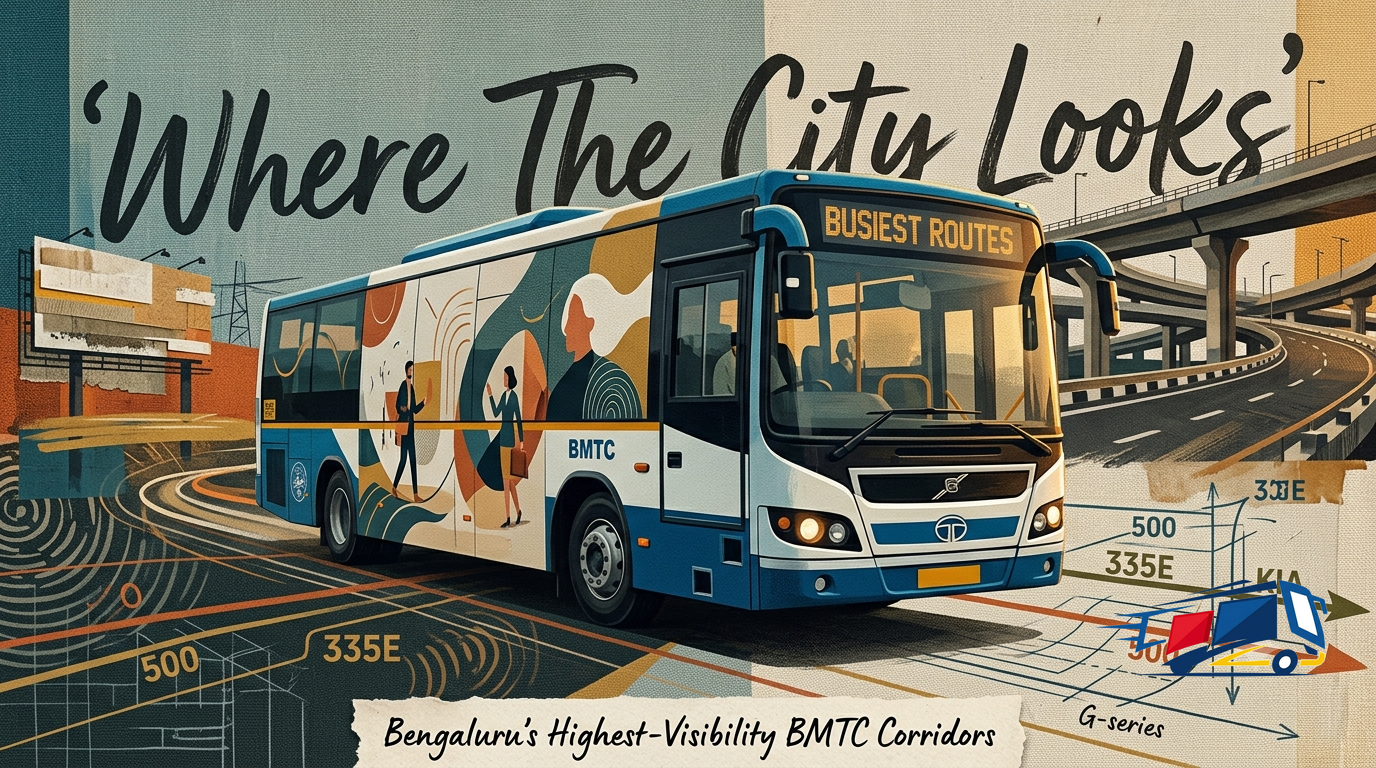
Not every BMTC route carries the same weight. A handful of corridors, the 500 series along the Outer Ring Road, 335E to Whitefield, and the Big 10 arterials, carry the bulk of the city's daily riders. For an advertiser, those are the routes where a single branded bus collects the most eyes per kilometre.
Key takeaways
- The 500 series on the Outer Ring Road is the city's highest-demand bus corridor.
- 335E (Majestic to ITPL Whitefield) and 365 (Majestic to Bannerghatta) are flagship trunk routes.
- The Big 10 G-series runs 12 major arterials at roughly 10-minute frequency.
- Vayu Vajra KIA routes carry a high-value airport audience, some every 10 to 20 minutes.
- Route choice, not just bus count, decides how many eyes a campaign reaches.
What makes a BMTC route busy?
Three things stack up: high frequency, a corridor full of workplaces or homes, and a long run through dense parts of the city. The busiest routes have all three.
| Factor | What it means | Ad value |
|---|---|---|
| Frequency | Buses every few minutes | Design repeats all day |
| Corridor | Tech parks, markets, homes | Right audience density |
| Length | Long run, many stops | More streets covered |
| Congestion | Slow, crowded roads | Longer dwell, more views |
The last point is counterintuitive. A bus crawling through Silk Board traffic is bad for the commuter but good for the brand on its side, because the panel sits in view of the same jam for longer.
The busiest BMTC routes and corridors
These are the high-frequency, high-demand routes that advertisers ask for by name, anchored on the ORR, the tech belts and the city's main arterials.
| Route / family | Corridor | Connects | Why advertisers want it |
|---|---|---|---|
| 500 series | Outer Ring Road | KR Puram, Marathahalli, Silk Board | Highest demand |
| 335E | Majestic to ITPL | KR Puram, Whitefield | East tech belt |
| 365 | Majestic to Bannerghatta | South Bengaluru | Dense residential |
| Big 10 (G-series) | 12 arterials | City centre to edges | ~10-min frequency |
| Vayu Vajra (KIA) | Airport routes | City to KIA | High-value travellers |
Want your brand on Bengaluru's buses?
Get a route plan, format recommendation and pricing, usually within a minute.
The areas these routes connect
The busiest routes are busy because of where they go: the IT corridors, the central business district and the high-density southern suburbs.
| Corridor | Key areas | Audience profile |
|---|---|---|
| Outer Ring Road | Marathahalli, Bellandur, Silk Board | Tech workforce |
| Whitefield | ITPL, Kadugodi, KR Puram | IT, residential |
| Hosur Road | Electronic City, Bommanahalli | IT, industry |
| Bannerghatta Road | BTM, Jayadeva, Arekere | Residential, hospitals |
| MG Road / CBD | Brigade Road, Shivajinagar | Retail, offices |
The commuter scale behind them
BMTC moves around 45 lakh riders a day across the network, and the busiest corridors take a disproportionate share of that load.
Source: BMTC ridership and fleet data, 2025. Corridor demand is indicative, not a published per-route ranking.
How route choice drives reach
The same branded bus delivers wildly different reach depending on its route. Choosing a busy corridor can multiply impressions without adding a single extra bus.
| If the bus runs on... | Frequency | Audience | Relative reach |
|---|---|---|---|
| A quiet feeder route | Low | Thin | Low |
| A mid-tier city route | Medium | Mixed | Medium |
| An ORR or Big 10 corridor | High | Dense | High |
Two buses can cost the same to wrap and reach completely different cities. The route is the media plan, the bus is just the canvas.
How we pick routes for a campaign:
- Start from the audience: where do your customers live, work and travel?
- Match them to corridors: ORR for tech, Bannerghatta for south, CBD for retail.
- Prioritise high-frequency routes so the design repeats through the day.
- Add congestion-heavy stretches where dwell time lifts views.
- Spread across a few routes rather than over-concentrating on one.
Turning the busiest routes into your reach
The shortlist of high-demand corridors is the foundation of any serious bus campaign in Bengaluru. Get the routes right and the reach follows.
The route list is the real media buy
Wrapping a bus is easy. Putting it on the right corridor is the skill. A design on the 500 series or a Big 10 arterial works the densest commuter streams in the city, while the same wrap on a quiet route barely registers. We plan campaigns around the corridors that actually carry your audience.
See how we build a route plan in bus branding in Bengaluru, or compare formats and corridors in transit advertising.
Frequently Asked Questions
What is the busiest BMTC route in Bengaluru?+
The 500 series along the Outer Ring Road is widely regarded as the highest-demand corridor, with variants like 500A, 500C and 500D covering the KR Puram to Silk Board stretch.
Which BMTC routes go to Whitefield?+
Route 335E (Majestic to ITPL) is the flagship, alongside 500-series variants such as 500CA and several KIA airport routes that pass through Whitefield.
What are Big 10 buses?+
The Big 10 is a set of 12 arterial corridors with a G-prefix, designed to run buses at roughly 10-minute frequency along major roads like Hosur Road, Bannerghatta Road and Old Madras Road.
Why do advertisers prefer busy routes?+
High-frequency routes mean the same branded design is seen repeatedly through the day, and busy corridors put it in front of the densest commuter crowds, so reach rises without extra buses.
How many people does BMTC carry daily?+
About 45 lakh riders a day across the network, with the busiest corridors carrying a disproportionate share of that load.
Should a campaign use one route or several?+
Usually several. Spreading a wrap across a few high-demand corridors balances reach and frequency better than concentrating every bus on a single route.
Bus Branding Glossary
- Full bus branding (wrap)
- A full vehicle wrap covering both sides and the rear of the bus, the highest-impact, most visible format.
- Bus back / rear branding
- Advertising on the rear panel of the bus, in the line of sight of traffic queued behind it at signals and junctions.
- Side panel branding
- Branding on one or both side panels of the bus body, facing pedestrians and parallel traffic along the route.
- Vajra / AC service
- BMTC's premium air-conditioned (Volvo / Vayu Vajra) services, carrying a higher-income commuter set on IT and airport corridors.
- TTMC
- Traffic and Transit Management Centre, a large BMTC bus terminal where many routes start, terminate and interchange.
- Depot
- The BMTC facility where buses are parked, serviced and from which many local routes originate.
- Dwell time
- How long a bus stays in view of a stationary crowd, at a stop, signal or in slow traffic, which lengthens brand exposure.
- Corridor
- A main arterial road (e.g. the Outer Ring Road or Hosur Road) that a bus route runs along, defining who sees the branding.
How to run a BMTC bus branding campaign
Five simple steps from enquiry to a live, tracked campaign on Bengaluru's buses.
- 1
Pick your area & audience
Tell us the Bengaluru area or corridor you want to reach and who you're targeting, IT professionals, shoppers, students or residents.
- 2
Choose a format
Select a format, full bus wrap, rear panel, side panel or premium AC/Vajra service, based on your budget and the impact you want.
- 3
Select routes & bus count
We map the high-frequency routes and stops that cover your audience and recommend how many buses to brand.
- 4
Approve the creative
Share your artwork (or we help design it). We prepare it to BMTC specifications and get the approvals.
- 5
Go live & get proof
We print, wrap and deploy the buses, then share proof of display so you can see your brand on the road.
Bus Branding Formats
Choose how your brand rides, pick the format that fits your goal and budget.
Bus Branding Across Bengaluru
We run BMTC bus branding in every major Bengaluru neighbourhood. Explore more areas:
Outdoor & Transit Advertising Specialists
We plan, design and run BMTC bus branding campaigns across every major Bengaluru corridor, matching brands to the routes, formats and audiences that deliver the most visibility.
Discover More
Brand Awareness vs Response Campaigns on Buses
What bus branding does best: awareness or direct response? A comparison of the two campaign types on buses, why a moving vehicle favours brand-building, and how to blend both.
Geo-Targeting With Bus Routes: Advertising Where Your Customers Are
A bus route is a geo-targeting tool you can drive. How to map your customers to the routes they use, think in catchments instead of points, and stack corridors to cover a neighbourhood or a whole city.
Setting Campaign Objectives Before You Advertise
Why setting one clear objective before you advertise decides everything: awareness vs consideration vs response, how each maps to a different message, format and KPI, and how to write a SMART objective.