
Hebbal & the Airport Feeder Corridor
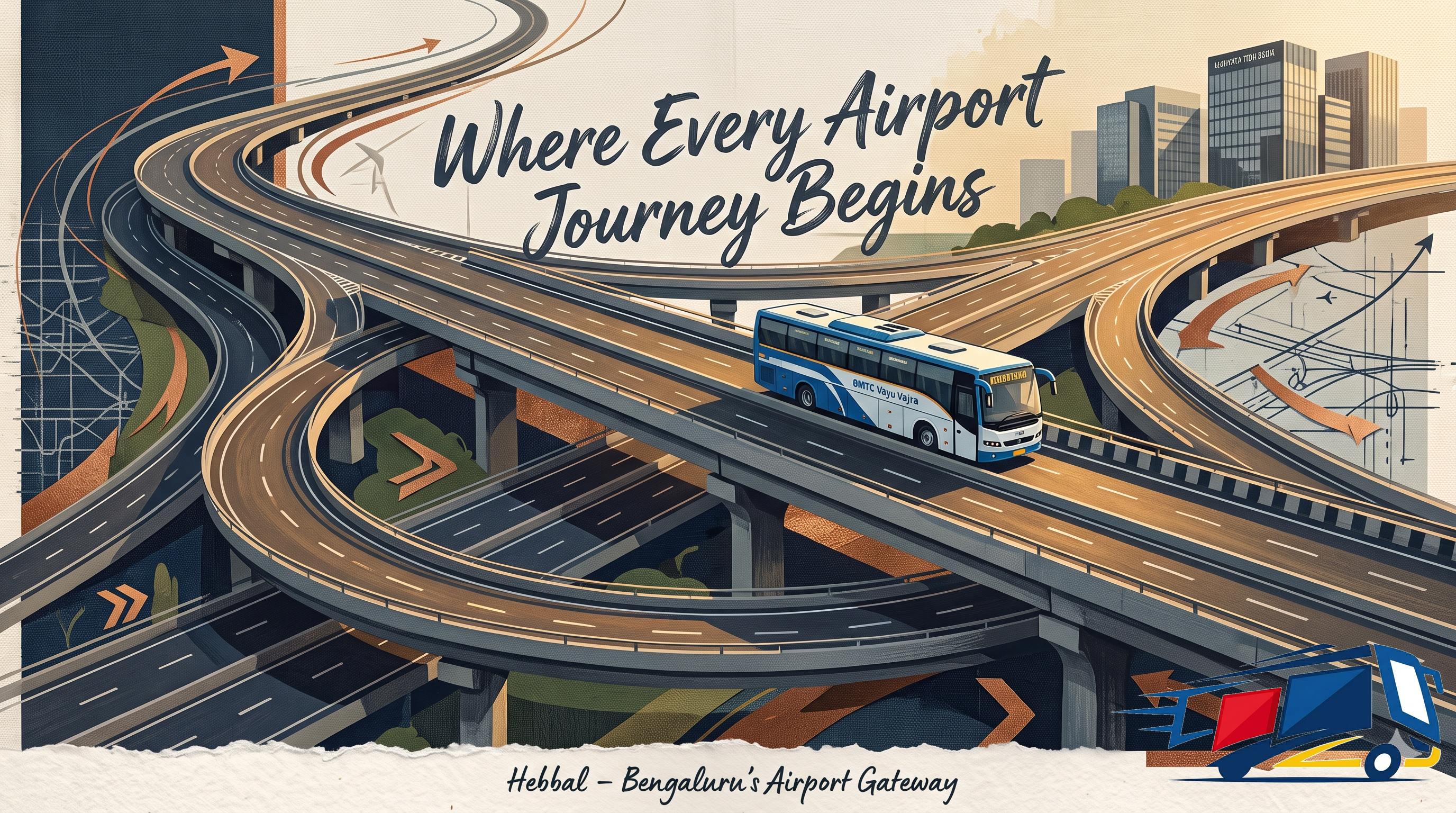
Almost everything bound for the airport from the city passes through one point. Hebbal is the funnel on Bellary Road (NH44), the junction where ORR, Tumkur Road and the north all merge before the run to Kempegowda Airport, about 28 to 30 km on. Flyers and north-side commuters share the same crowded road.
Key takeaways
- Hebbal is the funnel point on the city's main airport route, Bellary Road (NH44).
- Almost all Vayu Vajra airport buses heading north pass through the corridor.
- The airport is about 28 to 30 km on, so this is a feeder stretch, not the destination.
- The crowd is a mix: airport flyers plus dense north-side tech and residential commuters.
- Heavy, slow-moving traffic means long dwell time in front of roadside and on-bus media.
The corridor everything funnels through
Hebbal is not a destination so much as a gateway. It is the mega-junction where traffic from the Outer Ring Road, Tumkur Road and the northern suburbs converges onto Bellary Road for the run to the airport.
| Feeds in from | Carrying |
|---|---|
| Outer Ring Road | City-centre and tech traffic |
| Tumkur Road (NH48) | Industrial and northern traffic |
| Nagavara / KR Puram | Tech parks and residential |
| Bellary Road (NH44) | The airport stream itself |
Because so many streams meet here before narrowing onto one road north, Hebbal concentrates an enormous, varied flow into a single corridor. That concentration is what makes it interesting to a brand.
How the airport feeder works
From Hebbal, Bellary Road runs roughly 28 to 30 km north to Kempegowda Airport. Nearly every airport bus, cab and private car from the city threads this stretch, making it the spine of airport access.
| Measure | Detail |
|---|---|
| Road | Bellary Road (NH44) |
| Distance to KIA | ~28 to 30 km |
| Off-peak time | ~45 to 60 min |
| Peak time | up to ~90 to 120 min |
| Bus service | Vayu Vajra (KIA series) |
Want your brand on Bengaluru's buses?
Get a route plan, format recommendation and pricing, usually within a minute.
Routes on the corridor
The corridor carries the airport Vayu Vajra fleet alongside a thick layer of north-side city routes, so it is busy with both flyers and daily commuters.
| Route | Type | Note |
|---|---|---|
| KIA-8 / 8H / 9H | Airport (Vayu Vajra) | KIA-9H from Hebbal Bridge |
| KIA-4 / 4A / 14 | Airport (Vayu Vajra) | Via the corridor |
| 500 series | City (ORR) | ORR into Hebbal |
| 280 / 281 / 282 | City | North-side routes |
| 290 / 501 series | City and corridor | Nagavara, Yelahanka side |
That an airport route like KIA-9H starts right at Hebbal Bridge shows the corridor's role: it is both a through-route for flyers and a boarding point for the north's own airport traffic.
The flyer and commuter mix
The corridor's audience is two crowds in one: travellers heading to or from the airport, and the dense daily commuters of north Bengaluru's tech and residential belt.
| Group | Who they are |
|---|---|
| Airport flyers | Business and leisure travellers |
| North tech commuters | Manyata and ORR professionals |
| Residents | Hebbal, Yelahanka, Hennur belt |
| Hospitality and staff | Hotels and offices along NH44 |
| Through traffic | ORR and Tumkur Road movers |
It is a rare blend. A single corridor reaches both the high-value airport flyer and the high-volume daily north-side commuter, which lets a brand speak to two audiences from one stretch of road.
Why this corridor suits advertisers
Hebbal stacks scale, dwell time and a mixed audience. Heavy traffic on a corridor everyone uses means a message here is seen for longer, by more kinds of people, than almost anywhere north.
A bus on the airport corridor does not pass a brand once. In Hebbal traffic, it sits with the same flyers and commuters for the length of the jam.
The brands that fit
Brands that want both an affluent flyer and a broad north-side commuter gain most here, reaching travel-minded and everyday audiences along the same stretch.
Own the road to the airport
Everything heading to Bengaluru's airport from the city funnels through Hebbal and up Bellary Road. A presence on the corridor reaches the affluent flyer and the dense north-side commuter at once, and the corridor's notorious traffic means long, repeated exposure rather than a passing glance. For travel, real estate, fintech and device brands chasing both audiences, owning this stretch is the northern play.
See how we plan corridor campaigns in bus branding in Bengaluru, or scope an airport-route buy with transit advertising.
Frequently Asked Questions
What is the Hebbal airport feeder corridor?+
It is the stretch of Bellary Road (NH44) from Hebbal junction north to Kempegowda Airport, the main route carrying the city's airport traffic and buses.
How far is the airport from Hebbal?+
About 28 to 30 km, roughly 45 to 60 minutes off-peak and up to 90 to 120 minutes in heavy traffic on NH44.
Which airport buses use the Hebbal corridor?+
The Vayu Vajra KIA fleet, including KIA-8, KIA-8H and KIA-9H (which originates near Hebbal Bridge), plus several other KIA routes heading north.
Why is Hebbal important for the airport?+
It is the funnel point where ORR, Tumkur Road and northern traffic merge onto the airport road, so almost everything bound for KIA from the city passes through.
Why is this corridor good for advertisers?+
It reaches an affluent flyer and a dense commuter at once, and its heavy traffic means long dwell time, so a message is seen for longer by a wide audience.
Which brands should advertise here?+
Travel and hospitality, real estate, fintech, devices, telecom and FMCG brands targeting flyers and north Bengaluru commuters together.
Bus Branding Glossary
- Full bus branding (wrap)
- A full vehicle wrap covering both sides and the rear of the bus, the highest-impact, most visible format.
- Bus back / rear branding
- Advertising on the rear panel of the bus, in the line of sight of traffic queued behind it at signals and junctions.
- Side panel branding
- Branding on one or both side panels of the bus body, facing pedestrians and parallel traffic along the route.
- Vajra / AC service
- BMTC's premium air-conditioned (Volvo / Vayu Vajra) services, carrying a higher-income commuter set on IT and airport corridors.
- TTMC
- Traffic and Transit Management Centre, a large BMTC bus terminal where many routes start, terminate and interchange.
- Depot
- The BMTC facility where buses are parked, serviced and from which many local routes originate.
- Dwell time
- How long a bus stays in view of a stationary crowd, at a stop, signal or in slow traffic, which lengthens brand exposure.
- Corridor
- A main arterial road (e.g. the Outer Ring Road or Hosur Road) that a bus route runs along, defining who sees the branding.
How to run a BMTC bus branding campaign
Five simple steps from enquiry to a live, tracked campaign on Bengaluru's buses.
- 1
Pick your area & audience
Tell us the Bengaluru area or corridor you want to reach and who you're targeting, IT professionals, shoppers, students or residents.
- 2
Choose a format
Select a format, full bus wrap, rear panel, side panel or premium AC/Vajra service, based on your budget and the impact you want.
- 3
Select routes & bus count
We map the high-frequency routes and stops that cover your audience and recommend how many buses to brand.
- 4
Approve the creative
Share your artwork (or we help design it). We prepare it to BMTC specifications and get the approvals.
- 5
Go live & get proof
We print, wrap and deploy the buses, then share proof of display so you can see your brand on the road.
Bus Branding Formats
Choose how your brand rides, pick the format that fits your goal and budget.
Bus Branding Across Bengaluru
We run BMTC bus branding in every major Bengaluru neighbourhood. Explore more areas:
Outdoor & Transit Advertising Specialists
We plan, design and run BMTC bus branding campaigns across every major Bengaluru corridor, matching brands to the routes, formats and audiences that deliver the most visibility.
Discover More
Brand Awareness vs Response Campaigns on Buses
What bus branding does best: awareness or direct response? A comparison of the two campaign types on buses, why a moving vehicle favours brand-building, and how to blend both.
Geo-Targeting With Bus Routes: Advertising Where Your Customers Are
A bus route is a geo-targeting tool you can drive. How to map your customers to the routes they use, think in catchments instead of points, and stack corridors to cover a neighbourhood or a whole city.
Setting Campaign Objectives Before You Advertise
Why setting one clear objective before you advertise decides everything: awareness vs consideration vs response, how each maps to a different message, format and KPI, and how to write a SMART objective.