The History of BMTC: From 1997 to Today
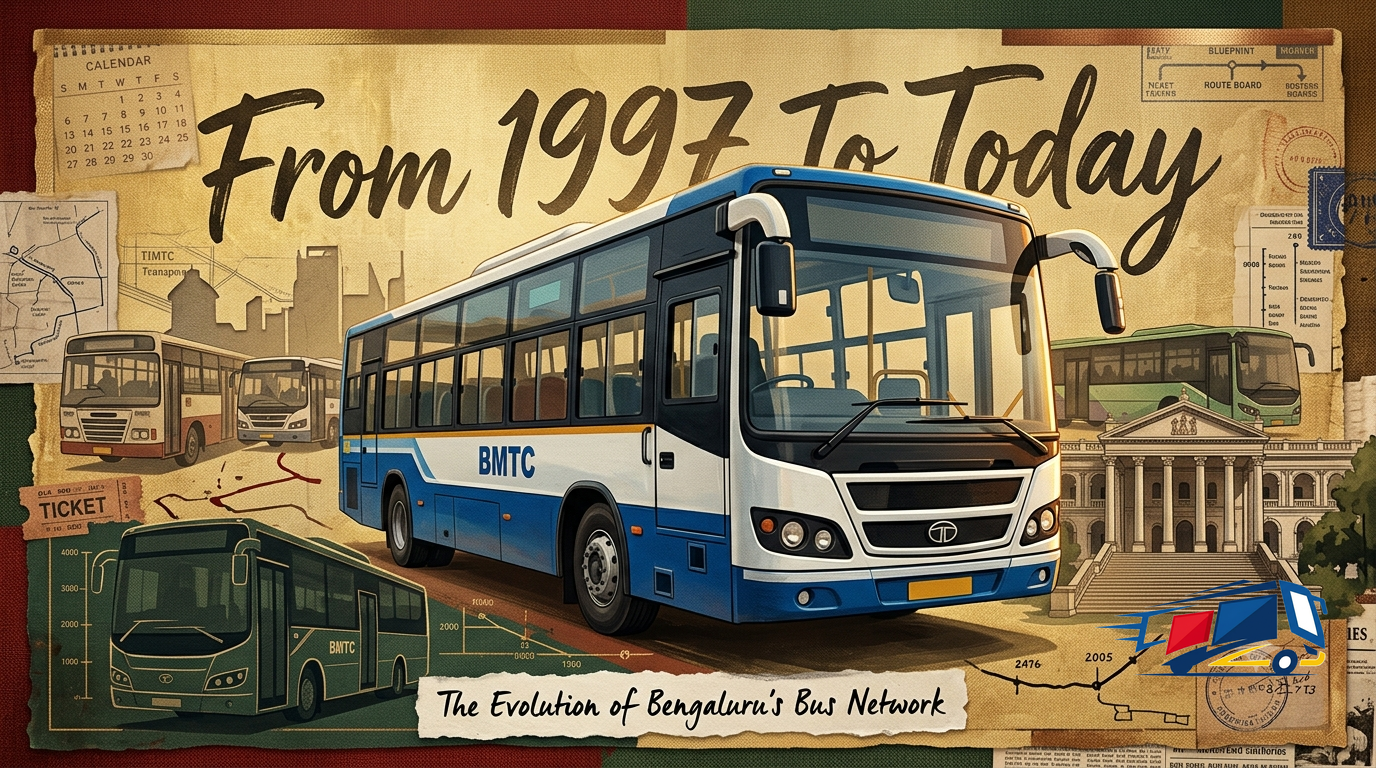
BMTC was born on 15 August 1997, split off from KSRTC to run Bengaluru on its own. In the years since, it has grown from roughly 2,098 buses to about 7,000, and gone from plain diesel buses to AC Volvos, an app and an electric fleet.
The story of BMTC is really the story of how Bengaluru outgrew its old bus service. City buses here date back to 1940, but the corporation people know today was created in 1997, when the state separated Bengaluru's transport from the rest of Karnataka. What followed was nearly three decades of steady expansion and a string of firsts for an Indian city bus operator.
| Key fact | Detail |
|---|---|
| Founded | 15 August 1997, split from KSRTC |
| Roots | Bangalore Transport Company, 1940 |
| Fleet growth | ~2,098 buses (1997) to ~7,000 today |
| India first | AC city buses in 2006 (Vajra) |
| Renamed | Bengaluru, in 2014 |
Where BMTC came from
BMTC was created out of the Bangalore Transport Service on 15 August 1997, split from KSRTC.
Before BMTC, city buses ran under a chain of older bodies, starting with a private company in 1940 and later folding into the state corporation. As Bengaluru grew, the state decided the city needed its own dedicated operator, so BMTC was carved out of KSRTC. The familiar blue and white livery replaced the older red around the same time.
| Year | Step |
|---|---|
| 1940 | Bangalore Transport Company (BTC) set up by the Mysore government |
| 1956 | BTC nationalised by the state |
| 1962 | Renamed Bangalore Transport Service (BTS) |
| 1997 | Reorganised as BMTC, split from KSRTC on 15 August |
The milestones since 1997
Nearly three decades of firsts, from AC Volvos to a free-travel scheme and electric buses.
Once on its own, BMTC moved fast. The timeline below picks out the moments that shaped the corporation, several of them national firsts for a city bus service.
| Year | Milestone |
|---|---|
| 1997 | BMTC formed, split from KSRTC |
| 2002 | UITP Asia Pacific award for affordable public transport |
| 2006 | First AC Volvo city buses in India, branded Vajra |
| 2009 | Atal Sarige low-fare service; Vayu Vajra airport buses |
| 2010 | Bus Day launched, on the 4th of each month |
| 2011 | Metro Feeder services after Namma Metro opens |
| 2014 | Renamed Bengaluru Metropolitan Transport Corporation |
| 2016 | Intelligent Transport System and smart card introduced |
| 2022 | Silver Jubilee, 25 years of service |
| 2023 | Namma BMTC app; Shakti free travel for women |
| 2025 | Fleet crosses 7,000; full bus-wrap advertising begins |
| 2026 | PM E-DRIVE phase one, 1,750 electric buses approved |
Want your brand on Bengaluru's buses?
Get a route plan, format recommendation and pricing, usually within a minute.
How the fleet grew
From about 2,098 buses at the start to roughly 7,000 today, a more than threefold rise.
Fleet size is the clearest measure of how far BMTC has come. It expanded quickly in the early years, then held near 6,500 for a long stretch before the recent electric push lifted it past 7,000. The buses also got younger, with one of the lowest average fleet ages of any Indian operator.
| Year | Approx fleet | Context |
|---|---|---|
| 1997 | ~2,098 | At formation |
| 2013 | ~6,000 | TTMC and Volvo era |
| 2016 | ~6,400 | Steady years |
| 2022 | ~6,799 | Per official audit |
| 2025 | ~7,000 | Electric expansion |
From diesel to digital and electric
Modernisation came in waves: comfort, then technology, then clean energy.
The character of the fleet changed as much as its size. BMTC went from basic diesel buses to AC Volvos, then layered on smart cards, GPS tracking and an app, and is now swapping diesel for electric. Each wave kept the service relevant as the city changed around it.
| Year | Step forward |
|---|---|
| 2006 | AC comfort arrives with Vajra Volvos |
| 2010 | Bus Day pushes a public-transport habit |
| 2016 | GPS tracking and smart cards go live |
| 2023 | Namma BMTC app brings live tracking and digital tickets |
| 2025 | Electric buses pass one in five of the fleet |
What strikes you reading the timeline is how often BMTC went first: first AC city buses in the country, an early smart card, one of the bigger electric rollouts. The buses have rarely stood still, and neither has the surface they offer a brand.
Where advertising fits the modern BMTC
As BMTC modernised, advertising grew into a formal part of how it runs.
The same drive to modernise reshaped how BMTC earns. Alongside fares, it built advertising into a tendered revenue stream, and in 2025 moved to full bus wraps. For brands, the modern fleet, cleaner, newer and consistent, is a far better canvas than the buses of twenty years ago.
| Then | Now |
|---|---|
| Ads mostly on the rear of buses | Full bus wraps, around 350 sq.ft each |
| Older, varied buses | Newer, consistent, electric fleet |
| A minor side income | A tendered non-traffic revenue stream |
To advertise on today's fleet, our bus branding solutions handle formats and routes. You can also read how BMTC earns revenue for the advertising context, or pick an area such as Koramangala.
Frequently Asked Questions
When was BMTC founded?+
BMTC was founded on 15 August 1997, created out of the Bangalore Transport Service after splitting from KSRTC to focus only on Bengaluru city transport.
Why did BMTC split from KSRTC?+
It was carved out in 1997 so a dedicated body could run Bengaluru's fast-growing city transport, leaving KSRTC to handle intercity and interstate routes across the rest of Karnataka.
When did BMTC launch AC buses?+
BMTC introduced air-conditioned Volvo city buses, branded Vajra, in 2006. It was the first state road transport undertaking in India to run AC buses for intra-city travel.
When did the name change from Bangalore to Bengaluru?+
The name changed from Bangalore to Bengaluru Metropolitan Transport Corporation on 1 November 2014, reflecting the city's official English name change. The acronym BMTC stayed the same.
How much has BMTC's fleet grown since 1997?+
BMTC started with around 2,098 buses in 1997 and now runs about 7,000, including roughly 1,700 electric, a more than threefold increase over nearly three decades.
How old is BMTC?+
BMTC has operated since 15 August 1997 and marked its silver jubilee of 25 years in 2022. Its roots reach back further, to the Bangalore Transport Company set up in 1940.
Bus Branding Glossary
- Full bus branding (wrap)
- A full vehicle wrap covering both sides and the rear of the bus, the highest-impact, most visible format.
- Bus back / rear branding
- Advertising on the rear panel of the bus, in the line of sight of traffic queued behind it at signals and junctions.
- Side panel branding
- Branding on one or both side panels of the bus body, facing pedestrians and parallel traffic along the route.
- Vajra / AC service
- BMTC's premium air-conditioned (Volvo / Vayu Vajra) services, carrying a higher-income commuter set on IT and airport corridors.
- TTMC
- Traffic and Transit Management Centre, a large BMTC bus terminal where many routes start, terminate and interchange.
- Depot
- The BMTC facility where buses are parked, serviced and from which many local routes originate.
- Dwell time
- How long a bus stays in view of a stationary crowd, at a stop, signal or in slow traffic, which lengthens brand exposure.
- Corridor
- A main arterial road (e.g. the Outer Ring Road or Hosur Road) that a bus route runs along, defining who sees the branding.
How to run a BMTC bus branding campaign
Five simple steps from enquiry to a live, tracked campaign on Bengaluru's buses.
- 1
Pick your area & audience
Tell us the Bengaluru area or corridor you want to reach and who you're targeting, IT professionals, shoppers, students or residents.
- 2
Choose a format
Select a format, full bus wrap, rear panel, side panel or premium AC/Vajra service, based on your budget and the impact you want.
- 3
Select routes & bus count
We map the high-frequency routes and stops that cover your audience and recommend how many buses to brand.
- 4
Approve the creative
Share your artwork (or we help design it). We prepare it to BMTC specifications and get the approvals.
- 5
Go live & get proof
We print, wrap and deploy the buses, then share proof of display so you can see your brand on the road.
Bus Branding Formats
Choose how your brand rides, pick the format that fits your goal and budget.
Bus Branding Across Bengaluru
We run BMTC bus branding in every major Bengaluru neighbourhood. Explore more areas:
Outdoor & Transit Advertising Specialists
We plan, design and run BMTC bus branding campaigns across every major Bengaluru corridor, matching brands to the routes, formats and audiences that deliver the most visibility.
Discover More
Brand Awareness vs Response Campaigns on Buses
What bus branding does best: awareness or direct response? A comparison of the two campaign types on buses, why a moving vehicle favours brand-building, and how to blend both.
Geo-Targeting With Bus Routes: Advertising Where Your Customers Are
A bus route is a geo-targeting tool you can drive. How to map your customers to the routes they use, think in catchments instead of points, and stack corridors to cover a neighbourhood or a whole city.
Setting Campaign Objectives Before You Advertise
Why setting one clear objective before you advertise decides everything: awareness vs consideration vs response, how each maps to a different message, format and KPI, and how to write a SMART objective.