How Many People See a Branded Bus Each Day? Reach Explained
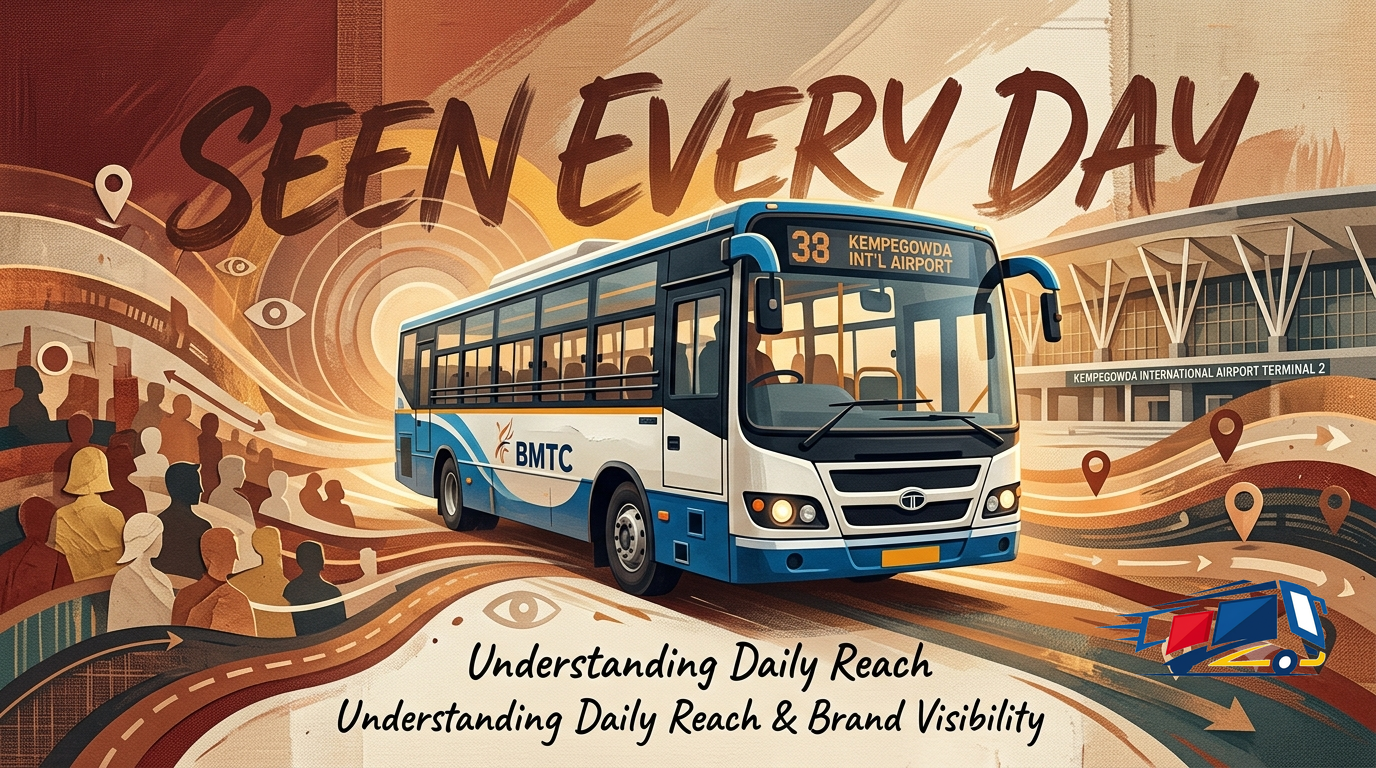
A branded bus has two audiences: the people on board and the far larger crowd outside, the pedestrians, riders and motorists it passes all day. The honest truth is that no one can give a precise per-bus figure, since route-level data is not public. But you can build a defensible picture from real numbers. Here is how the reach actually adds up.
Key takeaways
- Two audiences: riders on board, plus a much larger street audience of pedestrians, riders and motorists.
- On-board scale is defensible: 35.8 lakh rides a day across 7,038 buses is roughly 500 passenger-trips per bus.
- Street reach is large but estimated: a common OOH benchmark is 30,000 to 70,000 impressions per bus per day.
- Reach accumulates: a bus runs 8 to 15 trips daily through many neighbourhoods, gathering views all day.
- Impressions are views, not unique people; regulars see you repeatedly, which builds frequency and recall.
A bus has two audiences
Most people picture only the passengers, but the riders inside are the smaller audience. The bigger one is everyone the bus passes: pedestrians, people at stops, shopkeepers, and motorists and their passengers in the traffic around it, all day, on every trip.
The two are different in kind. Riders get long dwell time and read the interior and exterior up close; the street audience is far larger but each view is brief. A full wrap works both; a back panel mostly targets the traffic behind. Counting reach means counting both.
The riders on board: a defensible number
Here the maths is solid, because it comes from BMTC's own figures. The system carries 35.8 lakh rides a day across a fleet of 7,038 buses. Divide one by the other and the average bus carries roughly 500 passenger-trips a day.
Source: BMTC daily ridership 35.8 lakh and fleet 7,038 (Dec 2025). The per-bus figure is simple division and a citywide average, not a route-level count.
Want your brand on Bengaluru's buses?
Get a route plan, format recommendation and pricing, usually within a minute.
The street audience: large, but an estimate
The outside audience dwarfs the on-board one, but it is the harder one to pin down. A widely cited OOH benchmark puts a well-placed bus at 30,000 to 70,000 impressions a day, because it threads through high-footfall streets, markets and signal queues across the city.
| Audience | Rough daily scale | Nature of the view |
|---|---|---|
| On board | ~500 passenger-trips | Long dwell, up close |
| On the street | 30k to 70k (benchmark) | Brief, but very high volume |
How reach builds over the day
A bus is not seen once. It runs 8 to 15 trips a day, threading the same corridors repeatedly and moving through different neighbourhoods, so its audience accumulates from morning peak to late evening. That is why a moving billboard outperforms a fixed one on coverage.
Multiply that by a fleet and the picture scales fast: ten buses do not add reach once, they add it ten times over, every trip, all day. Reach in transit is cumulative, which is its quiet advantage over a single fixed site.
Views are not unique people
This is the point that keeps the numbers honest. Impressions count views, not distinct individuals. A regular commuter on your corridor sees your bus again and again, so a big daily impression count includes a lot of repeat views of the same people.
| Term | What it means |
|---|---|
| Impression | One view, by anyone, any time |
| Reach | Distinct people who saw it at least once |
| Frequency | How often each person saw it |
That repetition is not waste, it is the point. Repeated exposure is what builds recall, and transit ads earn strong recall: studies report a large majority of riders look at transit ads and recall them. So a fixed route trades some unique reach for high frequency, exactly what drives memory.
The citywide pool, for scale
Zoom out and the scale speaks for itself. BMTC moves 35.8 lakh rides a day across the city. Your campaign taps a slice of that on-board audience plus the much larger street audience around every bus you brand.
| Metric | Figure |
|---|---|
| Daily BMTC rides | 35.8 lakh |
| Fleet | 7,038 buses |
| Routes | 5,700+ |
| Per-bus rider average | ~500 / day |
Nobody can hand you an exact "your bus was seen X times today". What they can show you is a defensible range built from real numbers, hundreds of riders on board, tens of thousands on the street, building all day, every day.
Honest reach, built from real data
We will not quote you a made-up impression figure. What we will do is build your reach estimate from defensible numbers: the on-board audience from BMTC's own ridership, the street audience from OOH benchmarks, your routes and your bus count, flagged clearly for what is measured and what is estimated. You get a realistic picture of who sees your buses, not an inflated one.
Plan your reach under bus branding in Bengaluru, or see how it ties to scale in transit advertising.
Frequently Asked Questions
How many people see a branded bus each day?+
Two audiences. On board, an average BMTC bus carries roughly 500 passenger-trips a day. On the street, an OOH benchmark suggests 30,000 to 70,000 impressions a day, though that is an estimate, not a measured figure.
Where does the 500 riders figure come from?+
Simple division of real data: 35.8 lakh daily rides divided by 7,038 buses is about 500. It is a citywide average, busy routes carry far more, quiet ones fewer.
Is the 30,000 to 70,000 number reliable?+
It is a widely used OOH industry benchmark, not a BMTC-measured statistic. Locality and route-level reach data is not public, so treat it as a directional estimate.
Do these numbers mean unique people?+
No. They count views, not distinct individuals. The same regular commuter sees your bus repeatedly, which is repeat frequency, valuable for recall but not extra unique reach.
Does reach build over the day?+
Yes. A bus runs 8 to 15 trips a day through different areas, so its audience accumulates from morning to evening, and a fleet multiplies that across the city.
How do you estimate reach for my campaign?+
From defensible inputs: BMTC ridership for the on-board side, OOH benchmarks for the street side, your routes and bus count, with measured and estimated parts clearly flagged.
Bus Branding Glossary
- Full bus branding (wrap)
- A full vehicle wrap covering both sides and the rear of the bus, the highest-impact, most visible format.
- Bus back / rear branding
- Advertising on the rear panel of the bus, in the line of sight of traffic queued behind it at signals and junctions.
- Side panel branding
- Branding on one or both side panels of the bus body, facing pedestrians and parallel traffic along the route.
- Vajra / AC service
- BMTC's premium air-conditioned (Volvo / Vayu Vajra) services, carrying a higher-income commuter set on IT and airport corridors.
- TTMC
- Traffic and Transit Management Centre, a large BMTC bus terminal where many routes start, terminate and interchange.
- Depot
- The BMTC facility where buses are parked, serviced and from which many local routes originate.
- Dwell time
- How long a bus stays in view of a stationary crowd, at a stop, signal or in slow traffic, which lengthens brand exposure.
- Corridor
- A main arterial road (e.g. the Outer Ring Road or Hosur Road) that a bus route runs along, defining who sees the branding.
How to run a BMTC bus branding campaign
Five simple steps from enquiry to a live, tracked campaign on Bengaluru's buses.
- 1
Pick your area & audience
Tell us the Bengaluru area or corridor you want to reach and who you're targeting, IT professionals, shoppers, students or residents.
- 2
Choose a format
Select a format, full bus wrap, rear panel, side panel or premium AC/Vajra service, based on your budget and the impact you want.
- 3
Select routes & bus count
We map the high-frequency routes and stops that cover your audience and recommend how many buses to brand.
- 4
Approve the creative
Share your artwork (or we help design it). We prepare it to BMTC specifications and get the approvals.
- 5
Go live & get proof
We print, wrap and deploy the buses, then share proof of display so you can see your brand on the road.
Bus Branding Formats
Choose how your brand rides, pick the format that fits your goal and budget.
Bus Branding Across Bengaluru
We run BMTC bus branding in every major Bengaluru neighbourhood. Explore more areas:
Outdoor & Transit Advertising Specialists
We plan, design and run BMTC bus branding campaigns across every major Bengaluru corridor, matching brands to the routes, formats and audiences that deliver the most visibility.
Discover More
Brand Awareness vs Response Campaigns on Buses
What bus branding does best: awareness or direct response? A comparison of the two campaign types on buses, why a moving vehicle favours brand-building, and how to blend both.
Geo-Targeting With Bus Routes: Advertising Where Your Customers Are
A bus route is a geo-targeting tool you can drive. How to map your customers to the routes they use, think in catchments instead of points, and stack corridors to cover a neighbourhood or a whole city.
Setting Campaign Objectives Before You Advertise
Why setting one clear objective before you advertise decides everything: awareness vs consideration vs response, how each maps to a different message, format and KPI, and how to write a SMART objective.