Industrial Belt Routes: Peenya, Bommasandra & Beyond
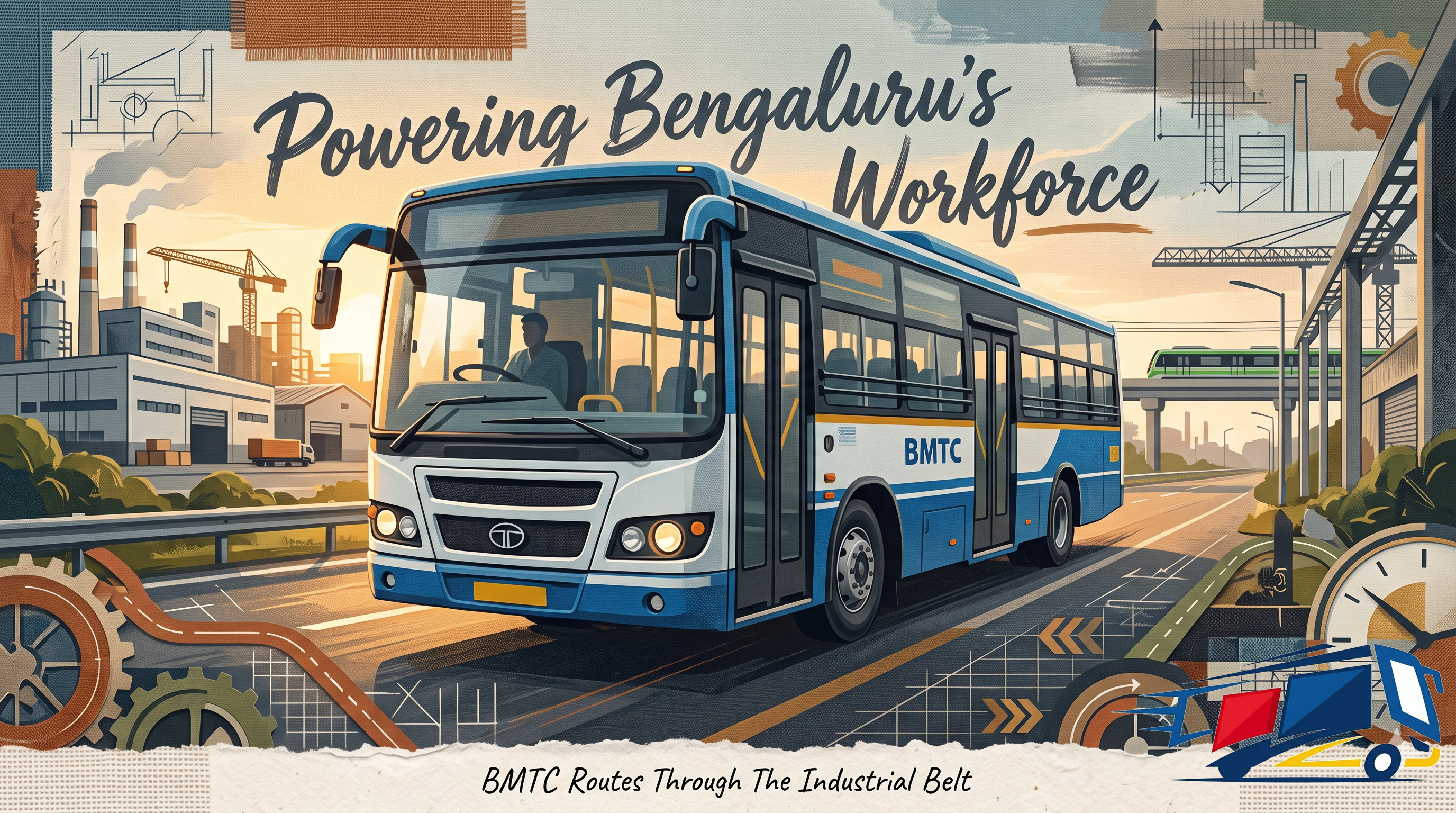
Behind Bengaluru's tech image is a working city of factories and workshops. Estates like Peenya in the north-west and Bommasandra in the south move a vast daily workforce, much of it by bus. Map those routes and you reach a crowd most consumer advertising overlooks.
Key takeaways
- Peenya on Tumkur Road is among Asia's largest and oldest industrial estates, since the 1970s.
- Peenya houses 13,000+ MSMEs plus large units; it was made a Special Investment Region in 2025.
- Bommasandra in the south anchors electronics, automotive and pharma-biotech near Electronic City.
- The workforce is shift-based, moving in heavy morning and evening waves on fixed routes.
- The belt reaches two audiences: a large blue-collar workforce and B2B decision-makers.
Bengaluru's industrial belts
The city's industry concentrates in a few large estates on its edges, north-west, south and east, each with its own sector mix and its own commuting workforce.
| Belt | Side | Known for |
|---|---|---|
| Peenya | North-west | Engineering, machine tools, textiles |
| Bommasandra | South | Electronics, auto, pharma-biotech |
| Whitefield | East | Manufacturing and IT-adjacent |
| Jigani / Attibele | South | Auto components, manufacturing |
| Hoskote / Nelamangala | Outer | Logistics, warehousing |
Peenya is the giant of the set. Set up in the 1970s and spread across a vast area on Tumkur Road, it holds thousands of units and feeds a workforce on a scale few single zones in the country match.
Routes by belt
Each estate is fed by its own bus signature, often paired with a metro line. Peenya sits on the Green Line; Bommasandra on the Yellow Line toward Electronic City.
| Belt | Bus routes | Metro |
|---|---|---|
| Peenya | 248 family, 252, 401 series | Peenya, Peenya Industry (Green) |
| Bommasandra | 356 family, Hosur Rd routes | Bommasandra (Yellow) |
| Whitefield | 335 / 500-series | Purple Line |
| Jigani / Attibele | Hosur Rd / Anekal routes | Yellow Line nearby |
| Outer belts | NH-corridor routes | Limited |
Want your brand on Bengaluru's buses?
Get a route plan, format recommendation and pricing, usually within a minute.
The shift rhythm
Industrial footfall does not spread evenly through the day. It moves in concentrated waves around shift changes, which makes the timing of the audience unusually sharp.
The pattern is two tall peaks. A flood of workers arrives before the shift and leaves after it, so the buses on these routes are packed at predictable hours, then quieter between.
Two audiences in one belt
An industrial belt carries two distinct crowds: a large blue-collar and skilled workforce on the buses, and the business owners, buyers and managers who run the units.
| Audience | Who they are |
|---|---|
| Factory workforce | Skilled, semi-skilled, line staff |
| Supervisors and technical | Engineers, floor managers |
| Business owners | MSME proprietors, B2B buyers |
| Logistics and transport | Drivers, warehouse staff |
| Support services | Vendors, eateries, local trade |
That split is what makes the belt unusual. The buses reach a high-volume worker audience, while the estate itself is full of the decision-makers a B2B brand wants, both in the same few square kilometres.
Why industrial routes work for B2B
Few advertising channels reach an industrial estate well. A bus on these routes is visible to the workforce daily and to the businesses lining the road, which suits both B2B and worker-facing brands.
Most media talks past the industrial belt. A bus that runs it every shift is one of the few things that reaches both the worker on board and the factory it drives past.
The brands that fit
B2B, industrial and worker-facing consumer brands gain most, reaching both the manufacturing workforce and the businesses that employ them.
Reach the working city most media skip
Peenya, Bommasandra and the other belts move a large workforce by bus every shift, past thousands of units run by the exact buyers a B2B brand wants. Branding the routes that serve these estates reaches both at once: the worker on the bus and the business owner watching it pass. For B2B, logistics, FMCG and skilling brands, it is one of the few ways to speak to the industrial economy directly.
See how we plan industrial-corridor campaigns in bus branding in Bengaluru, or scope a workforce buy with transit advertising.
Frequently Asked Questions
What are Bengaluru's main industrial belts?+
Peenya (north-west), Bommasandra (south), Whitefield (east), and Jigani, Attibele and the outer Hoskote and Nelamangala logistics zones.
How big is Peenya Industrial Area?+
It is among Asia's largest and oldest industrial estates, set up in the 1970s on Tumkur Road, with 13,000+ MSMEs plus large units, and was made a Special Investment Region in 2025.
Which routes serve Peenya and Bommasandra?+
Peenya is served by the Green Line metro and a dense 248 family plus 252 and 401 routes. Bommasandra sits on the Yellow Line with Hosur Road routes toward Electronic City.
What kind of audience do industrial routes reach?+
Two crowds: a large blue-collar and skilled workforce on the buses, and the business owners and B2B buyers who run the estate's units.
Why advertise on industrial routes?+
Because little other media reaches these estates well. A bus running them is seen daily by the workforce and by the businesses along the road, hitting both targets at once.
Which brands should advertise here?+
B2B and industrial, logistics, FMCG, MSME finance, telecom and skilling or hiring brands aimed at the manufacturing workforce and its employers.
Bus Branding Glossary
- Full bus branding (wrap)
- A full vehicle wrap covering both sides and the rear of the bus, the highest-impact, most visible format.
- Bus back / rear branding
- Advertising on the rear panel of the bus, in the line of sight of traffic queued behind it at signals and junctions.
- Side panel branding
- Branding on one or both side panels of the bus body, facing pedestrians and parallel traffic along the route.
- Vajra / AC service
- BMTC's premium air-conditioned (Volvo / Vayu Vajra) services, carrying a higher-income commuter set on IT and airport corridors.
- TTMC
- Traffic and Transit Management Centre, a large BMTC bus terminal where many routes start, terminate and interchange.
- Depot
- The BMTC facility where buses are parked, serviced and from which many local routes originate.
- Dwell time
- How long a bus stays in view of a stationary crowd, at a stop, signal or in slow traffic, which lengthens brand exposure.
- Corridor
- A main arterial road (e.g. the Outer Ring Road or Hosur Road) that a bus route runs along, defining who sees the branding.
How to run a BMTC bus branding campaign
Five simple steps from enquiry to a live, tracked campaign on Bengaluru's buses.
- 1
Pick your area & audience
Tell us the Bengaluru area or corridor you want to reach and who you're targeting, IT professionals, shoppers, students or residents.
- 2
Choose a format
Select a format, full bus wrap, rear panel, side panel or premium AC/Vajra service, based on your budget and the impact you want.
- 3
Select routes & bus count
We map the high-frequency routes and stops that cover your audience and recommend how many buses to brand.
- 4
Approve the creative
Share your artwork (or we help design it). We prepare it to BMTC specifications and get the approvals.
- 5
Go live & get proof
We print, wrap and deploy the buses, then share proof of display so you can see your brand on the road.
Bus Branding Formats
Choose how your brand rides, pick the format that fits your goal and budget.
Bus Branding Across Bengaluru
We run BMTC bus branding in every major Bengaluru neighbourhood. Explore more areas:
Outdoor & Transit Advertising Specialists
We plan, design and run BMTC bus branding campaigns across every major Bengaluru corridor, matching brands to the routes, formats and audiences that deliver the most visibility.
Discover More
Brand Awareness vs Response Campaigns on Buses
What bus branding does best: awareness or direct response? A comparison of the two campaign types on buses, why a moving vehicle favours brand-building, and how to blend both.
Geo-Targeting With Bus Routes: Advertising Where Your Customers Are
A bus route is a geo-targeting tool you can drive. How to map your customers to the routes they use, think in catchments instead of points, and stack corridors to cover a neighbourhood or a whole city.
Setting Campaign Objectives Before You Advertise
Why setting one clear objective before you advertise decides everything: awareness vs consideration vs response, how each maps to a different message, format and KPI, and how to write a SMART objective.