Kengeri TTMC: West Bengaluru's Growing Hub
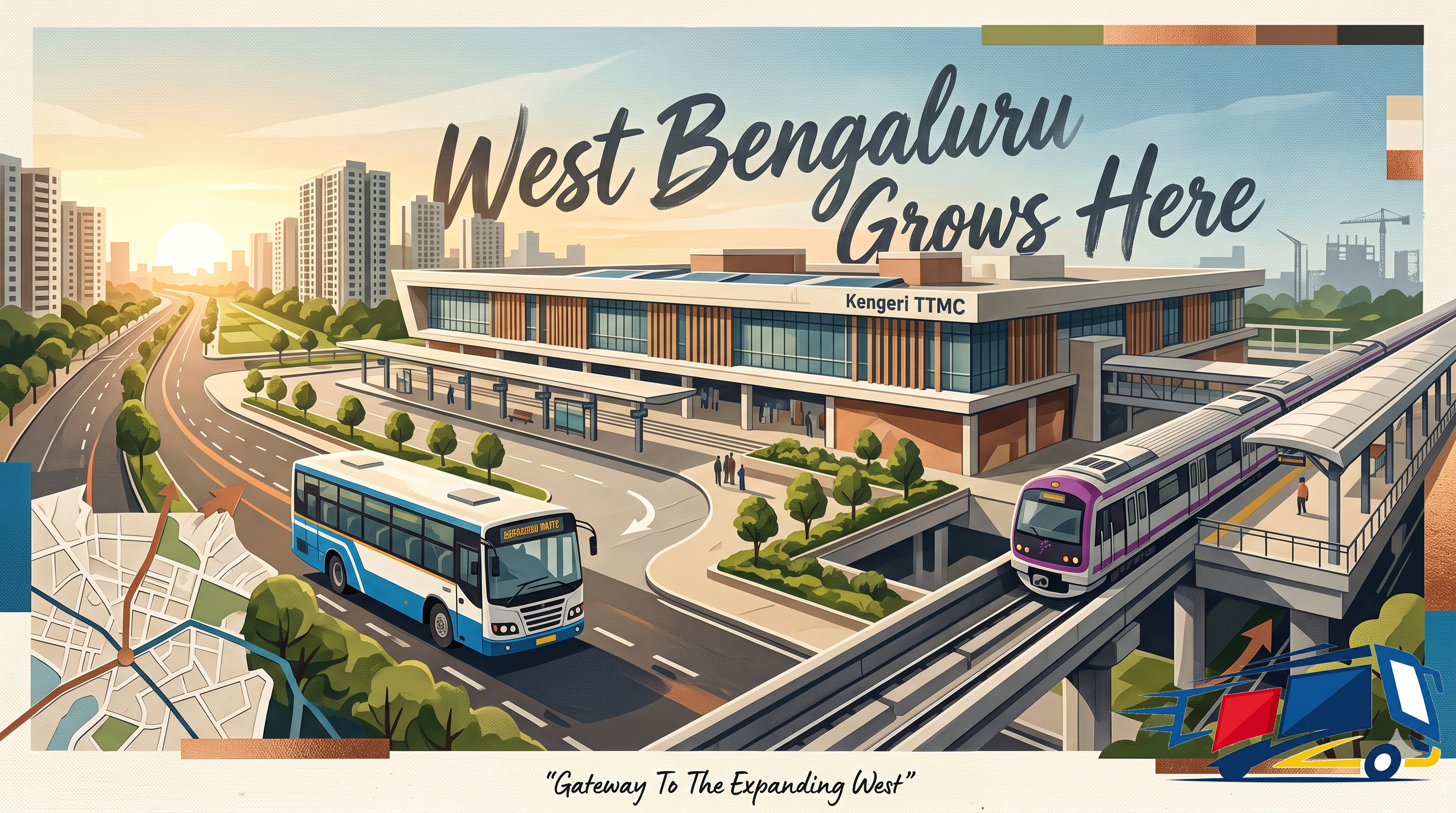
Where the city ends and the Mysore Road corridor begins, Kengeri is filling in fast. Its TTMC fuses a BMTC bus terminal with the Purple Line metro terminus, turning a former satellite town into west Bengaluru's transit gateway. This is a hub still on the way up.
Key takeaways
- Kengeri TTMC sits on Mysore Road, the gateway to west and southwest Bengaluru.
- It is fused with the Kengeri Bus Terminal metro station, a Purple Line terminus end since 2021.
- The area began as a BDA satellite town 30+ years ago and is now a fast-growing belt.
- The catchment mixes residents, students and corridor commuters heading into the city.
- As a growth hub, it offers rising footfall at a lower entry cost than the central terminals.
The gateway to the west
Kengeri TTMC sits on the Bangalore to Mysore road at the western edge of the city, making it the entry and exit point for the whole western and southwestern suburban belt.
| Attribute | Detail |
|---|---|
| Type | TTMC and metro terminus |
| Location | Mysore Road, Kengeri |
| Serves | West and southwest Bengaluru |
| Metro | Kengeri Bus Terminal, Purple Line |
| Origin | BDA satellite town, 30+ years ago |
Built as a planned satellite town decades ago and since absorbed into the city, Kengeri has shifted from a quiet edge suburb to a busy corridor node, which is exactly why its hub matters now.
Where bus meets metro
The defining feature is integration. The bus terminal and the Purple Line metro station sit together, so a rider switches between bus and metro in one place at the western end of the line.
The Purple Line reached Kengeri in 2021, when the western extension from Mysore Road added stations including Kengeri Bus Terminal. That turned the TTMC into a true bus-and-metro interchange and a feeder point for the whole western suburb into the city core.
Want your brand on Bengaluru's buses?
Get a route plan, format recommendation and pricing, usually within a minute.
Routes and reach
Kengeri is a busy origin for routes into the city and out along the Mysore Road corridor, plus metro feeder services tying the suburbs to the terminal.
| Route | Type | Towards |
|---|---|---|
| 401 family (401K, 401M) | City | Local and corridor |
| 222 series | City (many variants) | Majestic, KBS side |
| G-6 | Big 10 arterial | Mysore Road corridor |
| 375 / 378 series | City | West and south |
| MF feeder | Metro feeder | Last-mile to metro |
The G-6 arterial runs the Mysore Road spine, and the 222 family ties Kengeri to Majestic, so the hub links the western edge straight into the city centre by both road and rail.
A catchment that is still growing
Kengeri's crowd is a young, expanding mix: satellite-town residents, a large student population from nearby colleges, and a rising tide of corridor commuters as the west fills in.
| Group | Who they are |
|---|---|
| Satellite-town residents | Settled and new west-side households |
| Students | Engineering and other colleges nearby |
| Corridor commuters | Into the city via metro and bus |
| New movers | Buyers in growing west-side projects |
| Highway travellers | Mysore Road, Bidadi, Ramanagara side |
The key word is growing. This is not a settled, finished catchment like the central terminals. It is a belt still adding homes and people, which changes how a brand should think about it.
Why advertisers should watch this hub
Kengeri is a get-in-early hub. Footfall is rising as the west develops and the metro pulls more riders, often at a lower entry cost than the saturated central terminals.
The central hubs are already priced for their crowds. A growth hub lets a brand grow its presence as the neighbourhood grows around it.
The brands that fit
Brands selling to new and growing households, and to a young student base, find a receptive, expanding audience here ahead of the crowd.
Plant a flag where the city is heading
West Bengaluru is one of the city's growth fronts, and Kengeri is its gateway. Buses through the TTMC, and the metro riders boarding beside them, are a young, expanding catchment of new households, students and corridor commuters. For real estate, home, education and banking brands chasing growth markets, getting visible here early means growing with the area rather than buying into it once it is crowded.
See how we spot emerging corridors in bus branding in Bengaluru, or plan a growth-market buy with transit advertising.
Frequently Asked Questions
Where is Kengeri TTMC?+
On Mysore Road at the western edge of Bengaluru, in Kengeri, serving the western and southwestern suburbs. It doubles as the Purple Line metro terminus area.
Is there a metro at Kengeri TTMC?+
Yes. The Kengeri Bus Terminal metro station on the Purple Line sits with the bus terminal, open since 2021, making it a bus and metro interchange.
What makes Kengeri different from the central hubs?+
It is a growth hub, not a mature one. The catchment is younger and still expanding as west Bengaluru develops, so footfall is rising rather than settled.
Which routes run from Kengeri TTMC?+
The 401 family, the large 222 series towards Majestic, the Big 10 G-6 on the Mysore Road corridor, the 375 and 378 series, and metro feeder buses.
Why should advertisers watch Kengeri?+
Because it is rising, not saturated. Footfall grows as the west develops and the metro pulls more riders, often at a lower entry cost than central terminals.
Which brands suit Kengeri?+
Real estate, home and interiors, education, banking, telecom and FMCG brands targeting a young, growing west-side household and student base.
Bus Branding Glossary
- Full bus branding (wrap)
- A full vehicle wrap covering both sides and the rear of the bus, the highest-impact, most visible format.
- Bus back / rear branding
- Advertising on the rear panel of the bus, in the line of sight of traffic queued behind it at signals and junctions.
- Side panel branding
- Branding on one or both side panels of the bus body, facing pedestrians and parallel traffic along the route.
- Vajra / AC service
- BMTC's premium air-conditioned (Volvo / Vayu Vajra) services, carrying a higher-income commuter set on IT and airport corridors.
- TTMC
- Traffic and Transit Management Centre, a large BMTC bus terminal where many routes start, terminate and interchange.
- Depot
- The BMTC facility where buses are parked, serviced and from which many local routes originate.
- Dwell time
- How long a bus stays in view of a stationary crowd, at a stop, signal or in slow traffic, which lengthens brand exposure.
- Corridor
- A main arterial road (e.g. the Outer Ring Road or Hosur Road) that a bus route runs along, defining who sees the branding.
How to run a BMTC bus branding campaign
Five simple steps from enquiry to a live, tracked campaign on Bengaluru's buses.
- 1
Pick your area & audience
Tell us the Bengaluru area or corridor you want to reach and who you're targeting, IT professionals, shoppers, students or residents.
- 2
Choose a format
Select a format, full bus wrap, rear panel, side panel or premium AC/Vajra service, based on your budget and the impact you want.
- 3
Select routes & bus count
We map the high-frequency routes and stops that cover your audience and recommend how many buses to brand.
- 4
Approve the creative
Share your artwork (or we help design it). We prepare it to BMTC specifications and get the approvals.
- 5
Go live & get proof
We print, wrap and deploy the buses, then share proof of display so you can see your brand on the road.
Bus Branding Formats
Choose how your brand rides, pick the format that fits your goal and budget.
Bus Branding Across Bengaluru
We run BMTC bus branding in every major Bengaluru neighbourhood. Explore more areas:
Outdoor & Transit Advertising Specialists
We plan, design and run BMTC bus branding campaigns across every major Bengaluru corridor, matching brands to the routes, formats and audiences that deliver the most visibility.
Discover More
Brand Awareness vs Response Campaigns on Buses
What bus branding does best: awareness or direct response? A comparison of the two campaign types on buses, why a moving vehicle favours brand-building, and how to blend both.
Geo-Targeting With Bus Routes: Advertising Where Your Customers Are
A bus route is a geo-targeting tool you can drive. How to map your customers to the routes they use, think in catchments instead of points, and stack corridors to cover a neighbourhood or a whole city.
Setting Campaign Objectives Before You Advertise
Why setting one clear objective before you advertise decides everything: awareness vs consideration vs response, how each maps to a different message, format and KPI, and how to write a SMART objective.