KR Market Bus Stand: Old-City Footfall for Branding
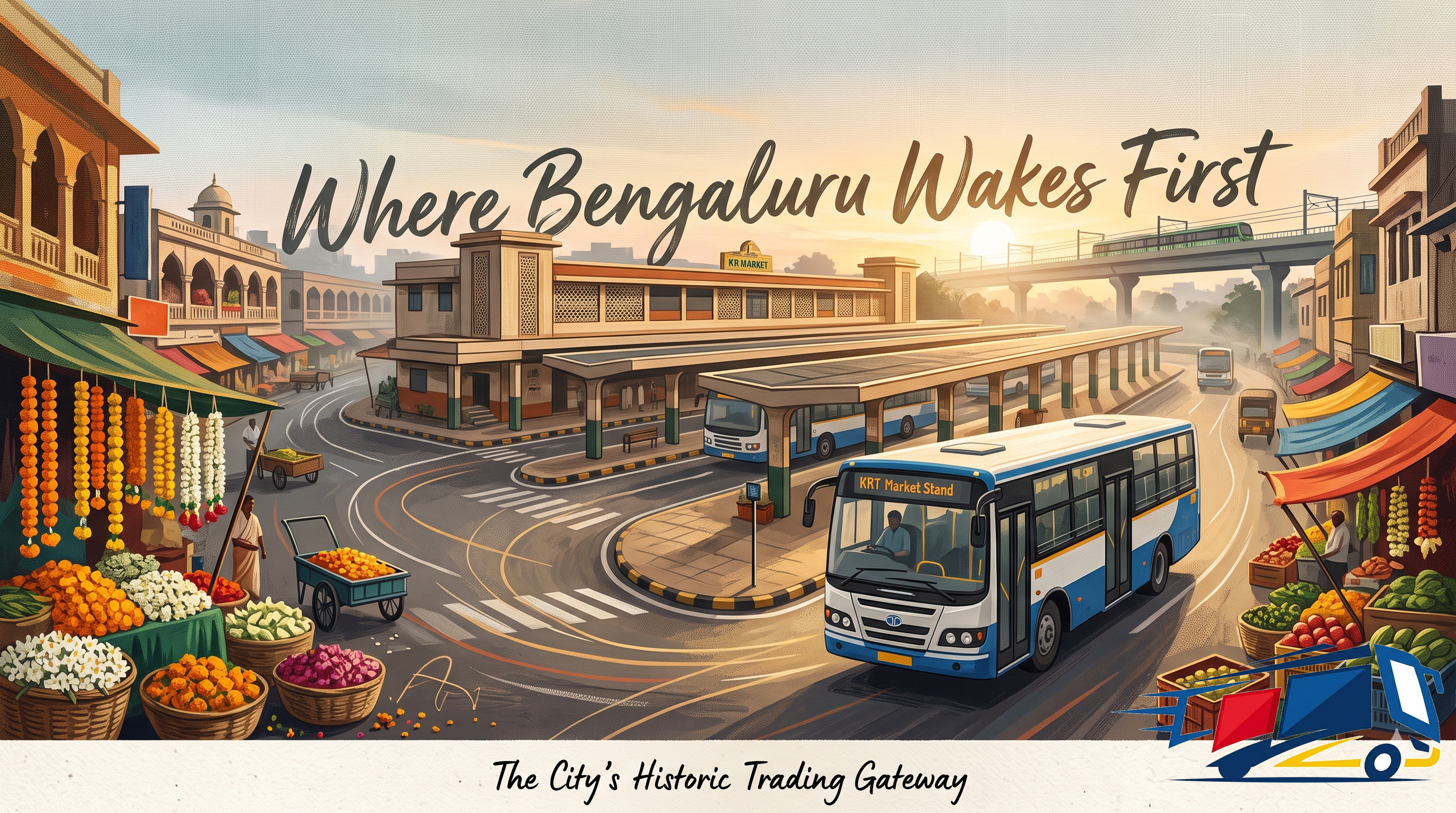
Before most of Bengaluru wakes, KR Market is already roaring. The bus stand at Kalasipalya sits beside one of the largest wholesale markets in Asia, where the flower trade peaks between 4 and 8 AM. This is the old city's trading heart, and its footfall starts in the dark.
Key takeaways
- KR Market is one of BMTC's three main terminals, with Majestic and Shivajinagar.
- It adjoins Krishna Rajendra Market, one of the largest wholesale markets in Asia, built in 1928.
- The crowd is traders and bulk buyers, arriving before dawn for flowers, fruit and produce.
- The Green Line metro (KR Market station) has sat right beside the terminal since 2017.
- Its value is dense, mass-market footfall, ideal for high-frequency consumer branding.
The terminal at the heart of the old city
KR Market Bus Stand, around Kalasipalya, is a core BMTC terminal in the historic Pete area. It serves Krishna Rajendra Market, the wholesale engine of the city's food and flower trade.
| Attribute | Detail |
|---|---|
| Status | 1 of 3 BMTC main terminals |
| Area | Kalasipalya, Pete (old city) |
| Adjoins | Krishna Rajendra Market |
| Market built | 1928 |
| Metro | Green Line, KR Market station |
Near the terminal stand Tipu Sultan's Summer Palace, the old Bangalore Fort and Kote Venkataramana Swamy temple. This is the city's deepest layer of history, and its busiest traditional trade zone, in one place.
A footfall that runs on a different clock
Most hubs peak with the office commute. KR Market peaks before dawn, when wholesale buyers arrive to stock up, then shifts into a retail market through the day.
| Time | What happens | Who is there |
|---|---|---|
| ~3 to 4 AM | Flower market opens | Wholesale sellers |
| 4 to 8 AM | Wholesale flower peak | Bulk buyers, traders |
| 6 AM on | Produce and textiles open | Retailers, vendors |
| 10 AM on | Retail market mode | Shoppers, public |
| till ~9 to 10 PM | General trade | Mixed crowd |
Want your brand on Bengaluru's buses?
Get a route plan, format recommendation and pricing, usually within a minute.
Routes and connectivity
As a main terminal, KR Market is a heavy origin point. A large spread of city routes start or pass here, fanning out across the south and west of Bengaluru.
| Route | Type | Towards |
|---|---|---|
| G-10 | Big 10 arterial | Major corridor |
| 210 / 211 series | City (many variants) | Banashankari, Kanakapura Rd |
| 248, 280, 291 | City | Across the city |
| 226, 241, 402 | City | West and south |
| Vajra (AC) | AC city | Select corridors |
The terminal is walkable to the Green Line KR Market metro and around 3 km from Majestic, so it ties the old city into the wider bus and metro network.
Who passes through KR Market?
The defining crowd is the trade: wholesalers, retailers buying in bulk, porters, vendors and shoppers, layered with tourists drawn to the heritage quarter.
| Group | Who they are |
|---|---|
| Wholesale traders | Bulk flower, fruit, produce buyers |
| Retail vendors | Small shop owners restocking |
| Daily shoppers | Households buying fresh and cheap |
| Textile and puja buyers | Sarees, fabrics, temple supplies |
| Tourists | Heritage and market visitors |
It is a broad, mass-market crowd, not a niche one. The common thread is commerce: almost everyone here is buying or selling something, often daily.
Why this hub suits branding
KR Market offers what mass-reach brands chase: very high density, a long active day, and a crowd built around buying, in one of the city's most concentrated footfall zones.
A commuter hub goes quiet between the rushes. A market hub never really does, because trade does not keep office hours.
The brands that fit
Mass-market and value-led brands gain most here, reaching a high-volume, price-aware, daily-trade crowd at one of the city's densest points.
Density is the whole pitch
Few places in Bengaluru pack as many people into as little space for as many hours as KR Market. Buses moving through Kalasipalya pass a constant, mass-market trade crowd, the daily buyers and sellers who keep the city stocked. For FMCG, payments, telecom and value brands chasing sheer reach, this old-city hub is among the densest canvases in the city.
See how we pick high-density routes in bus branding in Bengaluru, or plan a footfall-led buy with transit advertising.
Frequently Asked Questions
Where is KR Market Bus Stand?+
In Kalasipalya, in Bengaluru's historic Pete area near Tipu Sultan's Summer Palace. It is one of BMTC's three main terminals, beside Krishna Rajendra Market.
What makes KR Market different from Majestic?+
Majestic is a commuter interchange. KR Market is a wholesale trade hub, so its crowd is traders and bulk buyers, and it peaks before dawn rather than at office rush.
When is KR Market busiest?+
The wholesale flower market peaks 4 to 8 AM. Produce and textile sections open through the morning, and it runs as a retail market until around 9 to 10 PM.
Which routes run from KR Market?+
The Big 10 G-10, the large 210 and 211 route families towards Banashankari and Kanakapura Road, plus many city routes (248, 280, 291) and select AC Vajra services.
Is there a metro at KR Market?+
Yes. The Green Line KR Market station has been open since 2017, right beside the terminal, linking the old city into the metro network.
Which brands should advertise here?+
FMCG, value retail, telecom, payments, agri-trade and gold or finance brands, all targeting the high-volume, price-aware daily-trade crowd.
Bus Branding Glossary
- Full bus branding (wrap)
- A full vehicle wrap covering both sides and the rear of the bus, the highest-impact, most visible format.
- Bus back / rear branding
- Advertising on the rear panel of the bus, in the line of sight of traffic queued behind it at signals and junctions.
- Side panel branding
- Branding on one or both side panels of the bus body, facing pedestrians and parallel traffic along the route.
- Vajra / AC service
- BMTC's premium air-conditioned (Volvo / Vayu Vajra) services, carrying a higher-income commuter set on IT and airport corridors.
- TTMC
- Traffic and Transit Management Centre, a large BMTC bus terminal where many routes start, terminate and interchange.
- Depot
- The BMTC facility where buses are parked, serviced and from which many local routes originate.
- Dwell time
- How long a bus stays in view of a stationary crowd, at a stop, signal or in slow traffic, which lengthens brand exposure.
- Corridor
- A main arterial road (e.g. the Outer Ring Road or Hosur Road) that a bus route runs along, defining who sees the branding.
How to run a BMTC bus branding campaign
Five simple steps from enquiry to a live, tracked campaign on Bengaluru's buses.
- 1
Pick your area & audience
Tell us the Bengaluru area or corridor you want to reach and who you're targeting, IT professionals, shoppers, students or residents.
- 2
Choose a format
Select a format, full bus wrap, rear panel, side panel or premium AC/Vajra service, based on your budget and the impact you want.
- 3
Select routes & bus count
We map the high-frequency routes and stops that cover your audience and recommend how many buses to brand.
- 4
Approve the creative
Share your artwork (or we help design it). We prepare it to BMTC specifications and get the approvals.
- 5
Go live & get proof
We print, wrap and deploy the buses, then share proof of display so you can see your brand on the road.
Bus Branding Formats
Choose how your brand rides, pick the format that fits your goal and budget.
Bus Branding Across Bengaluru
We run BMTC bus branding in every major Bengaluru neighbourhood. Explore more areas:
Outdoor & Transit Advertising Specialists
We plan, design and run BMTC bus branding campaigns across every major Bengaluru corridor, matching brands to the routes, formats and audiences that deliver the most visibility.
Discover More
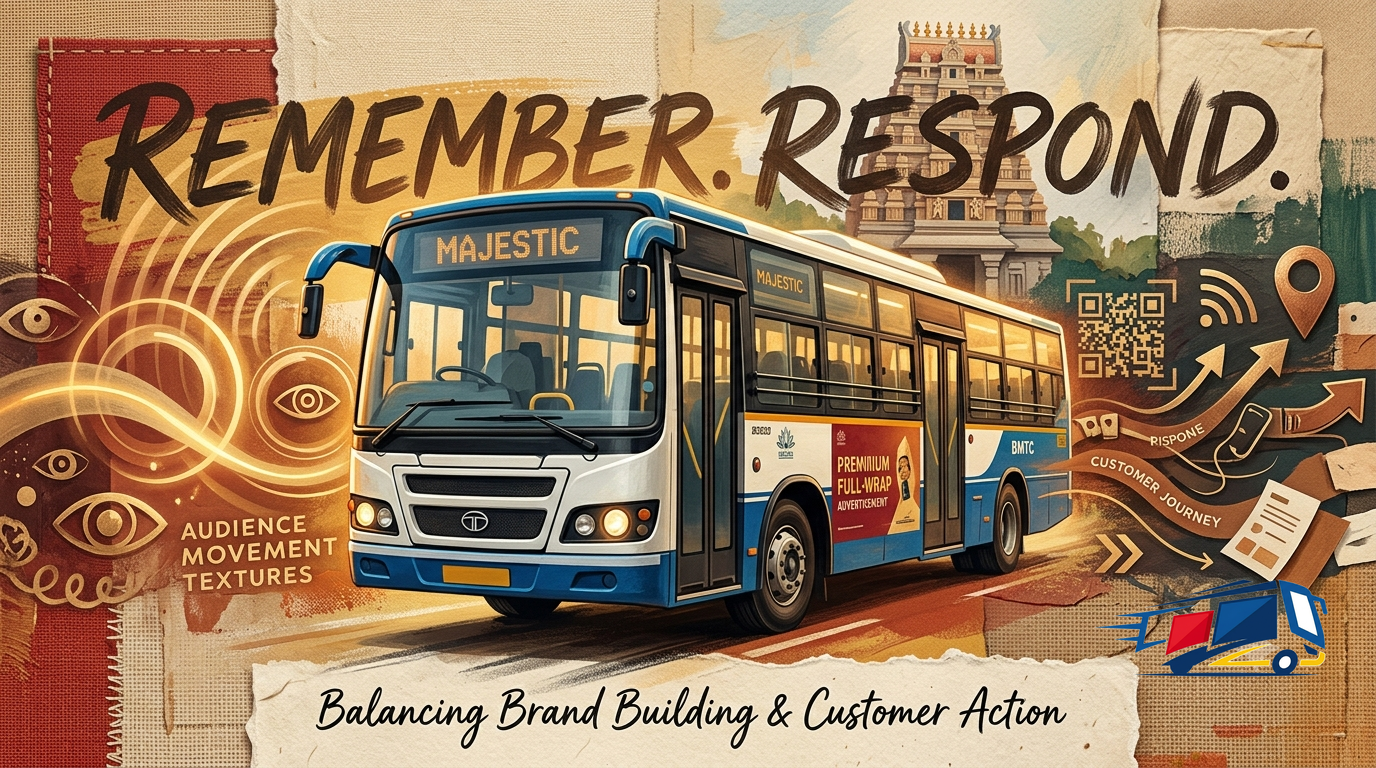
Brand Awareness vs Response Campaigns on Buses
What bus branding does best: awareness or direct response? A comparison of the two campaign types on buses, why a moving vehicle favours brand-building, and how to blend both.
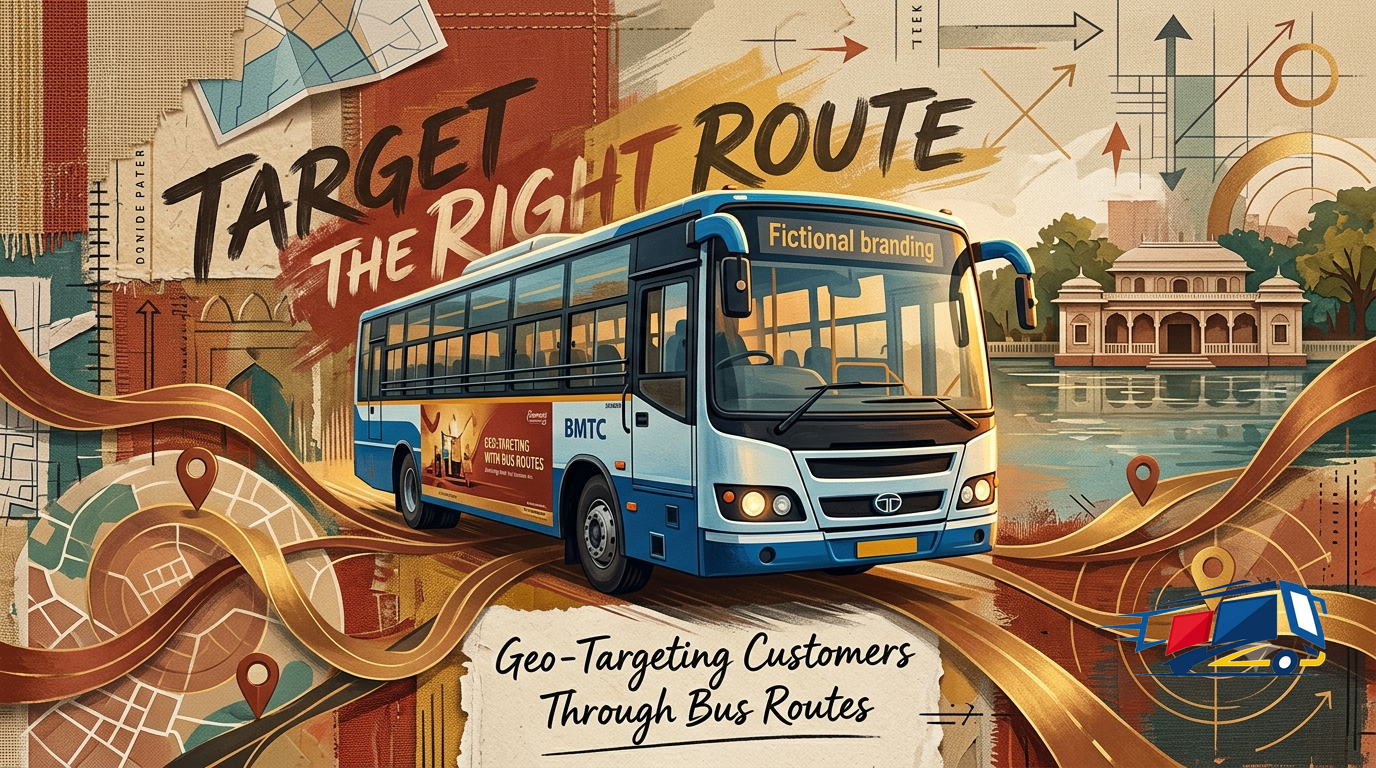
Geo-Targeting With Bus Routes: Advertising Where Your Customers Are
A bus route is a geo-targeting tool you can drive. How to map your customers to the routes they use, think in catchments instead of points, and stack corridors to cover a neighbourhood or a whole city.
Setting Campaign Objectives Before You Advertise
Why setting one clear objective before you advertise decides everything: awareness vs consideration vs response, how each maps to a different message, format and KPI, and how to write a SMART objective.