Namma Metro vs BMTC Buses: Which Reaches More of Bengaluru?
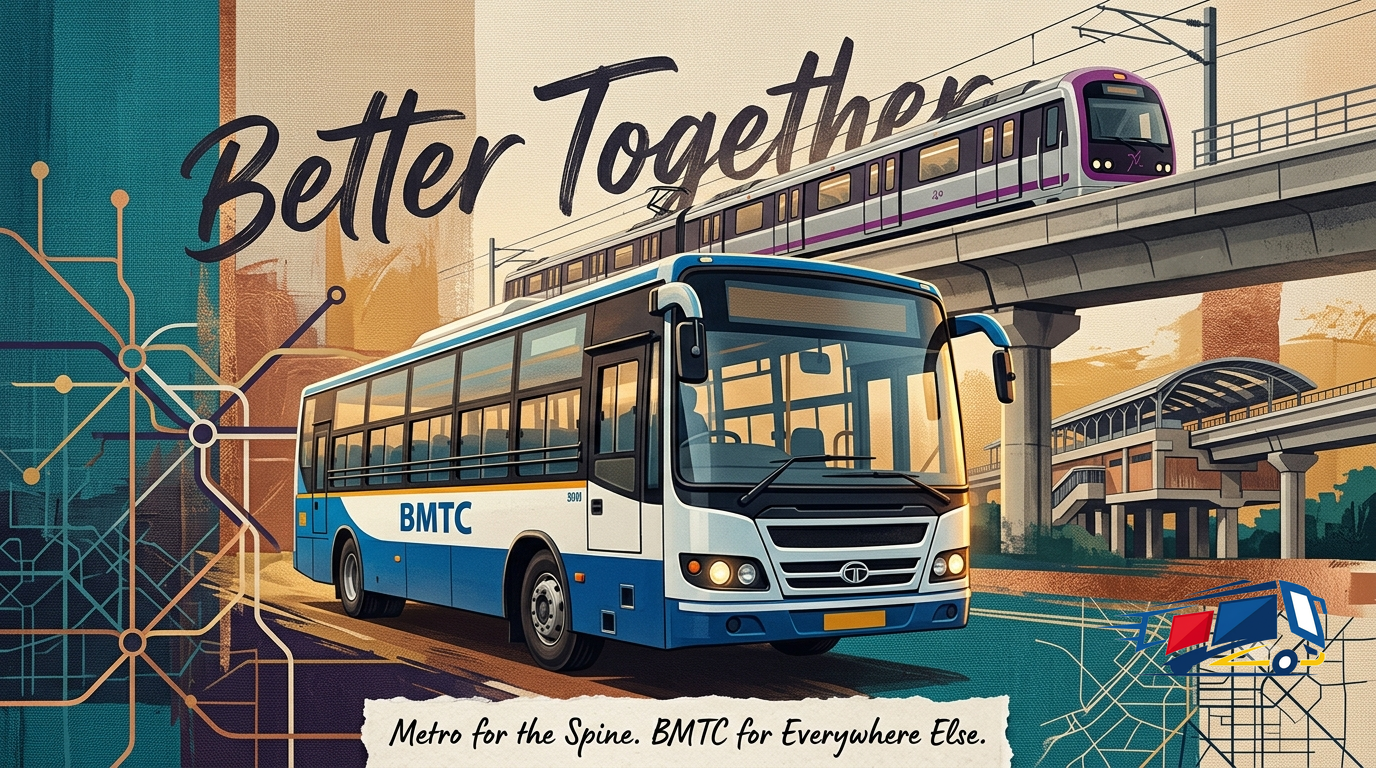
On geographic reach, it is not a close contest. Namma Metro is fast and growing, but it runs on about 96 km of track across 83 stations. BMTC buses cover the whole metropolitan region with more than 7,000 buses on 5,700-plus routes, reaching streets the rail lines do not touch.
Key takeaways
- Metro covers about 96 km on 83 stations; BMTC runs 5,700+ routes across the metro region.
- Metro carries close to 10 lakh daily riders; BMTC moves around 40 to 45 lakh.
- There is no metro to the airport yet; BMTC Vayu Vajra has covered it for years.
- Bus fares start at ₹6; metro fares run ₹10 to ₹90 by distance.
- The two work best together: metro for the spine, buses for everywhere else.
Namma Metro vs BMTC buses, side by side
Metro wins on speed and reliability per kilometre. Buses win on raw coverage, fares and the number of people moved every day.
| Measure | Namma Metro | BMTC buses |
|---|---|---|
| Network size | ~96 km, 83 stations | 5,700+ routes |
| Daily riders | ~10 lakh | ~40 to 45 lakh |
| Reach | 3 line corridors | Whole metro region |
| Fare range | ₹10 to ₹90 | From ₹6 |
| Airport link | Not yet | Vayu Vajra |
| Speed | Fixed, traffic-free | Shares the road |
Read this as two tools, not two rivals. The metro is a high-speed spine through a few dense corridors. The bus network is the fine mesh laid over the entire city, including the parts no train serves.
Which network reaches more of the city?
By coverage, buses reach far more of Bengaluru. The metro is concentrated on three corridors, while bus routes thread through almost every neighbourhood and the outer towns.
| Reach factor | Metro | Buses |
|---|---|---|
| Corridors | 3 lines | Citywide grid |
| Stops near homes | Station catchment | Stops on most streets |
| Outer towns | Limited | Covered |
| Last mile | Needs a feeder | Often door to area |
| New layouts | Years to build | Route added quickly |
A train can only serve what its line passes. A bus route can be drawn to a new layout in weeks. That flexibility is why the bus map keeps pace with a city that spreads outward every year.
Want your brand on Bengaluru's buses?
Get a route plan, format recommendation and pricing, usually within a minute.
Where the metro does not reach yet
Several of Bengaluru's biggest destinations still have no metro station, and buses carry that load today.
| Area | Metro status | Bus answer |
|---|---|---|
| KIA airport | Blue Line under build | Vayu Vajra |
| Sarjapur Road | Planned | Many routes |
| Kanakapura outskirts | Partial | Covered |
| Inner residential lanes | Not served | Stop-level reach |
| Outer suburbs and towns | Out of network | Regional routes |
Cost and flexibility
Bus fares start lower and bend to your route; metro fares are distance based and were among the steepest in the country after the 2025 revision.
| Factor | Metro | Buses |
|---|---|---|
| Starting fare | ₹10 | ₹6 |
| Top fare | ~₹90 | ~₹30 (city) |
| Free for women | No | Yes, non-AC |
| Route change | Fixed track | Flexible |
| Stops you choose | Set stations | Many stops |
The Shakti scheme tilts the everyday maths further. For a large share of women commuters, the non-AC bus is not just cheaper than the metro, it is free.
The smarter answer: use both
The strongest commute is rarely metro or bus alone. It is the metro for the fast middle stretch, with buses handling the start and the finish.
BMTC already runs feeder routes to metro stations for exactly this reason. The networks are being stitched together, not set against each other, with one NCMC card meant to cover both from 2026.
Ask which mode reaches more of Bengaluru and the honest answer is the bus, because it goes wherever there is a road, and Bengaluru is mostly road.
What this means for reaching an audience
If the goal is to be seen across the widest slice of the city, the network with more routes and more daily eyes on the street has the edge.
A bus goes to your customer; a station waits for them
Metro advertising reaches a fixed set of stations and the corridors between them. A branded bus travels into residential layouts, market roads, tech belts and outer towns, the same wide map that lets BMTC move four to five times the metro's daily riders. For citywide visibility, that spread is hard to match.
The sharpest plans use both: metro placements for the dense corridors, and buses to blanket everywhere else. See how we build that mix in bus branding in Bengaluru and across transit advertising.
Frequently Asked Questions
Does Namma Metro or BMTC cover more of Bengaluru?+
BMTC covers far more. It runs 5,700-plus routes across the metropolitan region, while the metro spans about 96 km on three lines. Buses reach areas no metro line touches.
How many people use the metro vs buses daily?+
Namma Metro carries close to 10 lakh riders a day, while BMTC moves around 40 to 45 lakh, roughly four to five times more.
Is there a metro to Bengaluru airport?+
Not yet. The Blue Line to KIA is under construction. Until it opens, BMTC Vayu Vajra buses are the public transport link to the airport.
Which is cheaper, metro or bus?+
Buses. Ordinary fares start at ₹6 against the metro's ₹10, and women travel free on non-AC buses under the Shakti scheme. Metro fares rise with distance up to about ₹90.
Can I use one card for both?+
That is the plan. A single NCMC card is being rolled out to work across BMTC buses and Namma Metro from 2026, as buses get compatible machines.
Should I take the metro or the bus?+
Use the metro for fast travel along its corridors, and buses for everywhere else and the last mile. Many trips are quickest using both.
Bus Branding Glossary
- Full bus branding (wrap)
- A full vehicle wrap covering both sides and the rear of the bus, the highest-impact, most visible format.
- Bus back / rear branding
- Advertising on the rear panel of the bus, in the line of sight of traffic queued behind it at signals and junctions.
- Side panel branding
- Branding on one or both side panels of the bus body, facing pedestrians and parallel traffic along the route.
- Vajra / AC service
- BMTC's premium air-conditioned (Volvo / Vayu Vajra) services, carrying a higher-income commuter set on IT and airport corridors.
- TTMC
- Traffic and Transit Management Centre, a large BMTC bus terminal where many routes start, terminate and interchange.
- Depot
- The BMTC facility where buses are parked, serviced and from which many local routes originate.
- Dwell time
- How long a bus stays in view of a stationary crowd, at a stop, signal or in slow traffic, which lengthens brand exposure.
- Corridor
- A main arterial road (e.g. the Outer Ring Road or Hosur Road) that a bus route runs along, defining who sees the branding.
How to run a BMTC bus branding campaign
Five simple steps from enquiry to a live, tracked campaign on Bengaluru's buses.
- 1
Pick your area & audience
Tell us the Bengaluru area or corridor you want to reach and who you're targeting, IT professionals, shoppers, students or residents.
- 2
Choose a format
Select a format, full bus wrap, rear panel, side panel or premium AC/Vajra service, based on your budget and the impact you want.
- 3
Select routes & bus count
We map the high-frequency routes and stops that cover your audience and recommend how many buses to brand.
- 4
Approve the creative
Share your artwork (or we help design it). We prepare it to BMTC specifications and get the approvals.
- 5
Go live & get proof
We print, wrap and deploy the buses, then share proof of display so you can see your brand on the road.
Bus Branding Formats
Choose how your brand rides, pick the format that fits your goal and budget.
Bus Branding Across Bengaluru
We run BMTC bus branding in every major Bengaluru neighbourhood. Explore more areas:
Outdoor & Transit Advertising Specialists
We plan, design and run BMTC bus branding campaigns across every major Bengaluru corridor, matching brands to the routes, formats and audiences that deliver the most visibility.
Discover More
Brand Awareness vs Response Campaigns on Buses
What bus branding does best: awareness or direct response? A comparison of the two campaign types on buses, why a moving vehicle favours brand-building, and how to blend both.
Geo-Targeting With Bus Routes: Advertising Where Your Customers Are
A bus route is a geo-targeting tool you can drive. How to map your customers to the routes they use, think in catchments instead of points, and stack corridors to cover a neighbourhood or a whole city.
Setting Campaign Objectives Before You Advertise
Why setting one clear objective before you advertise decides everything: awareness vs consideration vs response, how each maps to a different message, format and KPI, and how to write a SMART objective.