Reach vs Frequency in OOH: What Actually Matters
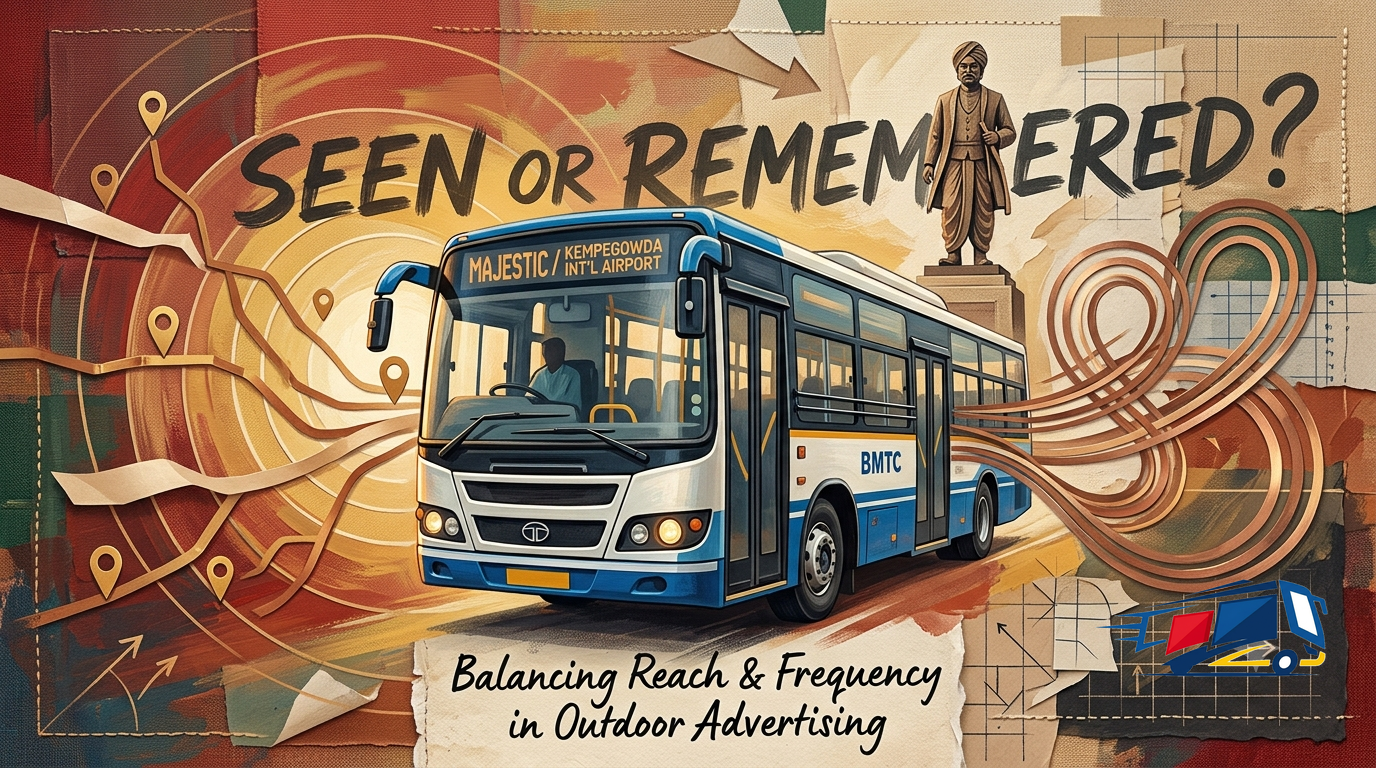
Reach is how many different people see your ad. Frequency is how many times each of them sees it. On a fixed budget you cannot max both at once, so the real planning question is not "how many people?" but "how many people, how many times?" For bus branding, a handful of route and fleet choices decide which one you get. Here is what actually matters.
Key takeaways
- Reach is breadth, frequency is depth. Reach counts unique people; frequency counts how often each sees it.
- They trade off: a fixed budget either spreads wide (more reach) or repeats often (more frequency), rarely both.
- One view is wasted: the common OOH benchmark is 3+ exposures before a message starts to stick.
- Route choice is the lever: spread buses across areas for reach, concentrate them on a corridor for frequency.
- Match it to your goal: reach for a launch, frequency for recall and action; awareness aims for ~60 to 70% reach at 3+.
The two terms, plainly
Strip away the jargon and they are simple. Reach is the count of distinct people who saw your ad at least once. Frequency is the average number of times each of those people saw it. Multiply them and you get total impressions.
| Term | Definition | Answers |
|---|---|---|
| Reach | Unique people who saw it | How many? |
| Frequency | Times each person saw it | How often? |
| Impressions | Reach × frequency | Total views |
The mistake is to chase impressions alone. A big impression number can be a lot of people once, or a few people many times, and those mean very different things for a campaign. Splitting it into reach and frequency is what makes the number useful.
Why they pull against each other
A budget buys a fixed pool of impressions. You can spend that pool on breadth or on depth, but not fully on both. Spread your buses across many areas and you touch more people fewer times; concentrate them and you touch fewer people more often.
Spend on reach when:
- Launching or entering a new area.
- Building broad awareness fast.
- The message is simple and instant.
- You want maximum people to know you exist.
Spend on frequency when:
- You need recall, not just a glance.
- The category is crowded or competitive.
- Driving action, not just awareness.
- Owning one area or audience deeply.
Source: reach and frequency have an opposing pull on a fixed budget; planners balance the two to a goal, 2026.
Want your brand on Bengaluru's buses?
Get a route plan, format recommendation and pricing, usually within a minute.
How much frequency is enough
Once is not enough. The widely used OOH benchmark is 3+ exposures, the point at which a message begins to register and stick. The classic logic: the first exposure sparks curiosity, the second brings recognition, the third prompts a response.
Source: a 3+ effective-frequency benchmark is common in OOH; the three-exposure logic (curiosity, recognition, response) underpins it. Crowded categories and considered purchases may need more, 2026.
| Goal | Frequency to aim for |
|---|---|
| Awareness | 3+ exposures, ~60 to 70% reach |
| Action / sales | 4 to 6 exposures |
| Crowded category | Often more, up to 8 to 10 |
The bus levers that shift each
This is where it gets practical. In bus branding, four choices move the reach-frequency balance, and you tune them deliberately. The biggest is route strategy: spread for reach, concentrate for frequency.
| Choice | More reach | More frequency |
|---|---|---|
| Routes | Spread across many areas | Concentrate on one corridor |
| Fleet size | More buses, wider spread | More buses, same routes |
| Duration | Shorter, broad burst | Longer, repeated exposure |
| Format | Wraps for street visibility | Back panels for repeat traffic |
A bus has a quiet advantage here: it builds frequency for free. Regular commuters pass the same branded bus day after day, so a concentrated route racks up repeat exposures without you paying for extra reach.
The same bus count gives very different results depending on how you deploy it. Ten buses across ten corridors maximise reach; ten buses on one corridor maximise frequency. Neither is wrong, the right choice is the one that matches your goal.
Which should win your plan
Decide by where your brand is and what you need next. New or unknown brands usually need reach first, get known. Established or competitive brands usually need frequency, be remembered and chosen. Then tune the bus levers to deliver it.
- Name your goal. Awareness and launch lean reach; recall and action lean frequency.
- Set a frequency floor. Aim for at least 3+ exposures so the spend is not wasted on single glances.
- Pick the route strategy. Spread for reach, concentrate for frequency, the single biggest lever.
- Tune duration and format. Longer runs and back panels add frequency; wraps and short bursts add reach.
- Hold enough of both. Do not chase reach so hard that frequency drops below the point of sticking.
We will plan the balance, not just the buses
Tell us your goal and we will build the route and fleet plan to hit it: spread across the city when you need broad awareness, concentrated on your corridors when you need to be remembered, always keeping frequency above the point where a message actually sticks. You will know whether your plan is buying breadth or depth, and why that fits what you are trying to do, rather than just counting buses.
Plan the right balance under bus branding in Bengaluru, or see how it ties to scale in transit advertising.
Frequently Asked Questions
What is the difference between reach and frequency?+
Reach is the number of unique people who see your ad; frequency is how many times each of them sees it. Reach is breadth, frequency is depth, and reach times frequency equals total impressions.
Which matters more for bus branding?+
It depends on your goal. Reach matters more for a launch or broad awareness; frequency matters more for recall, action, or a crowded category. Most plans need a sensible balance of both.
How many times should people see my bus?+
At least 3 times is the common OOH benchmark before a message sticks. Awareness goals aim for that across roughly 60 to 70% reach; sales or competitive goals often want 4 to 6 or more.
How do I get more frequency from a campaign?+
Concentrate buses on fewer routes, run longer, and use formats like back panels that catch repeat traffic. The same buses on one corridor build far more frequency than spread across many.
How do I get more reach?+
Spread buses across more areas and corridors, and favour high-visibility formats like wraps. A shorter, wider burst touches more unique people, though each one fewer times.
Is a big impression number a good sign?+
Not on its own. A large number can be many people once or few people often. Split it into reach and frequency to know whether your campaign is actually likely to stick.
Bus Branding Glossary
- Full bus branding (wrap)
- A full vehicle wrap covering both sides and the rear of the bus, the highest-impact, most visible format.
- Bus back / rear branding
- Advertising on the rear panel of the bus, in the line of sight of traffic queued behind it at signals and junctions.
- Side panel branding
- Branding on one or both side panels of the bus body, facing pedestrians and parallel traffic along the route.
- Vajra / AC service
- BMTC's premium air-conditioned (Volvo / Vayu Vajra) services, carrying a higher-income commuter set on IT and airport corridors.
- TTMC
- Traffic and Transit Management Centre, a large BMTC bus terminal where many routes start, terminate and interchange.
- Depot
- The BMTC facility where buses are parked, serviced and from which many local routes originate.
- Dwell time
- How long a bus stays in view of a stationary crowd, at a stop, signal or in slow traffic, which lengthens brand exposure.
- Corridor
- A main arterial road (e.g. the Outer Ring Road or Hosur Road) that a bus route runs along, defining who sees the branding.
How to run a BMTC bus branding campaign
Five simple steps from enquiry to a live, tracked campaign on Bengaluru's buses.
- 1
Pick your area & audience
Tell us the Bengaluru area or corridor you want to reach and who you're targeting, IT professionals, shoppers, students or residents.
- 2
Choose a format
Select a format, full bus wrap, rear panel, side panel or premium AC/Vajra service, based on your budget and the impact you want.
- 3
Select routes & bus count
We map the high-frequency routes and stops that cover your audience and recommend how many buses to brand.
- 4
Approve the creative
Share your artwork (or we help design it). We prepare it to BMTC specifications and get the approvals.
- 5
Go live & get proof
We print, wrap and deploy the buses, then share proof of display so you can see your brand on the road.
Bus Branding Formats
Choose how your brand rides, pick the format that fits your goal and budget.
Bus Branding Across Bengaluru
We run BMTC bus branding in every major Bengaluru neighbourhood. Explore more areas:
Outdoor & Transit Advertising Specialists
We plan, design and run BMTC bus branding campaigns across every major Bengaluru corridor, matching brands to the routes, formats and audiences that deliver the most visibility.
Discover More
Brand Awareness vs Response Campaigns on Buses
What bus branding does best: awareness or direct response? A comparison of the two campaign types on buses, why a moving vehicle favours brand-building, and how to blend both.
Geo-Targeting With Bus Routes: Advertising Where Your Customers Are
A bus route is a geo-targeting tool you can drive. How to map your customers to the routes they use, think in catchments instead of points, and stack corridors to cover a neighbourhood or a whole city.
Setting Campaign Objectives Before You Advertise
Why setting one clear objective before you advertise decides everything: awareness vs consideration vs response, how each maps to a different message, format and KPI, and how to write a SMART objective.