Renewing or Extending Your Bus Branding Campaign
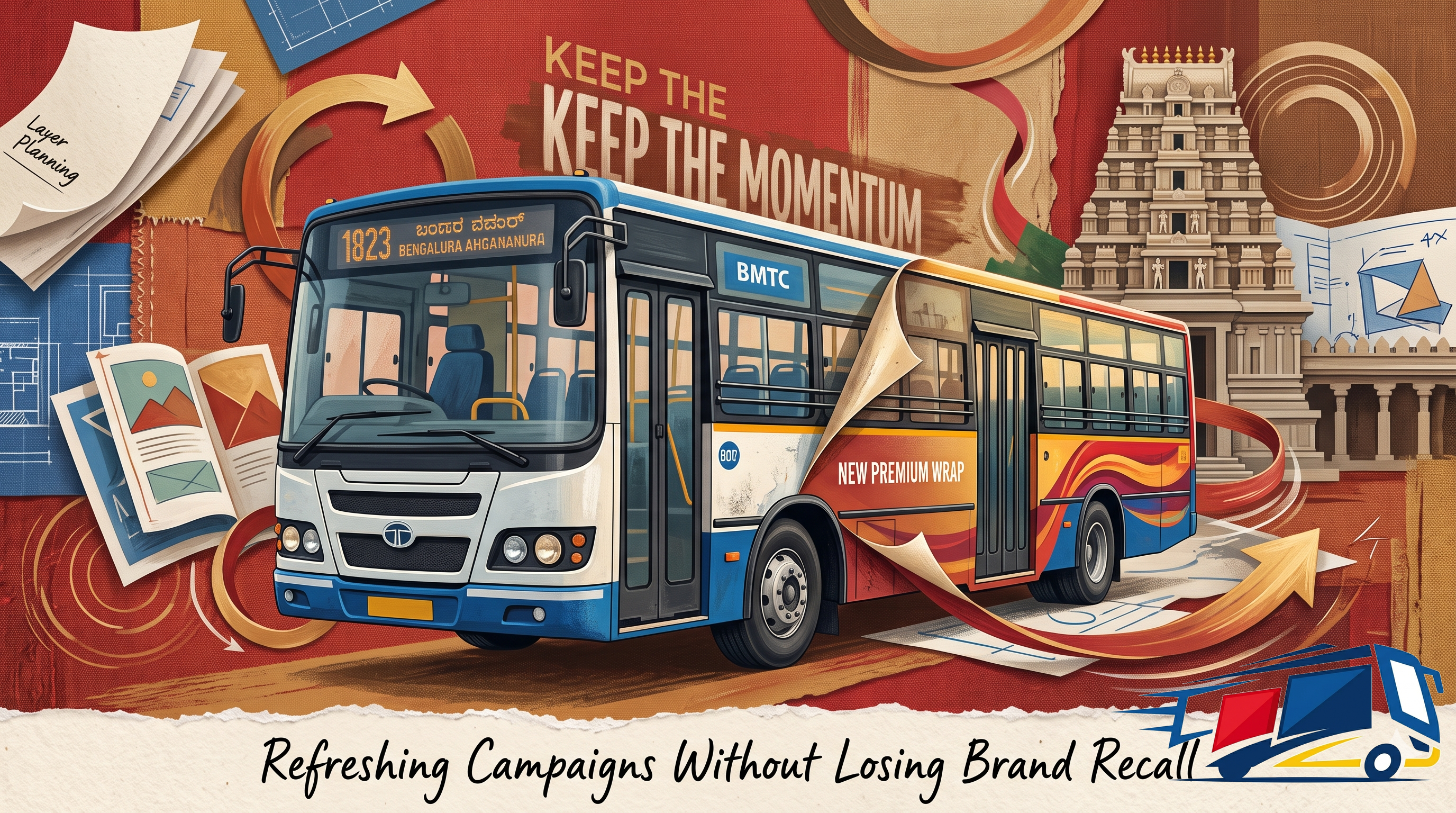
If your buses are working, the decision is not really whether to renew, it is whether you can afford to stop. Recall you paid weeks to build starts fading within days of the buses coming down. Extending protects that, lets you refresh the creative, and usually costs less per month than starting cold again later. Here is the case in numbers.
Key takeaways
- Stopping is expensive: unaided recall drops 40 to 60% within ~2 weeks of the last exposure, so a gap erases what you built.
- Refresh on renewal: rotating 3 to 4 creative variations extends the effective lifecycle by about 40%.
- Cycle by message: pricing messages refresh on a short cycle (max ~6 months), brand-building on 6 to 12.
- Renewing is cheaper per month than restarting cold, since a continued, longer commitment avoids paying setup again.
- Switch routes on renewal to refresh reach into new areas without breaking continuity.
Logic 1: the momentum you lose by stopping
The strongest reason to extend is what happens if you do not. Recall is not a permanent asset, it fades. Once the buses come down, unaided recall drops by roughly 40 to 60% within about two weeks, so a pause hands back most of the familiarity you spent the campaign building.
Logic 2: renewal is the moment to refresh creative
Running the same artwork forever invites fatigue, where people stop noticing what they have seen many times. Renewal is the natural point to rotate the creative, and rotating a small pool of designs measurably extends how long the campaign keeps working.
| Approach | Effect |
|---|---|
| Single creative, run long | Fatigue sets in, attention drops |
| Rotate 3 to 4 variations | ~40% longer effective lifecycle |
| Refresh at renewal | Resets attention, keeps the brand cue |
The skill is to refresh the execution while keeping the brand cue constant. Change the image, the offer or the headline, but hold the logo, colours and identity steady so each new design still compounds the same recall rather than starting over.
| Message type | Refresh cycle |
|---|---|
| Pricing / offer (rational) | Short, up to ~6 months |
| Brand building (emotive) | Longer, 6 to 12 months |
Want your brand on Bengaluru's buses?
Get a route plan, format recommendation and pricing, usually within a minute.
Logic 3: switch routes to refresh reach
Renewal does not have to mean the same buses on the same roads. Moving some or all of the fleet to new corridors lets you reach fresh audiences while keeping your overall presence unbroken, so continuity holds even as coverage shifts.
This turns a renewal into a growth lever. A brand that has saturated one corridor can carry its built-up momentum into the next, treating each renewal as a chance to widen the map rather than simply repeat the last run.
Logic 4: the economics of continuing
Continuing is usually cheaper per month than stopping and restarting later. A cold restart can mean fresh setup and printing, and you lose the lower per-month rate that a longer, continued commitment earns.
| Path | Per-month rate | Recall at restart |
|---|---|---|
| Extend / renew | Lower (longer commitment) | Held, compounding |
| Stop, restart later | Higher (short booking) | Rebuilt from a lower base |
Renew, refresh, or rest?
Extending is usually right, but not always. Use a simple read: if the buses are delivering and the goal is ongoing, renew and refresh; if it was a one-off event, a rest is fine.
- The campaign is building recall and you want it to hold.
- Your goal is ongoing awareness or category presence.
- You can refresh the creative or widen to new routes.
- Continuity matters more than a clean break.
- It was tied to a single event or season that has passed.
- The offer or message is no longer relevant.
- You are repositioning and need an entirely new approach.
- Budget must pause, accept recall will fade meanwhile.
Renewal is not buying the campaign again. It is protecting the recall you already paid for, refreshing the look so it keeps landing, and often paying less per month to do it.
How a renewal works
A renewal is lighter than a first campaign because the groundwork exists. The buses are already booked and branded, so extending is mostly a decision and, if you want, a creative swap.
- Decide before it ends. Confirm the extension before the current run finishes, so there is no gap for recall to fade in.
- Choose: same or refreshed. Keep the existing artwork, or rotate in new creative to beat fatigue.
- Keep or switch routes. Stay where recall is building, or move buses to widen reach.
- Lock the longer rate. A continued, longer commitment carries the lower per-month rate.
- Proof continues. The same daily photo and reporting cadence carries through the renewal.
Keep the momentum, refresh the look
If your buses are working, do not let the recall you built fade. We can extend before the current run ends, rotate in fresh creative so it keeps getting noticed, and move buses onto new routes if you want to grow reach, all while keeping the daily proof and a lower per-month rate for the longer commitment. Tell us what is working and what you want next, and we will set the renewal around it.
Plan a renewal under bus branding in Bengaluru, or revisit how duration and price connect in transit advertising.
Frequently Asked Questions
Why should I extend instead of stopping and returning later?+
Because recall fades fast. Unaided recall drops 40 to 60% within about two weeks of the last exposure, so returning later means rebuilding from a lower base rather than continuing from strength.
Should I change my creative when I renew?+
Usually yes. Rotating 3 to 4 creative variations extends the effective lifecycle by about 40%. Refresh the image or offer but keep the logo and identity constant so recall keeps compounding.
How often should the creative be refreshed?+
It depends on the message. Pricing or offer messages refresh on a short cycle, up to about 6 months; brand-building messages run longer, 6 to 12 months.
Can I move to different routes when I renew?+
Yes. You can keep routes to deepen recall, switch routes to reach new areas, or split the fleet. Your overall presence stays unbroken while coverage shifts.
Is renewing cheaper than starting again?+
Usually. A continued, longer commitment carries a lower per-month rate and avoids paying cold-restart setup, while keeping the recall a fresh start would have to rebuild.
When does it make sense not to renew?+
When the campaign was tied to a single event or season that has passed, the message is no longer relevant, or you are repositioning and need an entirely new approach.
Bus Branding Glossary
- Full bus branding (wrap)
- A full vehicle wrap covering both sides and the rear of the bus, the highest-impact, most visible format.
- Bus back / rear branding
- Advertising on the rear panel of the bus, in the line of sight of traffic queued behind it at signals and junctions.
- Side panel branding
- Branding on one or both side panels of the bus body, facing pedestrians and parallel traffic along the route.
- Vajra / AC service
- BMTC's premium air-conditioned (Volvo / Vayu Vajra) services, carrying a higher-income commuter set on IT and airport corridors.
- TTMC
- Traffic and Transit Management Centre, a large BMTC bus terminal where many routes start, terminate and interchange.
- Depot
- The BMTC facility where buses are parked, serviced and from which many local routes originate.
- Dwell time
- How long a bus stays in view of a stationary crowd, at a stop, signal or in slow traffic, which lengthens brand exposure.
- Corridor
- A main arterial road (e.g. the Outer Ring Road or Hosur Road) that a bus route runs along, defining who sees the branding.
How to run a BMTC bus branding campaign
Five simple steps from enquiry to a live, tracked campaign on Bengaluru's buses.
- 1
Pick your area & audience
Tell us the Bengaluru area or corridor you want to reach and who you're targeting, IT professionals, shoppers, students or residents.
- 2
Choose a format
Select a format, full bus wrap, rear panel, side panel or premium AC/Vajra service, based on your budget and the impact you want.
- 3
Select routes & bus count
We map the high-frequency routes and stops that cover your audience and recommend how many buses to brand.
- 4
Approve the creative
Share your artwork (or we help design it). We prepare it to BMTC specifications and get the approvals.
- 5
Go live & get proof
We print, wrap and deploy the buses, then share proof of display so you can see your brand on the road.
Bus Branding Formats
Choose how your brand rides, pick the format that fits your goal and budget.
Bus Branding Across Bengaluru
We run BMTC bus branding in every major Bengaluru neighbourhood. Explore more areas:
Outdoor & Transit Advertising Specialists
We plan, design and run BMTC bus branding campaigns across every major Bengaluru corridor, matching brands to the routes, formats and audiences that deliver the most visibility.
Discover More
Brand Awareness vs Response Campaigns on Buses
What bus branding does best: awareness or direct response? A comparison of the two campaign types on buses, why a moving vehicle favours brand-building, and how to blend both.
Geo-Targeting With Bus Routes: Advertising Where Your Customers Are
A bus route is a geo-targeting tool you can drive. How to map your customers to the routes they use, think in catchments instead of points, and stack corridors to cover a neighbourhood or a whole city.
Setting Campaign Objectives Before You Advertise
Why setting one clear objective before you advertise decides everything: awareness vs consideration vs response, how each maps to a different message, format and KPI, and how to write a SMART objective.