The Shakti Scheme: How Free Travel Changed BMTC Ridership
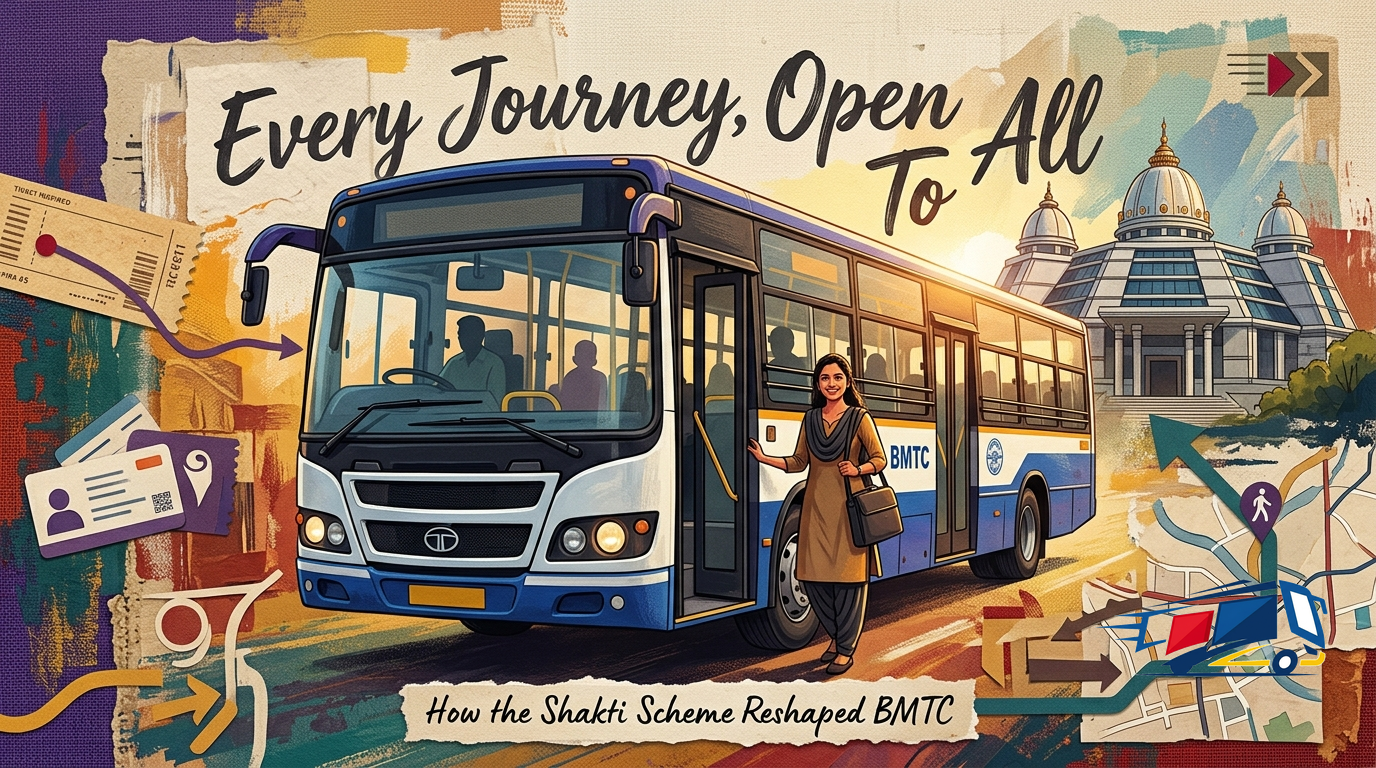
When Karnataka made bus travel free for women in June 2023, BMTC buses filled up fast. Women's ridership jumped over 150%, and their share of passengers climbed from 40% to 62%. Here is what changed, and who is on the bus now.
The Shakti scheme is the single biggest thing to happen to Bengaluru's buses in years. By removing the fare for women on ordinary buses, it pulled lakhs of new daily riders onto the network almost overnight. On BMTC, the effect was dramatic and, importantly, it has lasted rather than faded.
| Key fact | Detail |
|---|---|
| Launched | 11 June 2023 |
| Who | Women + transgender, Karnataka domiciled |
| Women's share (BMTC) | 40% to 62% |
| Women's ridership (BMTC) | +150% |
| Statewide tickets | 500 crore+ by Jul 2025 |
What the Shakti scheme is
Free bus travel for women on ordinary, non-AC, intra-state buses, since 11 June 2023.
Shakti is one of the Karnataka government's flagship guarantee schemes. Any woman or transgender person domiciled in the state rides free on ordinary buses across the four state corporations, on showing a valid ID. It does not cover AC services or interstate trips, which still charge a fare.
| Aspect | Detail |
|---|---|
| Launched | 11 June 2023 |
| Who qualifies | Women and transgender persons domiciled in Karnataka |
| Buses covered | Ordinary, non-AC, within the state |
| Not covered | AC (Vajra, Vayu Vajra) and interstate routes |
| Corporations | BMTC, KSRTC, NWKRTC, KKRTC |
| Proof needed | Valid government ID |
What it did to BMTC ridership
Women's ridership on BMTC rose over 150%, lifting their share from 40% to 62%.
A detailed study by Azim Premji University, published in November 2025, analysed more than 2.7 crore BMTC trip records from January 2023 to early 2025. It found the surge was sharpest in the first six months and then settled into a steady, regular pattern, which is the signal that matters: this is durable demand, not a one-off bump.
| Measure (BMTC) | Before | After |
|---|---|---|
| Women's share of riders | 40% | 62% |
| Women's daily ridership | Baseline | +150% |
| Busiest CBD routes | Men in majority | Women outnumber men |
Want your brand on Bengaluru's buses?
Get a route plan, format recommendation and pricing, usually within a minute.
Who is travelling now
A new wave of women riders, especially through the commercial core of the city.
The scheme did not just add riders, it changed who fills the bus. Women now outnumber men on many of the busiest routes, particularly those running through Majestic, KR Market and Shivajinagar. The change is also linked to more women reaching jobs and education, with one report citing a 23% rise in women's employment in Bengaluru.
| Pattern | Detail |
|---|---|
| Central Business District | Highest Shakti rider shares (Majestic, KR Market, Shivajinagar) |
| New routes | Over 2,000 routes added since the scheme |
| Employment link | ~23% rise in women's employment in Bengaluru |
| Lagging | Some peripheral east and southeast routes |
The interesting shift for anyone planning reach is not just that buses are fuller, it is who fills them. On the core corridors a BMTC bus now carries a majority-women audience, every trip, all day.
The statewide picture
Across all four corporations, daily bus riders jumped from about 85.84 lakh to 1.17 crore.
BMTC is one of four state corporations in the scheme, so the headline statewide numbers are even larger. By mid 2025 the programme had crossed half a thousand crore free tickets, a scale that shows how deeply free travel has reshaped bus use across Karnataka.
| Measure | Figure |
|---|---|
| Daily riders before | ~85.84 lakh |
| Daily riders now | ~1.17 crore |
| Women riding daily | ~54 lakh |
| Free tickets issued | 500 crore+ (by Jul 2025) |
What bigger crowds mean for advertisers
Fuller buses and a majority-women audience on key routes mean more, and more targeted, daily exposure.
For a brand, the Shakti effect is straightforward. More riders means more people seeing a wrap or interior panel on every trip. And because the rider mix has shifted toward women on the busiest corridors, the same bus now offers stronger reach for brands aimed at women. Best of all, the gains have held steady, so the exposure is dependable.
| Shift | What it means for a brand |
|---|---|
| More riders per bus | More eyeballs on every trip |
| Women a majority on key routes | Strong reach for women-focused brands |
| Sustained, not a spike | Dependable daily exposure |
| CBD routes busiest | Dense reach through the commercial core |
To use this audience, our bus branding solutions plan routes by rider profile. You can also read the bus types guide for who rides each service, or pick an area such as Koramangala.
Frequently Asked Questions
What is the Shakti scheme?+
A Karnataka government programme launched on 11 June 2023 that lets all women and transgender residents of the state travel free on ordinary, non-AC buses run by BMTC, KSRTC, NWKRTC and KKRTC within Karnataka.
How did the Shakti scheme change BMTC ridership?+
On BMTC, women's daily ridership rose by over 150% and women's share of passengers grew from 40% to 62%, according to an Azim Premji University study published in November 2025.
Are AC buses free under the Shakti scheme?+
No. The scheme covers only ordinary, non-AC, non-luxury buses within Karnataka. AC services such as Vajra and Vayu Vajra, and interstate routes, are not included and still charge fares.
How many free tickets has Shakti issued?+
The scheme crossed 500 crore free tickets across all four Karnataka transport corporations by July 2025, with a ticket value of more than Rs 12,500 crore over two years.
Do women now outnumber men on BMTC buses?+
On many of the busiest routes, yes, especially through the Central Business District. Women became the majority of riders on these corridors after the scheme, while some peripheral routes lag.
What does this mean for bus advertising?+
Higher, sustained ridership means more daily exposure for bus advertising, and a rider base skewed toward women on many routes, which strengthens reach for brands targeting women.
Bus Branding Glossary
- Full bus branding (wrap)
- A full vehicle wrap covering both sides and the rear of the bus, the highest-impact, most visible format.
- Bus back / rear branding
- Advertising on the rear panel of the bus, in the line of sight of traffic queued behind it at signals and junctions.
- Side panel branding
- Branding on one or both side panels of the bus body, facing pedestrians and parallel traffic along the route.
- Vajra / AC service
- BMTC's premium air-conditioned (Volvo / Vayu Vajra) services, carrying a higher-income commuter set on IT and airport corridors.
- TTMC
- Traffic and Transit Management Centre, a large BMTC bus terminal where many routes start, terminate and interchange.
- Depot
- The BMTC facility where buses are parked, serviced and from which many local routes originate.
- Dwell time
- How long a bus stays in view of a stationary crowd, at a stop, signal or in slow traffic, which lengthens brand exposure.
- Corridor
- A main arterial road (e.g. the Outer Ring Road or Hosur Road) that a bus route runs along, defining who sees the branding.
How to run a BMTC bus branding campaign
Five simple steps from enquiry to a live, tracked campaign on Bengaluru's buses.
- 1
Pick your area & audience
Tell us the Bengaluru area or corridor you want to reach and who you're targeting, IT professionals, shoppers, students or residents.
- 2
Choose a format
Select a format, full bus wrap, rear panel, side panel or premium AC/Vajra service, based on your budget and the impact you want.
- 3
Select routes & bus count
We map the high-frequency routes and stops that cover your audience and recommend how many buses to brand.
- 4
Approve the creative
Share your artwork (or we help design it). We prepare it to BMTC specifications and get the approvals.
- 5
Go live & get proof
We print, wrap and deploy the buses, then share proof of display so you can see your brand on the road.
Bus Branding Formats
Choose how your brand rides, pick the format that fits your goal and budget.
Bus Branding Across Bengaluru
We run BMTC bus branding in every major Bengaluru neighbourhood. Explore more areas:
Outdoor & Transit Advertising Specialists
We plan, design and run BMTC bus branding campaigns across every major Bengaluru corridor, matching brands to the routes, formats and audiences that deliver the most visibility.
Discover More
Brand Awareness vs Response Campaigns on Buses
What bus branding does best: awareness or direct response? A comparison of the two campaign types on buses, why a moving vehicle favours brand-building, and how to blend both.
Geo-Targeting With Bus Routes: Advertising Where Your Customers Are
A bus route is a geo-targeting tool you can drive. How to map your customers to the routes they use, think in catchments instead of points, and stack corridors to cover a neighbourhood or a whole city.
Setting Campaign Objectives Before You Advertise
Why setting one clear objective before you advertise decides everything: awareness vs consideration vs response, how each maps to a different message, format and KPI, and how to write a SMART objective.