Shivajinagar Bus Station: Central Reach for Advertisers
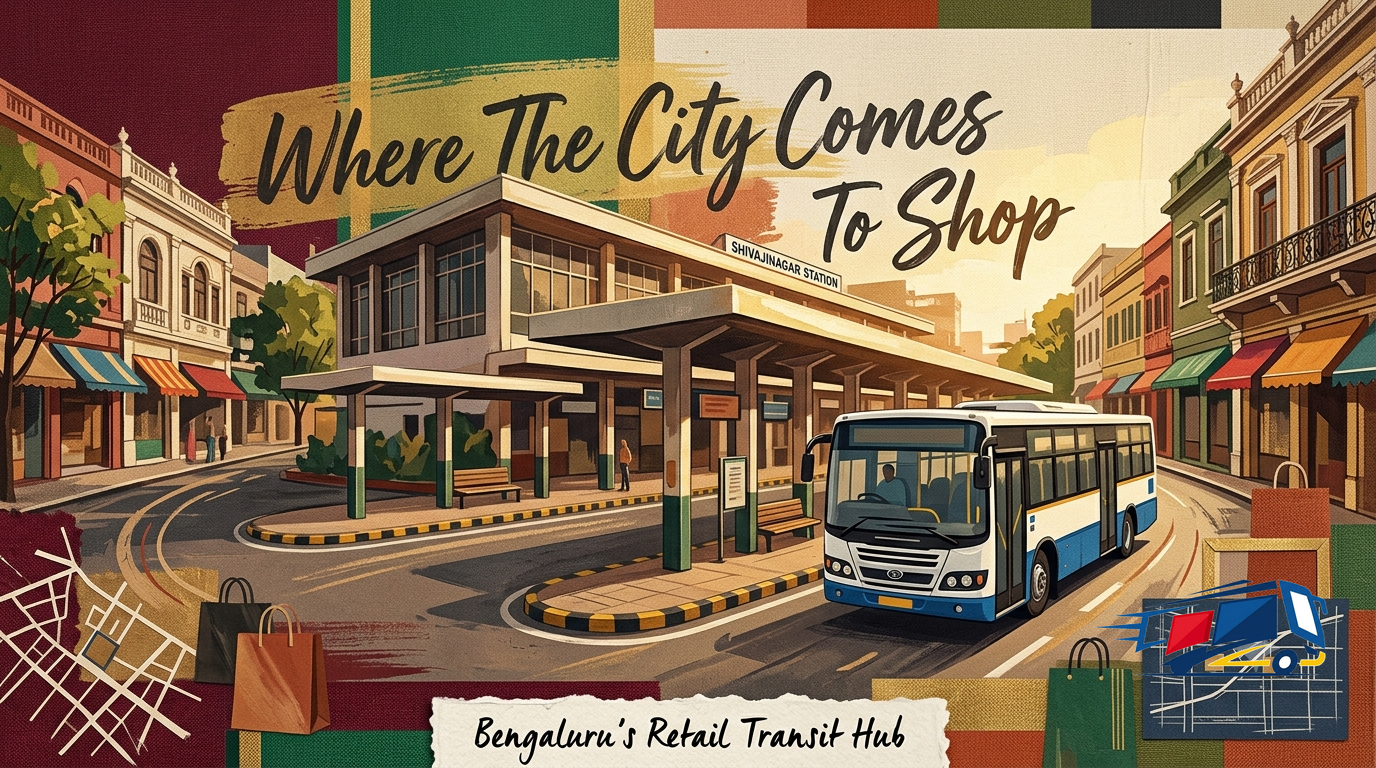
Some hubs move people. Shivajinagar moves shoppers. One of BMTC's three main terminals, it sits in the heart of the Central Business District, steps from Commercial Street and Russell Market, two of the oldest and busiest retail districts in Bengaluru. The footfall here arrives ready to buy.
Key takeaways
- Shivajinagar is one of BMTC's three main terminals, alongside Majestic and KR Market.
- It sits in the Central Business District, next to Commercial Street and Russell Market.
- It is a route origin (the SBS prefix) feeding Majestic, Hebbal, Yelahanka and more.
- The catchment is retail-led: shoppers, traders and CBD office crowds, not just commuters.
- An underground Pink Line metro station is coming around 2026, adding interchange footfall.
One of the city's three main terminals
Shivajinagar Bus Station is a core BMTC terminal in central Bengaluru. Where Majestic anchors the west and KR Market the old city, Shivajinagar anchors the Cantonment and the commercial core.
| Attribute | Detail |
|---|---|
| Status | 1 of 3 BMTC main terminals |
| Location | Central Street, Tasker Town |
| Zone | Central Business District |
| Route code | SBS |
| Beside | Commercial Street, Russell Market |
The address tells the story: the bus stand sits on Central Street, in Tasker Town, surrounded on all sides by retail. This is a terminal embedded in a shopping district, not parked on its edge.
Connectivity and routes served
Shivajinagar is a busy origin point. Routes fan out across the north and east of the city, and many carry the SBS prefix that marks this terminal as their start.
| Route | Type | Towards |
|---|---|---|
| G-3A, G-8, G-9 | Big 10 arterial | Major corridors |
| KIA-7A | Airport (Vayu Vajra) | Kempegowda Airport |
| 290 series | City | Hebbal, Nagawara |
| 126, 252, 306-S, 315 | City | Across the city |
| SBS-prefixed | Origin routes | Majestic, Yelahanka, Hebbal |
Want your brand on Bengaluru's buses?
Get a route plan, format recommendation and pricing, usually within a minute.
The catchment is built for retail
What sets Shivajinagar apart is what surrounds it. The terminal is ringed by the city's densest old-retail district, so its footfall is shopping-intent footfall.
| Landmark | What it is | Walk |
|---|---|---|
| Commercial Street | Clothes, footwear, jewellery, electronics | ~9 min |
| Russell Market | Historic fresh market | ~2 min |
| Bamboo Bazaar | Trade market | Nearby |
| MG Road | Premium retail and dining | Short hop |
| M. Chinnaswamy Stadium | Cricket, event crowds | Nearby |
Commercial Street alone is so dense it has only about 75 four-wheeler parking slots for its entire length, which pushes much of its shopper traffic onto buses, autos and on foot. That funnels a steady retail crowd straight past the terminal.
A metro station on the way
Shivajinagar is set to become a Namma Metro interchange. An underground Pink Line station is under construction, expected to open around 2026.
The Pink Line runs Kalena Agrahara to Nagawara, about 21.3 km with 18 stations, and its underground stretch includes Shivajinagar. Until it opens, the nearest metro is the Purple Line at MG Road and Trinity, a short walk away.
Why this hub suits advertisers
A bus terminal inside a shopping district reaches people at the moment they are spending, which is exactly when retail and consumer brands want to be seen.
A commuter is passing through on the way to somewhere else. A shopper at Shivajinagar has already arrived at the place they came to spend.
The brands that fit
Retail and consumer brands gain most here, because the terminal's crowd is already in a buying district and a buying frame of mind.
Reach shoppers where they shop
Buses turning in and out of Shivajinagar move through one of the busiest retail districts in the city, in front of a crowd that came to buy clothes, gold, electronics and food. For a retail or consumer brand, a bus on these central routes lands the message at the doorstep of the sale, not somewhere down a commuter line.
See how we pick central, high-intent routes in bus branding in Bengaluru, or plan a hub-led campaign with transit advertising.
Frequently Asked Questions
Where is Shivajinagar Bus Station?+
On Central Street, Tasker Town, in Bengaluru's Central Business District, beside Commercial Street and Russell Market. It is one of BMTC's three main terminals.
What makes Shivajinagar different from Majestic?+
Majestic is a high-volume interchange. Shivajinagar sits inside the city's retail core, so its footfall skews toward shoppers and traders rather than long-distance commuters.
Which routes run from Shivajinagar?+
Big 10 arterial routes (G-3A, G-8, G-9), the airport KIA-7A, the 290 series towards Hebbal, and many SBS-prefixed routes that originate here towards Majestic, Yelahanka and Hebbal.
Is there a metro at Shivajinagar?+
Not yet. An underground Pink Line station is under construction, expected around 2026. The nearest working metro is the Purple Line at MG Road and Trinity.
Why is Shivajinagar good for advertisers?+
Because its crowd is in a buying district and a buying mood. Buses serving the terminal reach shoppers around Commercial Street and Russell Market at the point of purchase.
Which brands should advertise here?+
Fashion, jewellery, electronics, food, retail finance and local services, all of which target the shopper crowd the retail district pulls in.
Bus Branding Glossary
- Full bus branding (wrap)
- A full vehicle wrap covering both sides and the rear of the bus, the highest-impact, most visible format.
- Bus back / rear branding
- Advertising on the rear panel of the bus, in the line of sight of traffic queued behind it at signals and junctions.
- Side panel branding
- Branding on one or both side panels of the bus body, facing pedestrians and parallel traffic along the route.
- Vajra / AC service
- BMTC's premium air-conditioned (Volvo / Vayu Vajra) services, carrying a higher-income commuter set on IT and airport corridors.
- TTMC
- Traffic and Transit Management Centre, a large BMTC bus terminal where many routes start, terminate and interchange.
- Depot
- The BMTC facility where buses are parked, serviced and from which many local routes originate.
- Dwell time
- How long a bus stays in view of a stationary crowd, at a stop, signal or in slow traffic, which lengthens brand exposure.
- Corridor
- A main arterial road (e.g. the Outer Ring Road or Hosur Road) that a bus route runs along, defining who sees the branding.
How to run a BMTC bus branding campaign
Five simple steps from enquiry to a live, tracked campaign on Bengaluru's buses.
- 1
Pick your area & audience
Tell us the Bengaluru area or corridor you want to reach and who you're targeting, IT professionals, shoppers, students or residents.
- 2
Choose a format
Select a format, full bus wrap, rear panel, side panel or premium AC/Vajra service, based on your budget and the impact you want.
- 3
Select routes & bus count
We map the high-frequency routes and stops that cover your audience and recommend how many buses to brand.
- 4
Approve the creative
Share your artwork (or we help design it). We prepare it to BMTC specifications and get the approvals.
- 5
Go live & get proof
We print, wrap and deploy the buses, then share proof of display so you can see your brand on the road.
Bus Branding Formats
Choose how your brand rides, pick the format that fits your goal and budget.
Bus Branding Across Bengaluru
We run BMTC bus branding in every major Bengaluru neighbourhood. Explore more areas:
Outdoor & Transit Advertising Specialists
We plan, design and run BMTC bus branding campaigns across every major Bengaluru corridor, matching brands to the routes, formats and audiences that deliver the most visibility.
Discover More
Brand Awareness vs Response Campaigns on Buses
What bus branding does best: awareness or direct response? A comparison of the two campaign types on buses, why a moving vehicle favours brand-building, and how to blend both.
Geo-Targeting With Bus Routes: Advertising Where Your Customers Are
A bus route is a geo-targeting tool you can drive. How to map your customers to the routes they use, think in catchments instead of points, and stack corridors to cover a neighbourhood or a whole city.
Setting Campaign Objectives Before You Advertise
Why setting one clear objective before you advertise decides everything: awareness vs consideration vs response, how each maps to a different message, format and KPI, and how to write a SMART objective.