Volvo & Vajra Premium Routes: Who Actually Rides Them
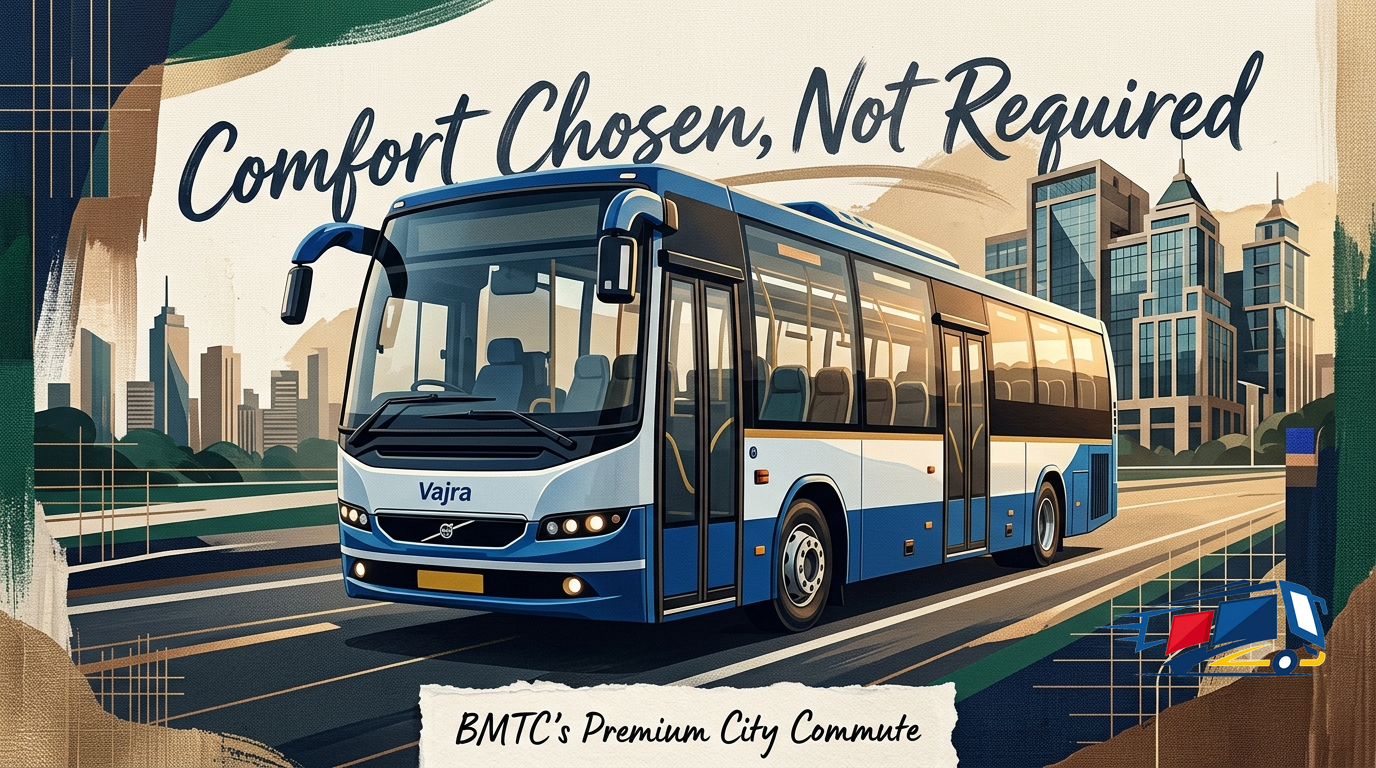
There is a simple tell about money on a BMTC route. Women ride non-AC buses free under the Shakti scheme, yet some still pay for the Vajra AC Volvo. Anyone choosing a Vajra is paying 1.5 to 3 times the ordinary fare for comfort, which makes the AC bus a self-sorting filter for spending power.
Key takeaways
- Vajra is BMTC's AC Volvo and Switch city class, a tier above ordinary buses.
- Vajra fares run 1.5 to 3x ordinary, and the monthly pass is ₹2,000 vs ₹1,200.
- Vajra is not covered by the free Shakti scheme, so every rider pays by choice.
- The class started on the IT corridors and still skews toward salaried professionals.
- That self-selection makes Vajra routes a clean way to reach a higher-income audience.
BMTC's service classes, top to bottom
BMTC runs several classes, but the line that matters for spending power is AC versus non-AC. Vajra sits at the premium end of city travel.
| Class | Type | Relative fare |
|---|---|---|
| Vajra | AC Volvo / Switch, city | Premium |
| Vayu Vajra | AC, airport only | Premium |
| Suvarna / Pushpak | Non-AC, slight upgrade | Near ordinary |
| Bengaluru Sarige | Standard non-AC | Ordinary |
| Astra | Non-AC electric | Ordinary |
BMTC was the first state transport body in India to run Volvo low-floor AC city buses, launching Vajra in the early 2000s on the IT corridors. That heritage still shapes who rides it.
Why the fare works as a wallet filter
On an ordinary bus, the crowd is everyone. On a Vajra, the crowd has chosen to pay a premium for AC and comfort, which quietly screens for higher disposable income.
| Measure | Ordinary | Vajra (AC) |
|---|---|---|
| Per-trip fare | from ₹6 | 1.5 to 3x higher |
| Monthly pass | ₹1,200 | ₹2,000 |
| Free for women | Yes (Shakti) | No |
| Comfort | Basic | AC, low-floor, seats |
| Self-selection | Everyone | Pays for comfort |
Want your brand on Bengaluru's buses?
Get a route plan, format recommendation and pricing, usually within a minute.
So who actually rides Vajra?
The Vajra crowd skews toward salaried professionals on the tech and CBD corridors: people who value time and comfort over the lowest fare.
| Trait | What it signals |
|---|---|
| Pays a premium fare | Disposable income, comfort-led |
| IT and corporate commuters | Salaried, stable spend |
| Time-sensitive | Values speed and reliability |
| Corridor-based | ORR, Whitefield, CBD routes |
| Digital-first | Apps, cards, online payment |
It is a smaller crowd than the ordinary buses carry, but a more uniform one. The AC fare has already done the segmentation a marketer would otherwise pay to do.
Vajra vs ordinary, as audiences
The two classes are almost different media. Ordinary buses are mass reach at low cost; Vajra is a smaller, higher-income audience at a premium.
The price of the ticket pre-sorts the bus. By the time someone sits down on a Vajra, they have already told you something about their wallet.
The advertisers Vajra suits
Brands selling to salaried, urban, higher-income buyers get a cleaner audience on Vajra than on any mass route.
Indicative categories whose buyers concentrate on AC premium routes.
Planning a premium-route campaign
Targeting by class is a budget decision: pay more per bus to reach fewer but wealthier riders, on the corridors where they cluster.
- Choose Vajra over ordinary when income skew matters more than raw reach.
- Focus on the IT and CBD corridors where Vajra demand is highest.
- Use the exterior wrap for presence and interiors for a captive AC audience.
- Match the message tone to a premium buyer; this is not a discount audience.
- Blend with ordinary routes only when you also need mass reach.
Let the fare do your targeting
Most outdoor media cannot segment by income. A Vajra route can, because the AC fare already filters for it. For premium fintech, devices, hospitality and lifestyle brands, branding the AC class reaches a smaller but markedly wealthier audience than the same spend on ordinary buses.
See how we segment routes by audience in bus branding in Bengaluru, or scope a premium-class buy with transit advertising.
Frequently Asked Questions
What is the difference between Vajra and ordinary BMTC buses?+
Vajra is the AC Volvo and Switch class, more comfortable and faster, costing 1.5 to 3 times the ordinary non-AC fare. Ordinary buses (Bengaluru Sarige) are the standard service.
How much more does a Vajra cost than an ordinary bus?+
Roughly 1.5 to 3 times per trip. The Vajra monthly pass is ₹2,000 against ₹1,200 for ordinary, after the January 2026 revision.
Is Vajra free for women under the Shakti scheme?+
No. Shakti free travel covers only non-AC buses. A woman riding a paid Vajra is choosing comfort over a free ride, a clear spending-power signal.
Who typically rides Vajra buses?+
Mostly salaried professionals on the IT and CBD corridors who value comfort, AC and reliability over the lowest fare.
Why would an advertiser pick Vajra routes?+
Because the premium fare pre-filters for income. Brands reach a smaller but wealthier, more uniform audience than on mass-reach ordinary routes.
Which brands suit premium bus routes?+
Premium fintech, devices, hospitality, lifestyle, real estate and healthcare brands, all targeting higher-income urban professionals.
Bus Branding Glossary
- Full bus branding (wrap)
- A full vehicle wrap covering both sides and the rear of the bus, the highest-impact, most visible format.
- Bus back / rear branding
- Advertising on the rear panel of the bus, in the line of sight of traffic queued behind it at signals and junctions.
- Side panel branding
- Branding on one or both side panels of the bus body, facing pedestrians and parallel traffic along the route.
- Vajra / AC service
- BMTC's premium air-conditioned (Volvo / Vayu Vajra) services, carrying a higher-income commuter set on IT and airport corridors.
- TTMC
- Traffic and Transit Management Centre, a large BMTC bus terminal where many routes start, terminate and interchange.
- Depot
- The BMTC facility where buses are parked, serviced and from which many local routes originate.
- Dwell time
- How long a bus stays in view of a stationary crowd, at a stop, signal or in slow traffic, which lengthens brand exposure.
- Corridor
- A main arterial road (e.g. the Outer Ring Road or Hosur Road) that a bus route runs along, defining who sees the branding.
How to run a BMTC bus branding campaign
Five simple steps from enquiry to a live, tracked campaign on Bengaluru's buses.
- 1
Pick your area & audience
Tell us the Bengaluru area or corridor you want to reach and who you're targeting, IT professionals, shoppers, students or residents.
- 2
Choose a format
Select a format, full bus wrap, rear panel, side panel or premium AC/Vajra service, based on your budget and the impact you want.
- 3
Select routes & bus count
We map the high-frequency routes and stops that cover your audience and recommend how many buses to brand.
- 4
Approve the creative
Share your artwork (or we help design it). We prepare it to BMTC specifications and get the approvals.
- 5
Go live & get proof
We print, wrap and deploy the buses, then share proof of display so you can see your brand on the road.
Bus Branding Formats
Choose how your brand rides, pick the format that fits your goal and budget.
Bus Branding Across Bengaluru
We run BMTC bus branding in every major Bengaluru neighbourhood. Explore more areas:
Outdoor & Transit Advertising Specialists
We plan, design and run BMTC bus branding campaigns across every major Bengaluru corridor, matching brands to the routes, formats and audiences that deliver the most visibility.
Discover More
Brand Awareness vs Response Campaigns on Buses
What bus branding does best: awareness or direct response? A comparison of the two campaign types on buses, why a moving vehicle favours brand-building, and how to blend both.
Geo-Targeting With Bus Routes: Advertising Where Your Customers Are
A bus route is a geo-targeting tool you can drive. How to map your customers to the routes they use, think in catchments instead of points, and stack corridors to cover a neighbourhood or a whole city.
Setting Campaign Objectives Before You Advertise
Why setting one clear objective before you advertise decides everything: awareness vs consideration vs response, how each maps to a different message, format and KPI, and how to write a SMART objective.