BMTC Depots in Bengaluru: Locations & Coverage
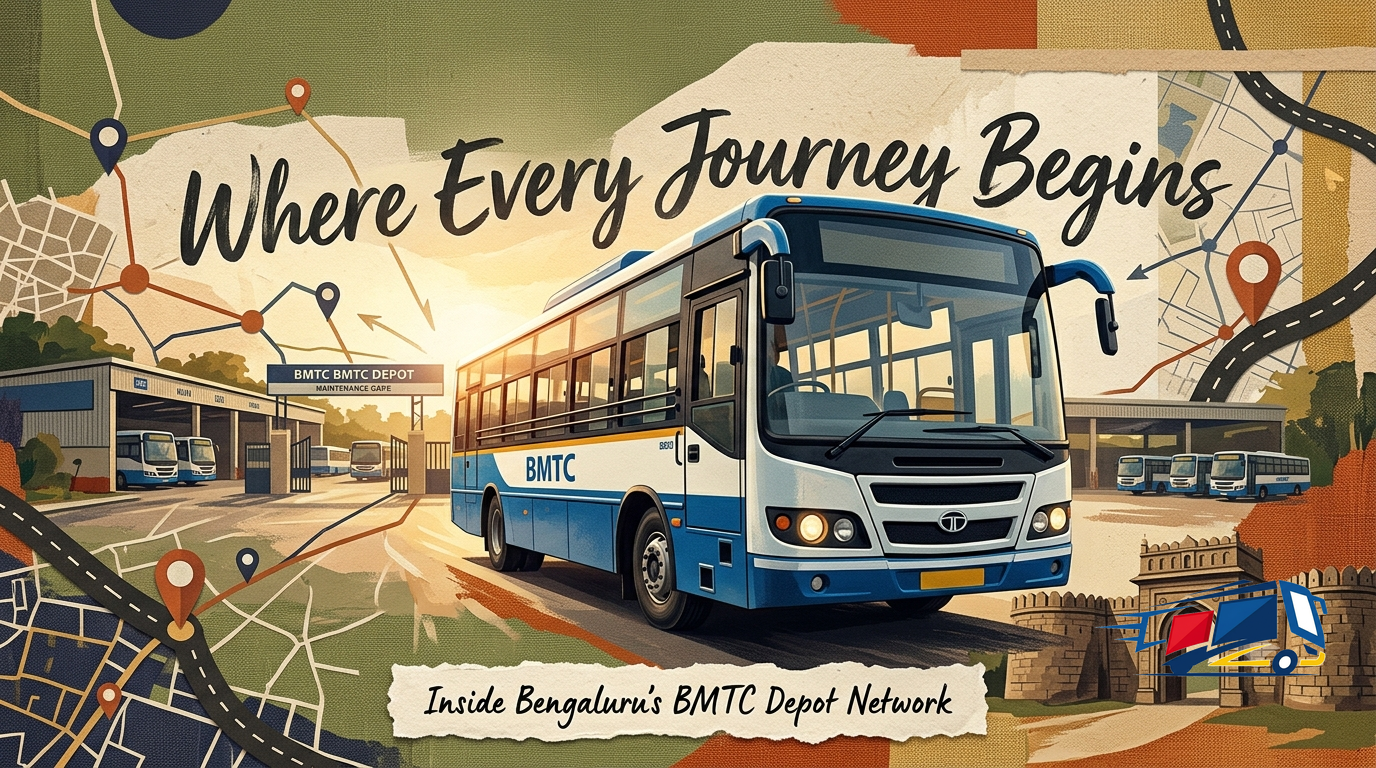
BMTC runs around 50 depots spread across Bengaluru, from Yelahanka in the north to Electronic City in the south. Each depot is a base that buses fan out from, which is what quietly decides how much of the city the network reaches.
A BMTC depot is more than a parking lot. It is where a cluster of buses is kept, serviced and sent out each morning, and the routes it runs tend to radiate from that spot. So the map of depots is really a map of where the network is strongest. BMTC has roughly 50 depots, reaching well past the city core into towns like Hoskote and Nelamangala.
| Key fact | Detail |
|---|---|
| Depots | ~50 across Bengaluru |
| Spread | Every side, core to satellite towns |
| Role | Each depot bases and launches its routes |
| Reach | Routes extend ~25 km beyond the city |
| Run from depots | 5,700+ routes citywide |
How many depots, and where
Around 50 depots, numbered and spread across every side of the city.
BMTC names its depots by number, from the central ones near Majestic out to the edges of the metropolitan region. The count has grown with the fleet, sitting near 50 today. Several depots double up as Traffic and Transit Management Centres, the larger hubs that also hold passenger amenities.
Major depots and the areas they anchor
Depots sit in every part of Bengaluru, grouped here by side of the city.
The table maps the major depots to their localities, organised by direction so you can see how evenly the network is anchored. Tech corridors, the core and the outskirts all have their own bases.
| Side | Depot localities |
|---|---|
| Central / South | Shanthinagar, Jayanagar, Katriguppe, Banashankari, Poornapragna Layout, Kothanur Dinne, Sadenahalli, Anjanapura |
| North | Yelahanka, Hebbal, R.T. Nagar, M.S. Palya |
| Northwest | Yeshwanthpura, Peenya, Sumanahalli, Shivanpura, Nelamangala |
| Northeast | Hennur, Kalyan Nagar, Byrathi |
| East | Indiranagar, ITPL Whitefield, K.R. Puram, Gunjur, Mandur, Hoskote |
| Southeast | Koramangala, HSR Layout, Chikkanagamangala, Surya City |
| South tech | Electronic City, Jigani |
| West / Southwest | Deepanjali Nagar, Chandra Layout, Rajarajeshwari Nagar, Kengeri, Bidadi |
Want your brand on Bengaluru's buses?
Get a route plan, format recommendation and pricing, usually within a minute.
How depots shape routes and coverage
Buses begin and end their day at a depot, so depot location sets which corridors run most.
Because a depot launches the routes around it, the areas closest to a depot tend to get the most frequent service. That is why tech corridors have dedicated depots nearby, and why the outskirts gained their own bases as the city sprawled. The table links depot clusters to the corridors they feed.
| Depot cluster | Anchors service to |
|---|---|
| ITPL, Gunjur (east) | The Whitefield tech corridor |
| Electronic City, Jigani (south) | The Hosur Road tech and industrial belt |
| Yeshwanthpura, Peenya (northwest) | The industrial belt and highway corridors |
| Koramangala, HSR Layout (southeast) | The startup and residential southeast |
| Yelahanka, Hebbal (north) | The airport side and north Bengaluru |
| Kengeri, RR Nagar (west) | Mysore Road and the western suburbs |
If you want to know where the buses really are during the day, look at the depots. A neighbourhood with two or three depots around it is moving a lot more buses than one on the far edge of a single depot's routes.
Why depot geography matters for targeting
Depot density in an area maps directly to how often a branded bus passes through it.
This is where depots become useful to advertisers. A campaign built around an area rides the buses based at nearby depots, so the more depots feeding a zone, the more often your brand moves through it. Depot geography is, in effect, a frequency map for transit advertising.
| Depot pattern | What it means for a brand |
|---|---|
| Several depots near a zone | More buses, so higher ad frequency there |
| Tech-corridor depots | Reach IT commuters on those routes |
| Outskirt depots | Extend a campaign to satellite towns |
| Central depots | Dense coverage of the core city |
To target by area, our bus branding solutions plan routes by depot and corridor. You can also read BMTC by the numbers for citywide scale, or pick an area such as Koramangala.
Frequently Asked Questions
How many depots does BMTC have?+
Around 50 across Bengaluru as of 2025. The number has grown with the fleet, and depots are spread from the city core out to satellite towns on the periphery.
Where are BMTC depots located?+
In every part of the city, including Shanthinagar, Jayanagar, Indiranagar, Koramangala, Yeshwanthpura, Peenya, Yelahanka, Kengeri, ITPL Whitefield and Electronic City, plus outlying depots like Hoskote and Nelamangala.
What is a BMTC depot?+
It is the base where a group of buses is parked, maintained and dispatched. Each depot runs a set of routes, so its location shapes which areas get frequent service.
Which depot serves Koramangala?+
Koramangala has its own depot, Depot 15, in the southeast. Nearby HSR Layout also has a depot, so the southeast startup and residential belt is well covered.
Do BMTC depots cover the outskirts?+
Yes. Beyond the core, depots at Hoskote, Nelamangala, Bidadi and Jigani extend BMTC's reach into satellite towns and the metropolitan periphery, roughly 25 km out.
How do depots affect bus advertising?+
Depot location decides which corridors get the most buses, so depot geography maps to where a campaign reaches with frequency. More depots near an area usually means more branded buses moving through it.
Bus Branding Glossary
- Full bus branding (wrap)
- A full vehicle wrap covering both sides and the rear of the bus, the highest-impact, most visible format.
- Bus back / rear branding
- Advertising on the rear panel of the bus, in the line of sight of traffic queued behind it at signals and junctions.
- Side panel branding
- Branding on one or both side panels of the bus body, facing pedestrians and parallel traffic along the route.
- Vajra / AC service
- BMTC's premium air-conditioned (Volvo / Vayu Vajra) services, carrying a higher-income commuter set on IT and airport corridors.
- TTMC
- Traffic and Transit Management Centre, a large BMTC bus terminal where many routes start, terminate and interchange.
- Depot
- The BMTC facility where buses are parked, serviced and from which many local routes originate.
- Dwell time
- How long a bus stays in view of a stationary crowd, at a stop, signal or in slow traffic, which lengthens brand exposure.
- Corridor
- A main arterial road (e.g. the Outer Ring Road or Hosur Road) that a bus route runs along, defining who sees the branding.
How to run a BMTC bus branding campaign
Five simple steps from enquiry to a live, tracked campaign on Bengaluru's buses.
- 1
Pick your area & audience
Tell us the Bengaluru area or corridor you want to reach and who you're targeting, IT professionals, shoppers, students or residents.
- 2
Choose a format
Select a format, full bus wrap, rear panel, side panel or premium AC/Vajra service, based on your budget and the impact you want.
- 3
Select routes & bus count
We map the high-frequency routes and stops that cover your audience and recommend how many buses to brand.
- 4
Approve the creative
Share your artwork (or we help design it). We prepare it to BMTC specifications and get the approvals.
- 5
Go live & get proof
We print, wrap and deploy the buses, then share proof of display so you can see your brand on the road.
Bus Branding Formats
Choose how your brand rides, pick the format that fits your goal and budget.
Bus Branding Across Bengaluru
We run BMTC bus branding in every major Bengaluru neighbourhood. Explore more areas:
Outdoor & Transit Advertising Specialists
We plan, design and run BMTC bus branding campaigns across every major Bengaluru corridor, matching brands to the routes, formats and audiences that deliver the most visibility.
Discover More
Brand Awareness vs Response Campaigns on Buses
What bus branding does best: awareness or direct response? A comparison of the two campaign types on buses, why a moving vehicle favours brand-building, and how to blend both.
Geo-Targeting With Bus Routes: Advertising Where Your Customers Are
A bus route is a geo-targeting tool you can drive. How to map your customers to the routes they use, think in catchments instead of points, and stack corridors to cover a neighbourhood or a whole city.
Setting Campaign Objectives Before You Advertise
Why setting one clear objective before you advertise decides everything: awareness vs consideration vs response, how each maps to a different message, format and KPI, and how to write a SMART objective.