What Is a TTMC? Bengaluru's Traffic & Transit Management Centres Explained
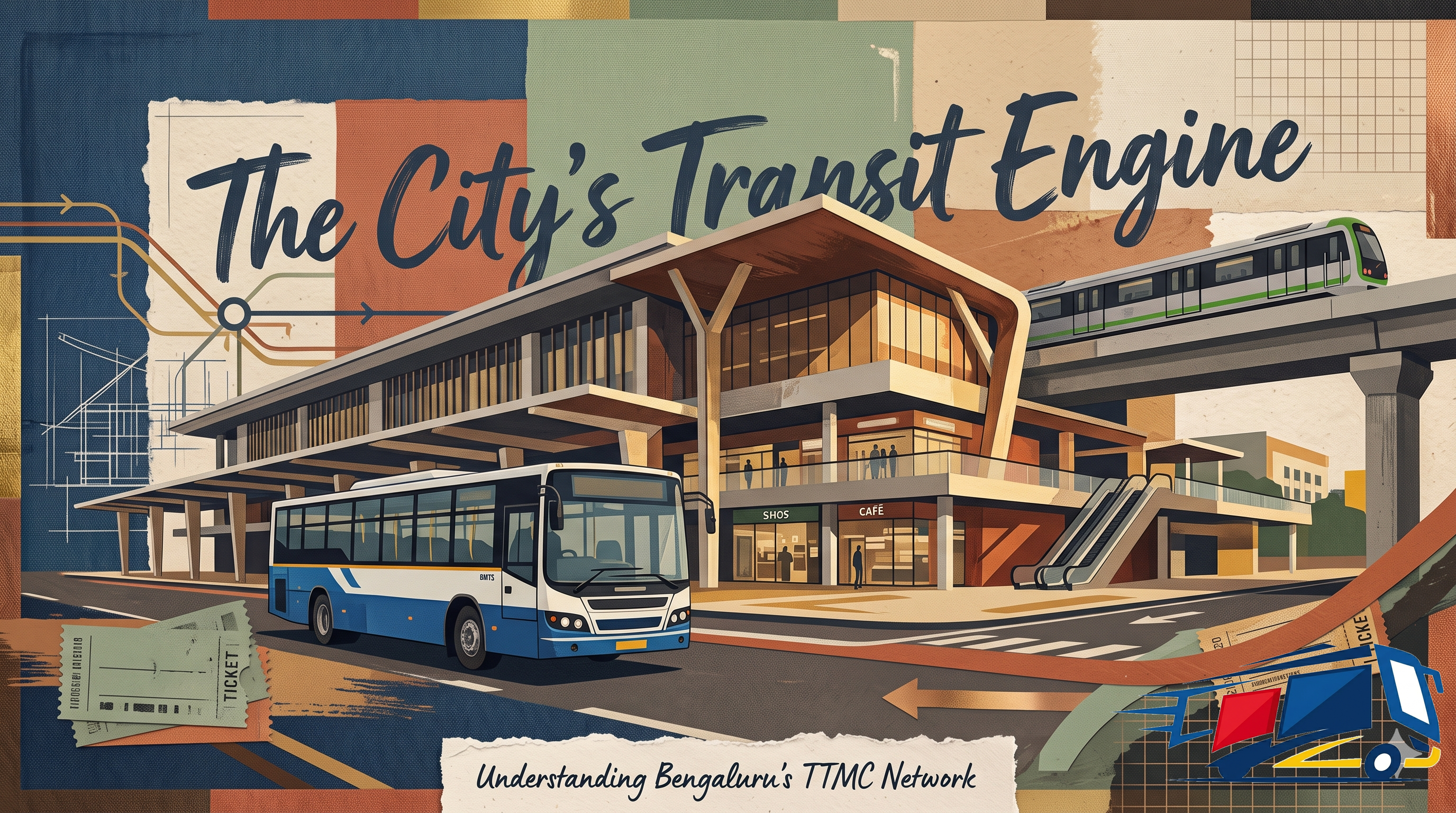
You see the letters on bus stations across Bengaluru, but few know what they stand for. A TTMC is a Traffic and Transit Management Centre: BMTC's idea of a modern terminal that stacks bus bays, parking and passenger amenities together with shops and offices. The city built ten of them, and they quietly shape how the bus network works.
Key takeaways
- TTMC stands for Traffic and Transit Management Centre, BMTC's transit-plus-commercial terminal.
- BMTC built 10 in the first phase, all operational by April 2011, at about ₹480 crore.
- They were funded 35% JNNURM, 15% state, 50% BMTC under the central urban renewal mission.
- The model bundles bus bays, park-and-ride, amenities and commercial space in one building.
- By concentrating footfall and amenities, TTMCs became high-traffic nodes for advertisers.
What a TTMC actually is
A Traffic and Transit Management Centre is a multi-storey bus terminal that does more than move buses. It combines transit functions with commercial and office space in a single building, so the terminal earns revenue and serves more than just passengers.
The simplest way to picture it: the lower levels handle buses and passengers, while upper floors hold parking, shops, food courts and offices. The commercial side helps fund the transit side, which is the core idea.
Why BMTC built them
The TTMCs were conceived under the central JNNURM urban renewal mission to modernise bus infrastructure, ease road congestion through park-and-ride, and give BMTC a steady commercial income.
| Source | Share | Role |
|---|---|---|
| JNNURM (central) | 35% | Urban renewal grant |
| State government | 15% | State contribution |
| BMTC | 50% | Operator share |
The logic was self-sustaining transport. Park-and-ride would pull private vehicles off congested roads, and the rent from shops and offices would help BMTC fund a service that buses alone struggle to pay for.
Want your brand on Bengaluru's buses?
Get a route plan, format recommendation and pricing, usually within a minute.
What you find inside a TTMC
A TTMC bundles transport and daily-life amenities under one roof, which is what makes it busier than a plain bus stand.
| Layer | What it includes |
|---|---|
| Bus operations | Bays, platforms, depot functions |
| Parking | Multi-level car and two-wheeler |
| Passenger amenities | Lounges, pass counters, toilets |
| Retail and food | Departmental stores, food courts |
| Offices | Government and corporate space |
This mix is the reason TTMCs draw people who are not catching a bus at all, which matters a great deal when you think about who passes through them each day.
The ten TTMCs of Bengaluru
The first phase delivered ten TTMCs across the city, spread to cover the main directions out of Bengaluru. Each anchors a different part of the network.
| TTMC | Side of city | Hub guide |
|---|---|---|
| Shantinagar | Central | Hub guide available |
| Jayanagar | South | Hub guide available |
| Banashankari | South-west | Hub guide available |
| Kengeri | West | Hub guide available |
| Yeshwanthpur | North-west | Hub guide available |
| Vijayanagar | West | Guide coming soon |
| Koramangala | South-east | Guide coming soon |
| Domlur | East | Guide coming soon |
| Bannerghatta | South | Guide coming soon |
| ITPL / Whitefield | East | Guide coming soon |
Read the detailed hub guides for Shantinagar, Jayanagar, Banashankari, Kengeri and Yeshwanthpur.
Why TTMCs concentrate footfall
A plain bus stand sees only bus passengers. A TTMC adds parkers, shoppers, diners and office workers, so it gathers a larger and more varied crowd in one place for longer.
A bus stand is a place you leave as fast as you can. A TTMC is a place people park, shop, eat and work, which is why the crowd lingers.
Why TTMCs matter to advertisers
For a brand, a TTMC is a concentrated, mixed-audience node with built-in dwell time, which is exactly the kind of place transit advertising works hardest.
Built to gather crowds, useful for reaching them
TTMCs were designed to pull people in and keep them there: parkers, shoppers and office workers on top of bus passengers. That makes each one a dense, varied audience at a fixed point, and the buses turning through them carry the message out across the city too. Knowing which TTMC anchors which part of Bengaluru, and which crowd it draws, is the starting point for picking where a brand should appear.
Explore the hub guides above, then plan a placement in bus branding in Bengaluru or scope a campaign with transit advertising.
Frequently Asked Questions
What does TTMC stand for?+
Traffic and Transit Management Centre, BMTC's name for its multi-storey terminals that combine bus operations with parking, amenities and commercial space.
How many TTMCs are there in Bengaluru?+
Ten were built in the first phase and were operational by April 2011. BMTC originally identified 45 sites, with later phases planned under public-private models.
Which are the TTMCs in Bengaluru?+
Shantinagar, Jayanagar, Banashankari, Kengeri, Yeshwanthpur, Vijayanagar, Koramangala, Domlur, Bannerghatta and ITPL (Whitefield).
How were the TTMCs funded?+
Under the central JNNURM scheme, split 35% central, 15% state, 50% BMTC. The first phase cost roughly ₹480 crore for ten centres.
Are Majestic and Shivajinagar TTMCs?+
No. They are major BMTC bus stations but sit outside the TTMC programme. The TTMCs are the newer, purpose-built transit-plus-commercial centres.
Why do TTMCs matter for advertising?+
They concentrate a mixed crowd, passengers, parkers, shoppers and office workers, in one place with long dwell time, which makes them strong nodes for transit media.
Bus Branding Glossary
- Full bus branding (wrap)
- A full vehicle wrap covering both sides and the rear of the bus, the highest-impact, most visible format.
- Bus back / rear branding
- Advertising on the rear panel of the bus, in the line of sight of traffic queued behind it at signals and junctions.
- Side panel branding
- Branding on one or both side panels of the bus body, facing pedestrians and parallel traffic along the route.
- Vajra / AC service
- BMTC's premium air-conditioned (Volvo / Vayu Vajra) services, carrying a higher-income commuter set on IT and airport corridors.
- TTMC
- Traffic and Transit Management Centre, a large BMTC bus terminal where many routes start, terminate and interchange.
- Depot
- The BMTC facility where buses are parked, serviced and from which many local routes originate.
- Dwell time
- How long a bus stays in view of a stationary crowd, at a stop, signal or in slow traffic, which lengthens brand exposure.
- Corridor
- A main arterial road (e.g. the Outer Ring Road or Hosur Road) that a bus route runs along, defining who sees the branding.
How to run a BMTC bus branding campaign
Five simple steps from enquiry to a live, tracked campaign on Bengaluru's buses.
- 1
Pick your area & audience
Tell us the Bengaluru area or corridor you want to reach and who you're targeting, IT professionals, shoppers, students or residents.
- 2
Choose a format
Select a format, full bus wrap, rear panel, side panel or premium AC/Vajra service, based on your budget and the impact you want.
- 3
Select routes & bus count
We map the high-frequency routes and stops that cover your audience and recommend how many buses to brand.
- 4
Approve the creative
Share your artwork (or we help design it). We prepare it to BMTC specifications and get the approvals.
- 5
Go live & get proof
We print, wrap and deploy the buses, then share proof of display so you can see your brand on the road.
Bus Branding Formats
Choose how your brand rides, pick the format that fits your goal and budget.
Bus Branding Across Bengaluru
We run BMTC bus branding in every major Bengaluru neighbourhood. Explore more areas:
Outdoor & Transit Advertising Specialists
We plan, design and run BMTC bus branding campaigns across every major Bengaluru corridor, matching brands to the routes, formats and audiences that deliver the most visibility.
Discover More
Brand Awareness vs Response Campaigns on Buses
What bus branding does best: awareness or direct response? A comparison of the two campaign types on buses, why a moving vehicle favours brand-building, and how to blend both.
Geo-Targeting With Bus Routes: Advertising Where Your Customers Are
A bus route is a geo-targeting tool you can drive. How to map your customers to the routes they use, think in catchments instead of points, and stack corridors to cover a neighbourhood or a whole city.
Setting Campaign Objectives Before You Advertise
Why setting one clear objective before you advertise decides everything: awareness vs consideration vs response, how each maps to a different message, format and KPI, and how to write a SMART objective.